
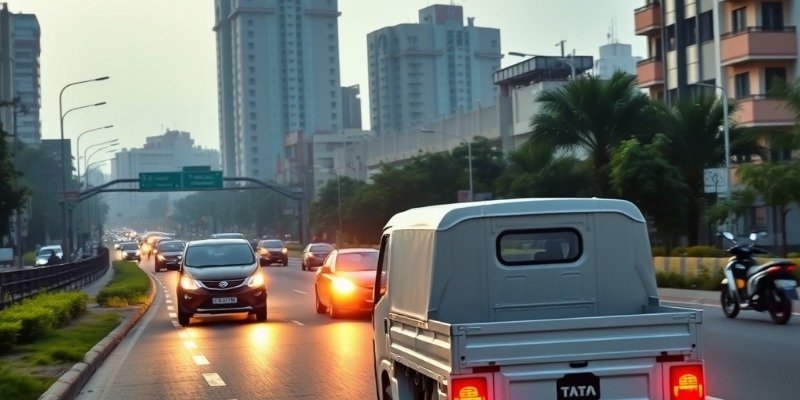
Electric mini trucks are changing how goods move across Delhi NCR. Rising fuel prices and stricter emission rules have pushed many small fleet owners and delivery businesses to switch from diesel to battery power. The region's dense traffic, frequent stops, and mixed road conditions make it a true test for any commercial EV. This article looks at what it is really like to run an electric mini truck in Delhi NCR using data from manufacturer specifications and early user feedback.
Real-world range in Delhi traffic
Certified range figures are tested under ideal conditions. In Delhi NCR, real-world range drops because of stop-and-go traffic, frequent acceleration, air-conditioning use, and occasional highway stretches. For example, the Tata Ace EV 1000 comes with a 161 km ARAI certified range. Early users in Delhi have reported a drop of 30 to 40 km in actual daily use, bringing the usable range closer to 120 to 130 km per charge. The Tata Ace EV with 600 kg payload offers 154 km certified range and similar real-world reduction. The Mahindra Zeo claims 135 to 160 km real-world range with 650 to 765 kg payload. The Euler HiLoad EV shows 135 km ARAI range and up to 170 km under ideal conditions. The Montra Electric Eviator lists 170 km real-world and 245 km certified range with 1707 kg payload. For most city routes under 100 km per day, these trucks cover a full shift without needing a mid-day charge.
Charging options and time
Charging infrastructure in Delhi NCR is growing but still uneven. Most electric mini trucks support home or depot charging using a 16 Amp socket. The Tata Ace EV 1000 takes about 7 hours for a full home charge. Fast charging using DC stations can bring the battery from 10 to 80 percent in 105 minutes. The Mahindra Zeo offers AC charging at 3.3 kW taking 7 hours 10 minutes, 6.6 kW in about 3 hours, and DC fast charging adding 100 km in 60 minutes. The Euler HiLoad EV supports DC fast charging that adds 50 km in 15 minutes. The Switch IeV4 and Switch IeV3 both support DC fast charge from 10 to 80 percent in 55 minutes. The Bajaj Maxima XL Cargo E-TEC 12.0 takes 5 hours 50 minutes for a full charge and 4 hours for 0 to 80 percent using an onboard charger. For fleets running two shifts, access to a fast charger at the depot or a public station is essential to keep vehicles moving.
Payload capacity for city logistics
Payload decides how much revenue a truck earns per trip. In Delhi NCR, typical last-mile loads include e-commerce parcels, FMCG boxes, milk cans, water jars, gas cylinders, and vegetable crates. The Tata Ace EV carries 600 kg. The Tata Ace EV 1000 raises this to 1000 kg with a GVW of 2120 kg. The Mahindra Zeo offers 650 to 765 kg. The Euler HiLoad EV handles 688 to 768 kg. The Euler Storm EV LongRange 200 moves 1250 kg. The Switch IeV3 manages 1200 to 1250 kg. The Switch IeV4 and Montra Eviator both cross 1700 kg payload with GVW near 3490 kg. The Eicher Pro X goes up to 1760 kg. For heavier mid-mile runs, the Montra Eviator and Switch IeV4 are strong choices. For lighter hyperlocal runs, the Mahindra Treo Zor at 550 kg or Piaggio Ape E Xtra FX at 550 kg work well.
Running cost and maintenance
Electric mini trucks cut running costs sharply. The Tata Ace EV 1000 claims a running cost as low as Re 1 per km. A Facebook review of the same model in Delhi noted a real-world cost of about ₹1.25 per km. Electricity in Delhi costs roughly ₹8 to ₹10 per unit for commercial connections. A 21.3 kWh battery full charge costs under ₹200. Compare this to diesel at ₹90 per litre giving 8 to 10 kmpl, which works out to ₹9 to ₹11 per km. Maintenance is lower because there is no engine oil, clutch, or gearbox. Regenerative braking reduces brake wear. Most makers offer 3 year vehicle warranty and 5 to 7 year battery warranty. Tata gives 7 years or 175000 km on the battery. Mahindra Zeo offers 7 years or 150000 km. Switch Mobility claims monthly savings of ₹17000 versus diesel for the IeV4 and ₹12000 for the IeV3.
Suitability for Delhi NCR routes
Delhi NCR routes vary from narrow lanes in Old Delhi to wide roads on the Gurgaon-Faridabad expressway. The Tata Ace EV 1000 has a turning circle of 4300 mm and ground clearance of 160 mm, making it agile in tight colonies. The Mahindra Zeo has a 2500 mm wheelbase and 32 percent gradeability for loaded climbs. The Switch IeV4 has a 2590 mm wheelbase and 22 percent gradeability. The Montra Eviator offers 35 percent gradeability. Top speeds range from 40 kmph for some three-wheelers to 80 kmph for the Eicher Pro X and Montra Eviator. For city speed limits and traffic, 50 to 60 kmph is sufficient. All models come with telematics for fleet tracking, geo-fencing, and driver alerts, which help manage operations across the region.
Final verdict
Running an electric mini truck in Delhi NCR works well for daily distances under 120 km with depot charging. The Tata Ace EV 1000 stands out for its 1000 kg payload, proven service network, and 7 year battery warranty. The Mahindra Zeo adds ADAS safety features and strong gradeability. For heavier loads, the Montra Eviator and Switch IeV4 deliver over 1700 kg payload with real-world range above 170 km. Fast charging access remains the key enabler for multi-shift use. Lower running cost, less maintenance, and zero tailpipe emissions make a strong case for switching, especially with state EV subsidies reducing upfront cost.
FAQs
What is the real-world range of Tata Ace EV 1000 in Delhi NCR?
The Tata Ace EV 1000 has a certified range of 161 km. Users in Delhi NCR report a drop of 30 to 40 km in daily traffic, giving a practical range of 120 to 130 km per charge.
How long does it take to charge an electric mini truck at home?
Most electric mini trucks take 6 to 8 hours for a full charge using a 16 Amp home socket. The Tata Ace EV 1000 needs about 7 hours. The Mahindra Zeo takes 7 hours 10 minutes on a 3.3 kW charger.
Which electric mini truck offers the highest payload for city delivery?
The Montra Electric Eviator and Switch IeV4 both offer payload above 1700 kg with GVW of 3490 kg. The Eicher Pro X goes up to 1760 kg payload.
What is the running cost per km for an electric mini truck in Delhi?
The Tata Ace EV 1000 claims Re 1 per km. A Delhi user reported about ₹1.25 per km. This is much lower than diesel at ₹9 to ₹11 per km.
Do electric mini trucks need commercial registration in Delhi NCR?
Yes. All electric mini trucks used for delivery must have commercial registration, valid insurance, and applicable permits like diesel commercial vehicles.