
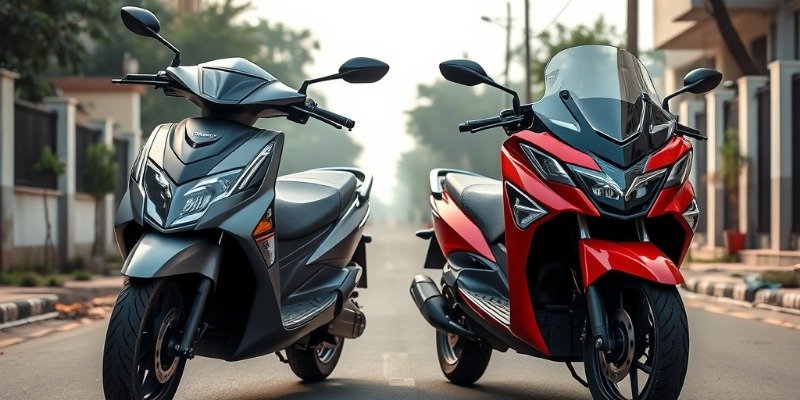
The Indian electric two-wheeler market is witnessing a sharp price war as new entrants and established players fight for buyers with aggressive pricing and feature-loaded variants. Two names drawing attention right now are the upcoming e-SPRINTO G1 and the recently launched E3 Trion. Both target the family commuter space but take different routes to reach the customer. Understanding where they slot in requires a close look at their specifications, pricing, and the existing alternatives from the same brands.
E3 Trion arrives with three variants and AI features
Bengaluru-based startup E3 Electric.AI launched the Trion on August 6, 2026, with an introductory ex-showroom price starting at Rs 99,999 for the base C1 variant. The scooter comes in three trims: C1, C1x, and C2. The C1 uses a 2.3 kWh removable LFP battery delivering a claimed IDC range of 108 km and a top speed of 67 km/h. The C1x steps up to a 3 kWh fixed battery with 165 km range at the same top speed, priced at Rs 1,09,999. The flagship C2, at Rs 1,19,999, uses the same 3 kWh battery but unlocks 82 km/h top speed, 3.5 kW peak power, 145 Nm torque, and a Sport riding mode alongside Eco and Power.
All variants share the TRIAXISFRAME modular platform, a PMSM hub motor with IP67 rating, 14-inch tubeless tyres, and 52 litres of combined storage across the boot, floorboard, and glovebox. The feature list is extensive: a 5-inch connected display with Google Maps, AI-powered diagnostics, predictive maintenance, geo-fencing, dashcam support, SOS alerts, regenerative braking, hill hold, cruise control, and a mobile app. The company claims up to eight years of battery life backed by an 8-year or 100,000 km warranty. Six colour options are offered across the range.
e-SPRINTO G1 prepares for B2C debut on October 13
e-SPRINTO, which has until now operated purely in the B2B commercial space across 18 states, will launch its first family-focused B2C scooter, the G1, on October 13, 2026. The company says the G1 has been developed using real-world data from its fleet operations. It promises a claimed range of 130 km on a single charge and is positioned as a practical daily commuter for urban families. The brand emphasises durability for Indian roads, everyday convenience, and a feature set aimed at retail buyers. Pricing and detailed specifications have not been officially disclosed yet, but the 130 km range claim places it between the Trion C1's 108 km and the C1x's 165 km on paper.
Existing e-SPRINTO models show the brand's current price ladder
To gauge where the G1 might land, it helps to look at e-SPRINTO's current lineup. The Sprinto HS sits at Rs 86,000 ex-showroom with a 2.52 kWh battery, 120 km claimed range, 800 W BLDC motor, and 50 km/h top speed. It charges in 3-4 hours and uses a digital console without Bluetooth or navigation. The Roamy and Rapo are low-speed models priced at Rs 54,999 and Rs 62,999 respectively. Both use 1.8 kWh batteries with 100 km claimed range, 250 W motors limited to 25 km/h, and basic digital displays. They lack connected features, regenerative braking, and combi-brake systems that the Trion offers as standard.
Competitive context: where the Trion sits today
At Rs 99,999, the Trion C1 undercuts the Ather Konarc (Rs 1,01,999), Vida VX2 (Rs 1,09,990), and TVS iQube (Rs 1,20,124) while offering a removable battery, IP67 motor, and a long list of connected features. The C1x at Rs 1,09,999 matches the Vida VX2 on price but claims 165 km range. The C2 at Rs 1,19,999 enters Bajaj Chetak and Honda Activa e territory but brings higher top speed and AI diagnostics. The Trion's combination of modular battery options, 52 litres storage, and software-heavy features makes it a strong value proposition in the Rs 1-1.2 lakh bracket.
Where the G1 could fit in the lineup
If the G1 launches near the Rs 90,000-1,00,000 mark, it would sit just above the Sprinto HS and directly challenge the Trion C1 on range (130 km vs 108 km) while likely offering fewer connected features. If priced closer to Rs 1,10,000, it would compete with the Trion C1x and Vida VX2. e-SPRINTO's B2B heritage suggests a focus on build quality and service reach, which could appeal to buyers wary of newer brands. However, the Trion's removable battery on the C1, 8-year battery warranty, and AI-driven ecosystem are hard differentiators that the G1 will need to match or counter with pricing.
The electric scooter segment is no longer just about range and price. Connected features, battery flexibility, warranty terms, and after-sales network are becoming decision drivers. The Trion has set a high bar for equipment at its price point. The G1's success will depend on whether e-SPRINTO can translate its commercial fleet experience into a compelling retail product that either undercuts the Trion on price or matches its feature depth at a similar cost.
FAQs
When is the e-SPRINTO G1 launching?
The e-SPRINTO G1 is scheduled to launch on October 13, 2026, as the brand's first B2C family electric scooter.
What is the starting price of the E3 Trion?
The E3 Trion base C1 variant starts at Rs 99,999 ex-showroom Bengaluru. The C1x is priced at Rs 1,09,999 and the C2 at Rs 1,19,999.
How does the e-SPRINTO G1 range compare to the E3 Trion?
The e-SPRINTO G1 claims 130 km range. The Trion C1 claims 108 km, the C1x claims 165 km, and the C2 claims 128 km on the IDC cycle.
Does the E3 Trion offer a removable battery?
Yes, the Trion C1 variant comes with a 2.3 kWh removable LFP battery. The C1x and C2 use a 3 kWh fixed battery.
What are the key differences between e-SPRINTO Sprinto HS and E3 Trion C1?
The Sprinto HS costs Rs 86,000 with 120 km range, 800 W motor, 50 km/h top speed, and basic digital console. The Trion C1 costs Rs 99,999 with 108 km range, 2.5 kW PMSM motor, 67 km/h top speed, removable battery, IP67 rating, and a full suite of connected features including navigation, AI diagnostics, and mobile app.