
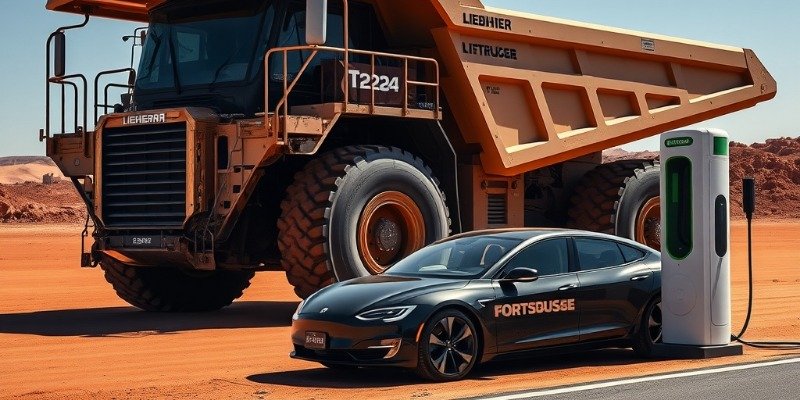
Australian mining giant Fortescue is making waves in the electric vehicle world, but not in the way you might expect. The company is not building passenger cars. Instead, it is electrifying massive 240-tonne haul trucks at its iron ore mines in Western Australia. The technology developed for these mining giants, however, has the potential to change how we charge our everyday electric cars in India and around the world.
The mining giant going electric
Fortescue has set a bold target to eliminate diesel from its Pilbara mining operations by 2030. This means replacing hundreds of pieces of heavy machinery with zero-emission alternatives. The centerpiece of this effort is the Liebherr T264 battery-electric haul truck. Each truck weighs 176 tonnes and can carry a payload of over 240 tonnes. It runs on a massive 3.2 MWh battery pack that can be recharged in just over 30 minutes using a proprietary 6 MW DC fast charger.
To put that charging power in perspective, the 6 MW charger delivers 6,000 kW of power. That is enough to theoretically charge a typical 75 kWh electric car battery in about 30 seconds. While current passenger car batteries cannot accept that much power safely, the engineering behind it is breaking new ground.
Billions saved and a test bed for innovation
The business case is strong. Fortescue is already saving an estimated $300 to $400 million per year in fuel costs. With a fleet of roughly 300 haul trucks planned for conversion, the company claims it can save more than 680 million litres of diesel annually. In a world where geopolitical events can spike fuel prices overnight, this energy independence is a major financial shield.
But the savings are only part of the story. Fortescue is using its mining operations as a massive real-world laboratory. Under its Fortescue Zero brand — which was formerly Williams Advanced Engineering, a spin-off from the famous Williams Formula 1 team — the company is developing motors, batteries, software, and charging systems that are pushed to their absolute limits in the harsh mining environment.
From track to truck: The Formula E connection
Fortescue Zero has taken its "track to truck" philosophy to the ABB FIA Formula E World Championship. The company developed the breakthrough "pit boost" charging system used in the series. This mobile charger uses onboard energy storage to deliver a 600 kW boost, adding 10 percent (3.85 kWh) of battery capacity to a race car in under 30 seconds.
The system relies on Fortescue's "Elysia" battery intelligence software to manage the extreme charging speeds while protecting battery health and longevity. Fortescue Energy and Growth CEO Gus Pichot has stated that motorsport acts as an incubator where innovations can be tested at the limit before being adapted for heavy industry and, eventually, on-road electric vehicles.
The road to passenger cars
Jaguar TCS Racing team principal James Barclay believes the pit boost technology will eventually find its way into public charging networks. He notes that 600 kW charging is no longer a pipe dream but a reality being demonstrated on the racetrack. Fortescue CEO Ellie Coates agrees, saying the ultra-fast boost technology has a "flow-on effect to real-world practicalities, too, including in heavy industry and on-road electric vehicle applications."
The company is also co-developing silicon-carbide inverter technology with Castrol for Formula E. This allows for faster switching speeds and more efficient regenerative braking. Jaguar has confirmed this race-proven technology will be used in its next generation of road-going electric vehicles.
What this means for Indian EV buyers
For the Indian market, where charging infrastructure is still growing and range anxiety remains a key concern, these developments are significant. The current fastest public chargers in Australia operate at 400 kW, while most networks run between 50 kW and 350 kW. BYD's Denza brand has announced plans for 1,500 kW flash chargers. Fortescue's goal of 6,000 kW charging for its mining trucks sets a new ceiling for what is technically possible.
As battery chemistries improve and thermal management systems advance — driven by the extreme demands of mining and motorsport — the charging speeds we see on passenger cars will inevitably rise. The software intelligence that manages battery health during ultra-fast charging, like Fortescue's Elysia system, will be critical for ensuring that faster charging does not come at the cost of battery life.
The bottom line
Fortescue's journey from mining trucks to motorsport to mainstream EV technology illustrates a clear pathway. The most extreme applications — 240-tonne trucks operating in the Australian outback and race cars pushing every limit on the track — are forcing the development of charging speeds, battery management, and power electronics that far exceed current passenger car standards. As these technologies mature and costs come down, they will trickle down to the electric cars we drive every day, potentially making a five-minute charge stop a reality for Indian EV owners in the future.