
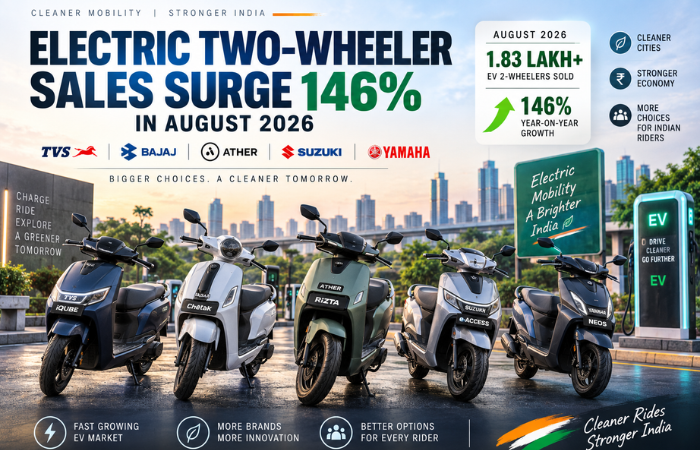
India's electric two-wheeler market recorded exceptional growth in August 2026. Total retail sales across listed models reached 1,87,214 units, marking a massive 146 percent year-on-year increase from 76,118 units in August 2025. The surge added 1,11,096 additional units compared to the same month last year. Every model with a comparable prior-year figure posted positive growth.
Bajaj Chetak Leads Model Rankings
Bajaj Chetak emerged as the highest-selling electric scooter model in August 2026 with 52,248 units. This represents a staggering 273 percent year-on-year growth from 14,014 units in August 2025. The sharp rise reflects recovery from production constraints that plagued Bajaj last year due to a global shortage of rare earth magnets sourced from China. The Chakan facility had even suspended production for several days in 2025. Chetak alone accounted for 27.9 percent of the total listed volume and finished 9,366 units ahead of the second-placed model.
TVS iQube secured second position with 42,882 units, growing 76 percent from 24,434 units a year ago. Hero Vida claimed third place with 25,558 units, more than doubling its volume with 108 percent growth over 12,273 units in August 2025. Ather Rizta followed in fourth with 22,586 units, posting a steady 30 percent increase from 17,344 units. Together, these top four models contributed 1,43,274 units, making up 76.5 percent of the total listed sales.
TVS Orbiter Strengthens TVS Position
TVS Motor Company led the manufacturer tally within the listed dataset. The combined sales of iQube and the entry-level Orbiter reached 57,523 units, ahead of Bajaj's 52,248 units. The Orbiter, which had no sales in August 2025, recorded 14,641 units in its first full month, becoming the fifth best-selling model overall. This new model contributed significantly to TVS's overall volume and highlights the company's expanding electric portfolio.
Strong Performers in the Mid-Segment
Ampere Magnus from Greaves Electric Mobility took sixth place with 9,772 units, nearly doubling with 98 percent growth from 4,924 units. River Indie continued its rapid ascent, surging 195 percent to 6,567 units from 2,229 units a year ago. Ather's established 450 model registered 6,891 units, while Ampere Reo posted spectacular 272 percent growth to reach 1,911 units from just 514 units. Ampere Nexus added 756 units with 107 percent growth. Across its three models — Magnus, Reo, and Nexus — Greaves Electric Mobility recorded a combined 12,439 units.
Japanese Brands Enter the Electric Scooter Race
August 2026 marked the notable entry of Japanese two-wheeler majors into the electric scooter space. Suzuki e-Access registered 668 units in its early sales phase. Yamaha EC-06 recorded 475 units, sold through the company's premium Blue Square showroom network. Honda QC1 debuted with 1,902 units, while the Honda Activa e: grew from a tiny base of 20 units to 140 units, showing 600 percent growth though on very low volumes. These three Japanese OEMs collectively sold 3,185 electric scooters in August, signaling the beginning of a new competitive phase.
Ather Expands Portfolio with Konarc
Ather Energy launched its new mass-market Konarc model on August 29, 2026. The model recorded 217 units in its launch month. Built on Ather's new EL platform and featuring a metal body, the Konarc is priced from Rs 99,999 ex-showroom. It remains to be seen whether the Konarc will cannibalize Rizta sales or help Ather capture additional market share against the high-volume TVS iQube, Orbiter, and Bajaj Chetak.
Brand-Level Performance Shows Mixed Fortunes
At the brand level, TVS Motor Company led with 48,873 units and 91 percent year-on-year growth, though month-on-month sales dipped 12 percent from July 2026's 55,823 units. TVS's electric two-wheeler market share improved to 27 percent from 23 percent a year ago. Bajaj Auto followed with 41,019 units and an extraordinary 235 percent growth from 12,246 units. Ather Energy held third with 28,708 units (30 percent growth) and 16 percent market share. Hero MotoCorp's Vida range sold 18,978 units with 38 percent growth and 10 percent share.
Ola Electric was the only major player to decline, falling 29 percent to 13,849 units from 19,464 units, with market share dropping to 8 percent from 18 percent. Greaves Electric Mobility (Ampere) grew 89 percent to 8,612 units. River Mobility surged 170 percent to 5,134 units. BGauss Auto, Simple Energy, and Motovolt Mobility rounded out the top ten brands.
Wholesale Data Confirms Strong Momentum
Wholesale dispatches reported by scooter manufacturers paint a similar picture. Total e-scooter wholesales hit a record 1,88,714 units in August 2026, up 131 percent year-on-year. This pushed electric penetration in the overall scooter segment to 22 percent, with total scooter wholesales (ICE + EV) reaching a record 8,55,715 units. TVS dispatched 57,523 electric units (iQube and Orbiter) to showrooms, Bajaj Auto clocked 53,748 units (Chetak and Yulu), and Ather Energy dispatched 29,694 units. Hero Vida more than doubled to 25,558 units. Greaves Electric Mobility reported 12,439 units, and River Mobility dispatched 6,567 Indie units.
The strong wholesale numbers indicate manufacturers are stocking showrooms heavily ahead of the festive season starting September. Cumulative January-August 2026 e-scooter wholesales crossed 10.8 lakh units, already exceeding full-year 2025 dispatches of 9.8 lakh units.
Overall Two-Wheeler Market Benefits
The electric scooter boom contributed to overall two-wheeler sales crossing 20 lakh units in August 2026, a new monthly high. Honda Motorcycle & Scooter India reclaimed the overall scooter market leadership with 2,85,527 total scooter dispatches (including 2,042 EVs), ahead of TVS Motor Company's 2,56,442 units. However, TVS's electric models continue to narrow the gap in the total scooter race, with every fifth TVS scooter sold in January-August 2026 being electric.
The August 2026 data confirms that India's electric two-wheeler transition is accelerating rapidly. Established players are scaling volumes, new models are expanding consumer choice, and legacy Japanese manufacturers have finally entered the fray. With the festive season underway, the momentum is likely to sustain in the coming months.