
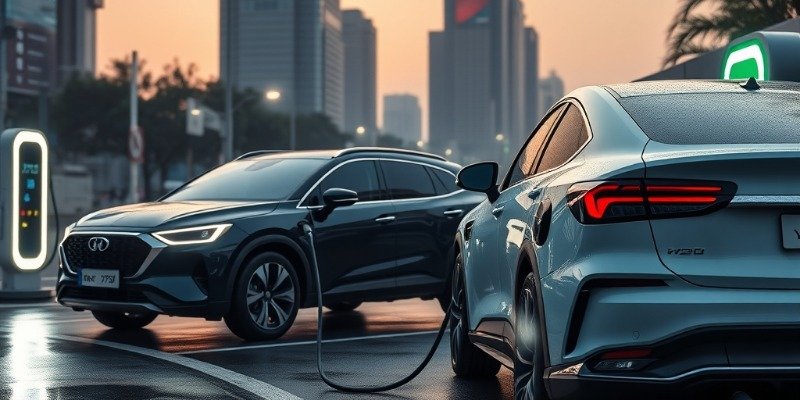
The race to charge electric cars as fast as filling a petrol tank has taken a big leap in China. Two major Chinese brands, BYD and Zeekr, have unveiled chargers that can deliver power at one megawatt or more. This article looks at what they have announced, how the technology works, and what it could mean for India.
BYD’s 1,000 kW Super e-Platform
BYD announced its 1,000 kW (1 MW) charger on March 17, 2025. It can add 400 km of range in 5 minutes. The new Han L sedan and Tang L SUV use a 10C battery that can charge to full in about 6 minutes. BYD plans to build 4,000 such stations in China, with the first 500 ready by early April 2025. The charger uses redesigned blade batteries. Tesla’s latest V4 Supercharger offers 500 kW, so BYD’s is double that power.
Zeekr’s 1,200 kW Liquid-Cooled Charger
Zeekr, owned by Geely, revealed a 1,200 kW (1.2 MW) fully liquid-cooled charger on March 30, 2025. It will debut at the Shanghai Auto Show in April 2025 and launch in the second quarter of 2025. Zeekr’s charging network already has 826 stations with 4,007 superchargers. The company’s Golden Battery supports 5.5C charging. However, Zeekr says no passenger car currently supports 1.2 MW charging. The charger is designed for future models.
Battery Technology Behind the Speed
Both use lithium iron phosphate (LFP) batteries. BYD’s blade battery redesign allows a 10C charge rate. Zeekr’s Golden Battery allows 5.5C. LFP batteries are safer, longer lasting, and work better in heat. Sodium-ion batteries are emerging for lower cost and cold weather performance. Solid-state batteries are promised by BYD for 2027, while Toyota targets the next decade.
Real-World Challenges
Ultra-fast chargers need compatible cars. BYD’s new models launch in April 2025, but older models cannot use the speed. Zeekr’s 1.2 MW charger has no compatible car yet. Both need energy storage near chargers to handle peak loads. Rolling out such high-power chargers outside China is hard due to grid limits, planning rules, and cost. In the UK, even slower chargers face delays. India faces similar grid and infrastructure challenges.
Industry Reactions
Mercedes-Benz charging CEO says 5-minute charge is unnecessary, as most people spend more time on a break. Some worry fast charging harms batteries, but a Hyundai Ioniq 5 fast-charged to 100% for 300,000 miles retained 87% capacity. Juniper Research says these breakthroughs will push global makers to invest more in charging speed.
What This Means for India
India’s EV market is growing but charging infrastructure is still developing. The Chinese megawatt chargers show the technical ceiling. Indian companies and policymakers can learn from China’s rapid deployment. However, India’s grid may not support 1 MW chargers widely yet. Focus may remain on 150-350 kW chargers for now. Cost of installing megawatt chargers with energy storage is high. Indian EV makers like Tata, Mahindra, and Ola may adopt faster charging as battery tech improves. The race in China could lower technology costs globally over time.
The BYD-Zeekr charging war marks a new phase where charging time approaches petrol refuelling. For India, the immediate impact is limited, but the technology direction is clear. Faster charging will become a key differentiator, and Indian players should prepare for higher charging standards while solving grid and cost issues.
FAQs
What is the maximum charging power announced by BYD and Zeekr?
BYD has announced a 1,000 kW (1 MW) charger, while Zeekr has unveiled a 1,200 kW (1.2 MW) charger. Both are intended for passenger electric vehicles in China.
Can current electric cars in India use these megawatt chargers?
No. The megawatt chargers require vehicles with specially designed batteries that can accept such high power. No passenger EV sold in India today supports 1 MW or 1.2 MW charging.
How long does it take to add 400 km range with BYD’s 1 MW charger?
BYD claims its 1 MW charger can add 400 km of range in 5 minutes, which is about 2 km of range per second.
Does Zeekr have any car that can use its 1.2 MW charger?
As of the announcements in March 2025, Zeekr stated that no passenger vehicle currently supports 1.2 MW charging. The charger is built for future models.
Will megawatt charging come to India soon?
Widespread megawatt charging in India is unlikely in the near term due to grid capacity, high installation costs, and lack of compatible vehicles. India’s charging network is currently focused on 50 kW to 350 kW chargers.