
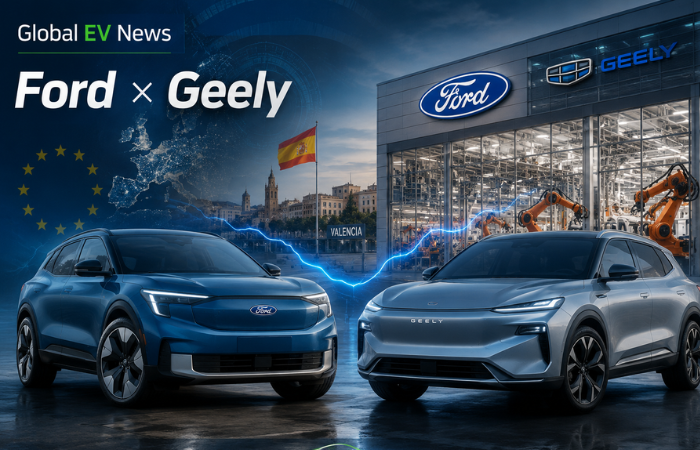
The global electric vehicle race has entered a new phase. Instead of competing solely through new products, major automakers are increasingly forming strategic partnerships to reduce costs, accelerate innovation, and strengthen regional manufacturing.
The latest example comes from Ford Motor Company and Geely Auto, which have announced plans to establish a joint venture in Valencia, Spain, to manufacture next-generation electric SUVs and develop a new crossover designed specifically for European customers. The partnership is expected to begin production in 2028, pending regulatory approvals.
At first glance, it appears to be another manufacturing agreement. However, a closer look reveals something much bigger. This partnership signals how legacy automakers and China’s rapidly growing EV companies are reshaping the future of Europe’s automotive industry.
Why This Partnership Matters
Europe remains one of the world’s largest electric vehicle markets, but manufacturers face increasing pressure.
Demand for affordable EVs is rising, production costs remain high, battery investments require billions of euros, and competition from Chinese brands has intensified over the past few years.
Rather than investing independently in every new electric platform, Ford has chosen collaboration.
For Geely, the agreement provides something equally valuable—its first significant passenger vehicle manufacturing base inside the European Union.
What’s Included in the Deal?
According to the announced plans, the joint venture will manufacture five vehicles at Ford’s Valencia facility.
The planned production includes:
- Two Geely-branded electric SUVs
- Two Ford models
- One jointly developed crossover available with multiple electrified powertrain options, including battery-electric, plug-in hybrid, and extended-range EV variants.
Spain Is Becoming Europe’s Next EV Manufacturing Hub
For years, Germany dominated European automobile production.
Today, Spain is quietly becoming one of Europe’s fastest-growing EV manufacturing destinations.
There are several reasons behind this transformation.
Established Automotive Infrastructure
Spain already hosts production facilities for several global manufacturers and has a mature supplier network capable of supporting large-scale vehicle manufacturing.
Instead of building an entirely new factory, Ford and Geely can utilize existing infrastructure while upgrading it for electric vehicle production.
Lower Manufacturing Costs
Compared with several Western European countries, Spain offers relatively competitive labour and operational costs.
This allows manufacturers to produce vehicles more efficiently without compromising quality.
Strategic Export Location
Valencia is one of Europe’s major logistics gateways.
Vehicles manufactured there can be exported quickly across the European Union, reducing transportation costs and improving delivery times.
Why Ford Needs This Partnership
Ford’s European business has faced increasing challenges over the last decade.
Several traditional models have been discontinued as consumer preferences shift toward SUVs and electric vehicles.
Meanwhile, Chinese EV manufacturers have entered Europe with competitive pricing, modern technology, and rapid product development cycles.
Ford now faces three major challenges:
- Increasing EV development costs
- Underutilized manufacturing facilities
- Growing competition from Chinese brands
Rather than investing billions independently, Ford is choosing a partnership model that spreads financial risk while accelerating future product launches
Why Geely Wins Big
For Geely, this agreement represents far more than additional production capacity.
It provides:
Local European Manufacturing
Instead of shipping every vehicle from China, Geely can manufacture inside Europe.
That means:
- Lower transportation costs
- Faster deliveries
- Improved supply chain resilience
- Better compliance with potential European local-content requirements.
Valencia Factory Gets a Second Life
Ford’s Valencia plant once produced hundreds of thousands of vehicles annually.
However, production volumes have declined significantly as older vehicle programs ended.
Instead of reducing operations further, the factory will now receive a long-term production roadmap through the Geely partnership.
Industry analysts believe this could preserve jobs while increasing factory utilization over the coming years.
EVMovz Analysis: Why This Story Matters Beyond Europe
While this partnership is focused on Europe, its impact could extend far beyond the continent.
If Ford successfully combines Geely’s EV expertise with its own manufacturing and brand strength, other global automakers may adopt similar strategies.
For Indian consumers, the collaboration is also worth watching. Many technologies, battery platforms, and manufacturing processes developed through global partnerships eventually influence products launched in emerging markets. Future Ford or Geely technologies could find their way into vehicles sold across Asia, making this alliance relevant well beyond Europe.
Rather than being just another factory announcement, the Ford–Geely venture highlights how the global EV industry is evolving—from isolated competition to strategic collaboration.
EV Cost Calculator & Compare Tool
EV Running Cost Calculator
Estimate your EV's running costs.
Calculation Type
Estimated Cost
₹--
Estimated Cost Per Kilometer
₹--
Calculations are estimates based on provided values.