
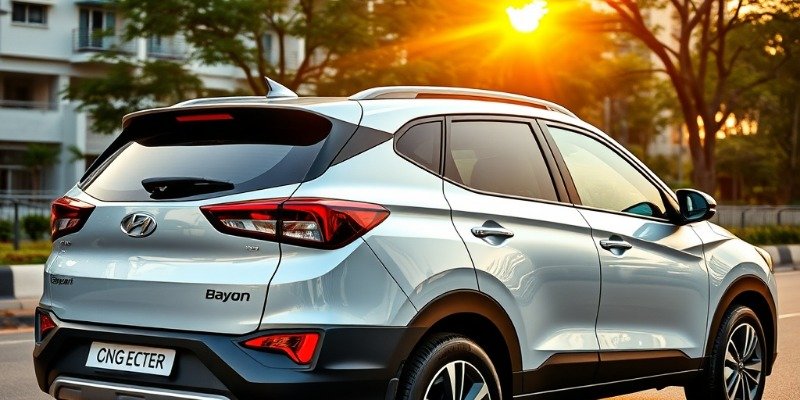
Hyundai has confirmed that the Bayon will receive a factory-fitted CNG variant in January 2027. The announcement comes after the petrol-powered Bayon went on sale earlier this year. This move will make the Bayon the largest Hyundai model in India to offer a CNG option, giving buyers a dual-fuel choice in the compact SUV segment.
The Bayon sits between the Venue and Creta in Hyundai's lineup. With the addition of CNG, the model aims to attract buyers who want lower running costs without giving up the practicality of an SUV. The petrol version currently starts at Rs 10 lakh ex-showroom, and the CNG variants are expected to carry a small premium over their petrol counterparts.
Powertrain and Performance
The Bayon CNG will use the same 1.5-litre four-cylinder naturally aspirated engine found in the petrol version. In petrol form, this engine produces 115 horsepower and 144 Nm of torque. The CNG tune will deliver slightly lower output, which is typical for dual-fuel conversions. A six-speed manual gearbox is almost certain to be offered. Whether a CVT automatic will be available with the CNG option remains unconfirmed at this stage.
Boot Space and Tank Placement
One of the key practical concerns with CNG vehicles is boot space. Hyundai is expected to follow the approach used in the Maruti Victoris by placing the CNG tank under the body floor. This layout keeps the luggage area identical to the petrol version, preserving the Bayon's everyday usability for families and long-distance travel.
Variant Strategy and Pricing
It is not yet clear how Hyundai will spread the CNG option across the Bayon trim range. The company could follow the Maruti and Toyota strategy of offering CNG only on a few lower-spec variants, or it could make the dual-fuel choice available across most of the lineup. The petrol Bayon is priced from Rs 10 lakh ex-showroom, and the CNG models will likely command a modest premium over equivalent petrol trims.
Rivals and Market Position
When it arrives, the Bayon CNG will compete directly with the Maruti Victoris, Maruti Grand Vitara, and Toyota Urban Cruiser Hyryder. All three rivals already offer factory-fitted CNG options in the same segment. The Bayon's entry adds another choice for buyers who prioritize fuel savings and want a modern SUV with a comprehensive feature list.
The January 2027 timeline gives Hyundai enough time to finalize homologation and prepare the dealer network for the new variant. Until then, the petrol Bayon continues to serve as the sole powertrain option for customers.
Hyundai's decision to bring CNG to the Bayon reflects the growing demand for alternative fuels in the compact SUV space. With an underbody tank, familiar engine hardware, and competitive pricing, the Bayon CNG could become a strong value proposition for high-mileage users.
FAQs
When will the Hyundai Bayon CNG be launched in India?
Hyundai has confirmed that the Bayon CNG will launch in January 2027.
What engine will the Bayon CNG use?
The Bayon CNG will use the same 1.5-litre four-cylinder naturally aspirated petrol engine as the standard model, tuned for CNG operation with slightly reduced power output.
Will the Bayon CNG have the same boot space as the petrol version?
Yes, the CNG tank is expected to be mounted under the body floor, which keeps the boot space unchanged from the petrol variant.
What gearbox options will be available with the Bayon CNG?
A six-speed manual transmission is expected to be standard. Availability of a CVT automatic with the CNG variant has not been confirmed.
Which cars will the Bayon CNG compete against?
The Bayon CNG will rival the Maruti Victoris, Maruti Grand Vitara, and Toyota Urban Cruiser Hyryder, all of which offer factory-fitted CNG options in the compact SUV segment.