
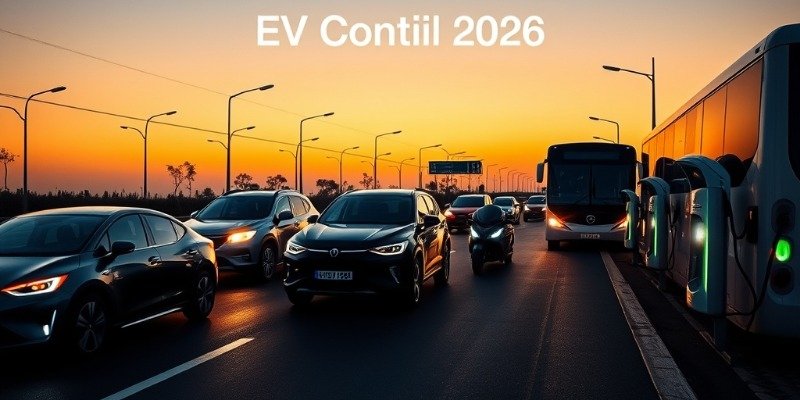
The Autocar EV Conclave 2026 brought together the most influential voices in India's electric mobility ecosystem. Policymakers, original equipment manufacturers, component suppliers, charging network operators, and technology leaders gathered to discuss the next phase of India's EV journey. The central theme was Electric Mobility 2.0, focusing on what will drive the next ten million EV sales in the country. The discussions revealed a clear roadmap centred on three pillars: deep localisation of the supply chain, solving the economics of charging infrastructure, and achieving a 30 percent penetration target by 2030.
Global context and the 30 percent milestone
The International Energy Agency's Global EV Outlook 2026 projects 23 million electric car sales worldwide this year, accounting for close to 30 percent of all new cars sold globally. This marks the fastest absolute annual growth in EV adoption on record. However, the global picture is split into three distinct speeds. China leads with nearly 55 percent penetration, Europe has accelerated past 28 percent driven by tighter CO2 standards, while the United States lags under 10 percent following the removal of federal tax credits. India sits in the emerging markets category, which grew 80 percent year-on-year in 2025, albeit from a smaller base. This divergence underscores that India's path to 30 percent penetration will be shaped by its own structural drivers rather than global averages.
India's EV growth story
India recorded 2.3 million total EV sales in 2025, a 75 percent increase over the previous year. Two- and three-wheelers dominate this volume, acting as the gateway to four-wheeler adoption as income levels rise. Passenger electric car sales grew over 75 percent in 2025, though from a low base. Senior government officials at the conclave indicated that India's EV sector may surpass NITI Aayog's 49 percent compound annual growth rate forecast by 2030. Tata Motors expressed confidence in achieving 30 percent plus EV penetration by 2030 with declining subsidy dependence. JSW MG Motor India forecast a 25 to 30 percent market share for EVs by 2030. BYD India targets 20 percent penetration by 2030 despite supply chain headwinds. These projections align with the broader emerging market trend where Chinese OEMs are expanding aggressively, offering compelling value propositions.
Localisation drive: reducing import dependence
A recurring theme at the conclave was the urgent need for deep localisation. India currently sources 75 percent of its lithium-ion batteries from China, which controls 65 percent of global nickel processing, 68 percent of cobalt, and 60 percent of lithium processing. Industry leaders sounded an alarm on this supply chain dependence. Gulf Oil announced a target of 55 percent plus localisation in its EV charging ecosystem, working to halve the cost of its Indra brand of four-wheeler chargers. Lumax Auto's strategic pivot highlighted pragmatism, as the company walked away from PLI benefits due to demand uncertainty and supply chain challenges. Continental India's CEO emphasised that India must localise research and development in software, noting that the shift to electrification is driven primarily by government policies rather than organic consumer demand. The Ministry of Heavy Industries is in active talks with potential producers to accelerate rare earth manufacturing, as major players including Bajaj Auto, Maruti Suzuki, Ather Energy, and TVS Motor flagged production constraints from depleting rare earth magnet inventories. The Automotive Mission Plan 2047, expected within six months, aims to boost India's position in global manufacturing and trade.
Charging infrastructure: economics and execution
The charging infrastructure conversation has shifted from buildout to execution. The EV Charging Summit 2026 in Las Vegas underscored that EV charging is no longer a technology problem but an execution challenge. The Roland Berger EV Charging Index 2026 notes that public charging installation outpaced EV parc growth for several years, but this trend reversed in 2025 as focus moved to charge point utilisation and economics. In Europe, more than half of all fast charge points are now ultra-fast capable (150 kW+), up from around 25 percent five years ago. China's public charging network approaches 50 percent fast-charge share.
However, a critical gap exists. Western Europe averages around 45 battery electric vehicles per fast charge point, well below the sustainable long-term ratio of over 100:1. In India, the economics of charging are shaped by demand charges — utility fees based on peak power usage. Operators sometimes intentionally limit power delivery to manage these costs, meaning a 350 kW charger may operate at lower levels. Energy storage systems are emerging as a key enabler for grid buffering, peak demand management, resilience, and performance gains. The PM E-DRIVE scheme, launched in October 2024 with a total outlay of Rs 10,900 crore, allocated Rs 4,391 crore specifically for electric buses. Olectra's CEO projected e-bus penetration reaching 20 to 30 percent by 2030. BMW India's CEO highlighted that financial guarantees can overcome hesitation about unknown depreciation patterns, particularly for higher acquisition cost vehicles. The luxury segment is showing the way forward, but the broader market needs durable, financeable systems that perform over time.
Policy consistency and skilling
Industry leaders called for policy consistency and infrastructure focus. The reopening of the Scheme to Promote Manufacturing of Electric Passenger Cars in India (SPMEPCI) window may face delays amid India-EU trade talks. This scheme offers reduced import duties to global EV manufacturers in exchange for significant domestic manufacturing investments. The government is in active discussions on an ICE vehicle phase-out timeline, balancing green goals with industry readiness and alternative fuel adoption. A critical skilling crisis was highlighted — EV technicians need to understand high-voltage electrical systems, battery management, power electronics, and software diagnostics. Semiconductor resilience was identified as a key challenge, as components like inverters and controllers rely heavily on chips, and India's semiconductor policy must align with EV goals.
Circular economy and used EV market
Nomura's vision for India's EV value chain positioned recycling as a core resource strategy. Urban mining could potentially feed 20 to 25 percent of lithium and cobalt demand, reducing environmental impact and import pressure. Tata Motors revealed it is actively working to establish a used EV market, starting with 50 to 100 vehicles. Developing a robust used EV market is essential for consumer confidence and residual value clarity, which in turn supports new vehicle sales.
The road ahead to 30 percent penetration
India's path to 30 percent EV penetration by 2030 requires simultaneous progress on multiple fronts. Localisation must deepen across batteries, power electronics, and software to reduce cost and geopolitical risk. Charging infrastructure needs to solve its economic model through energy storage integration, better utilisation, and innovative financing. Policy frameworks must provide long-term stability to enable investment. Skilling programs must scale rapidly to service the growing fleet. The used EV market and recycling ecosystem must mature to close the loop. The conclave made clear that while the foundation is in place, the next phase demands execution excellence across the entire value chain. The global EV story has reached a structural inflection point at 30 percent market share. For India, achieving this milestone domestically will require translating the collaborative spirit of the conclave into sustained, coordinated action.
India's EV transition is at a pivotal moment where the choices made today on localisation, charging economics, and policy consistency will determine whether the 2030 penetration target becomes a reality. The industry has moved beyond debating whether to build; the focus now is on building better, faster, and more reliably. Success will ultimately be measured not in chargers installed or policies announced, but in whether Indian drivers trust the electric mobility system enough to make it their primary choice.
FAQs
What is the global EV sales forecast for 2026 according to the IEA
The International Energy Agency's Global EV Outlook 2026 forecasts 23 million electric car sales worldwide in 2026, accounting for close to 30 percent of all new cars sold globally. This represents an increase from 20 million sales and 25 percent market share in 2025.
Where does India stand in EV penetration compared to major markets
India is part of the emerging markets group that grew 80 percent year-on-year in 2025. The country recorded 2.3 million total EV sales in 2025, dominated by two- and three-wheelers. Passenger car EV penetration is still at an early stage but growing fast. Major Indian OEMs target 20 to 30 percent EV penetration by 2030.
What are the main localisation challenges discussed at the conclave
India currently imports 75 percent of its lithium-ion batteries from China. The conclave highlighted dependence on China for critical minerals processing — 65 percent of nickel, 68 percent of cobalt, and 60 percent of lithium. Industry leaders stressed the need for deep localisation across batteries, power electronics, software, and rare earth magnets to reduce cost and geopolitical risk.
How are charging economics affecting infrastructure rollout
Charging operators face demand charges from utilities based on peak power usage. This leads to situations where high-capacity chargers operate at reduced power to control costs. Energy storage systems are emerging as a solution for grid buffering and peak demand management. The focus has shifted from network buildout to utilisation and economic viability.
What policy measures are expected to support India's EV growth
The Automotive Mission Plan 2047 is expected within six months. The government is discussing an ICE phase-out timeline. The PM E-DRIVE scheme with Rs 10,900 crore outlay supports electric buses. The SPMEPCI scheme offers duty reductions for committed domestic manufacturing. Policy consistency and alignment of semiconductor policy with EV goals were identified as critical needs.