
The family electric scooter segment in India has become a battleground where practicality meets technology. TVS Motor Company has positioned the iQube S as a scooter that feels familiar to petrol scooter owners while offering modern electric convenience. But rivals like Simple One, Ather 450X, Ola S1, and Bajaj Chetak bring aggressive specifications and feature-packed dashboards. This comparison examines whether the iQube S approach of prioritising everyday usability works better than chasing headline numbers.
Design Philosophy: Familiar vs Futuristic
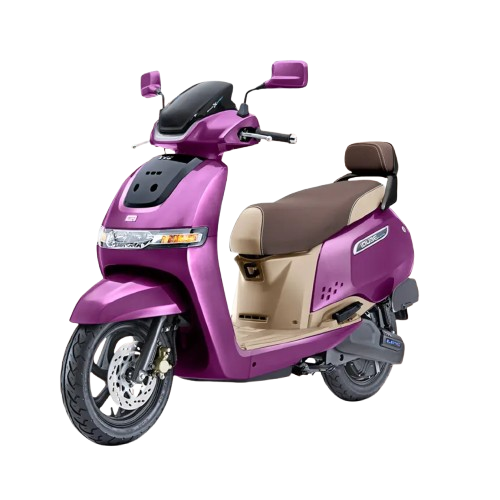
The TVS iQube S adopts a design language that TVS describes as family-friendly and close to a conventional petrol scooter. The silhouette is clean and upright, with a spacious footboard and well-cushioned seat suited for two riders. This deliberate choice targets buyers switching from petrol scooters who do not want a radical-looking vehicle. In contrast, the Simple One uses sharp side panels and a pointed fascia for a youthful, aggressive stance. Ather 450X and Ola S1 also lean towards modern, tech-forward aesthetics. For a family buyer, the iQube S design reduces the hesitation of moving to electric by keeping the visual experience familiar.
Variant Breakdown: Understanding the iQube Lineup
TVS currently offers five iQube variants. The entry-level 2.2 kWh model starts around ₹90,000 and delivers 75 km true range in Eco mode with a 75 km/h top speed. The 3.4 kWh variant extends range to 100 km and top speed to 78 km/h, adds a dual-tone colour option, and increases boot space to 32 litres. The iQube S 3.4 kWh sits above this with a 7-inch TFT display, joystick controls, Bluetooth connectivity, navigation, and call alerts for approximately ₹1,45,000. The ST 3.4 kWh adds premium comfort features and offers tyre pressure monitoring as an accessory. The flagship ST 5.1 kWh brings a 5.1 kWh battery, 150 km true range in Eco mode, 82 km/h top speed, and a 950 W home charger that reaches 0-80% in 4 hours 18 minutes, priced above ₹1,85,000. All variants use a 4.4 kW hub-mounted BLDC motor with 140 Nm peak torque and achieve 0-40 km/h in 4.2 seconds.
Performance and Range: Numbers vs Real-World Usability
The Simple One claims 105 km/h top speed and 212 km range from a 5 kWh fixed-plus-removable battery setup, significantly ahead of the iQube S 3.4 kWh's 78 km/h and 100 km. Ather 450X offers 90 km/h and 105 km range, while Ola S1 claims up to 121 km range. However, the iQube ST 5.1 kWh narrows the gap with 150 km true range at 82 km/h. Charging times vary: the iQube 2.2 kWh takes 2 hours 45 minutes (0-80%), the 3.4 kWh variants need 4 hours 30 minutes, and the ST 5.1 kWh uses its 950 W charger for 4 hours 18 minutes. None of the iQube variants support DC fast charging, relying instead on home charging convenience. For daily city commutes of 30-40 km, the 100 km range of the 3.4 kWh variants is sufficient, and the 150 km range of the ST 5.1 kWh covers weekend trips without public charging dependency.
Features and Technology: Essential vs Extensive
The iQube S 3.4 kWh provides a 7-inch TFT display with Bluetooth, navigation, call and SMS alerts, side-stand cut-off, ride modes, regenerative braking, OTA updates, and geo-fencing via the TVS iQube app. The Simple One counters with a 7-inch TFT touchscreen, Bluetooth for calls and music, document storage, navigation, OTA, four ride modes (Eco, Ride, Dash, Sonic), and park assist. Ather 450X and Ola S1 are known for deeper smartphone integration, voice control, and advanced ride analytics. The iQube approach focuses on features used daily — navigation, call alerts, geo-fencing — rather than speculative futuristic functions. The TVS app also helps locate charging stations and track ride statistics, addressing practical ownership needs.
Hardware and Ride Quality: Comfort Over Sport
Both iQube and Simple One use telescopic front forks. The Simple One employs a rear monoshock, while the iQube uses dual rear springs tuned for comfort. Braking on the Simple One comprises a 200 mm front disc and 190 mm rear disc. The iQube S 3.4 kWh and lower variants use a front disc with a rear drum brake; only the ST 5.1 kWh gets a rear disc. The hub motor layout limits rear brake options but contributes to the flat floorboard and spacious boot. Ride quality on the iQube is described as comfortable with an upright seating position, making it suitable for longer family rides. The Simple One's monoshock and disc-disc setup may appeal to spirited riders but transmits more road feedback.
Price Positioning: Value Across the Range
The Simple One is priced at ₹1,45,000 ex-showroom (Bengaluru) without the fast charger, and ₹1,58,000 with the 750 W charger. The iQube S 3.4 kWh on-road price in Bengaluru is approximately ₹1,32,454, making it more affordable. The iQube 2.2 kWh starts near ₹89,999, undercutting most rivals. The Hero Electric Photon remains the most budget-focused option around ₹90 km range, while Bajaj Chetak commands a premium for its retro design and 95 km range. The iQube ST 5.1 kWh at ₹1,85,000+ competes with higher-spec variants of Ather and Ola but offers the longest range in the TVS lineup.
Service Network and Ownership Experience
TVS leverages its extensive dealer and service network built over decades with products like the Jupiter. This gives iQube owners access to support in most urban and semi-urban areas. Ather and Ola are expanding their networks but do not yet match TVS's reach in smaller towns. Bajaj Chetak benefits from Bajaj's established network. For a family scooter where reliability and easy servicing are priorities, the TVS network is a tangible advantage that specification sheets do not capture.
The Practicality Argument
The iQube S wins on practicality through a combination of familiar design, comfortable ergonomics, sufficient range for city use, essential smart features, and a service network that reduces ownership anxiety. Its hub motor enables a flat floorboard and large boot — daily conveniences that matter more than a rear disc brake or an extra ride mode for many families. The ST 5.1 kWh extends this practicality to intercity trips with 150 km true range. Rivals offer higher top speeds, larger screens, and more ride modes, but those advantages often remain unused in congested city traffic where the iQube spends most of its time.
The TVS iQube S demonstrates that in the family e-scooter segment, practicality can trump tech when the technology serves daily needs rather than marketing brochures. For buyers seeking a reliable, comfortable, and serviceable electric replacement for a petrol scooter, the iQube S 3.4 kWh and ST 5.1 kWh make a compelling case. Those prioritising outright performance, cutting-edge interfaces, or maximum specifications will find better-suited alternatives in the Simple One, Ather 450X, or Ola S1.
FAQs
What is the real-world range of the TVS iQube S 3.4 kWh variant?
The TVS iQube S 3.4 kWh delivers a true range of 100 km in Eco mode and around 75 km in Power mode, making it suitable for daily city commutes.
How does the TVS iQube S compare to the Simple One on price?
The iQube S 3.4 kWh has an on-road price of approximately ₹1,32,454 in Bengaluru, while the Simple One is priced at ₹1,45,000 ex-showroom (Bengaluru) without the fast charger.
Does the TVS iQube S support fast charging?
No, the iQube lineup does not support DC fast charging. The 3.4 kWh variants take about 4 hours 30 minutes for 0-80% charge, while the ST 5.1 kWh uses a 950 W home charger for 0-80% in 4 hours 18 minutes.
What are the key hardware differences between iQube S and Simple One?
The Simple One uses a rear monoshock and dual disc brakes (200 mm front, 190 mm rear). The iQube S 3.4 kWh uses dual rear springs and a front disc with rear drum brake; only the ST 5.1 kWh gets a rear disc.
Is the TVS service network an advantage for iQube owners?
Yes, TVS has an extensive dealer and service network across India built over decades, providing wider support coverage compared to newer EV-only brands that are still expanding their networks.