
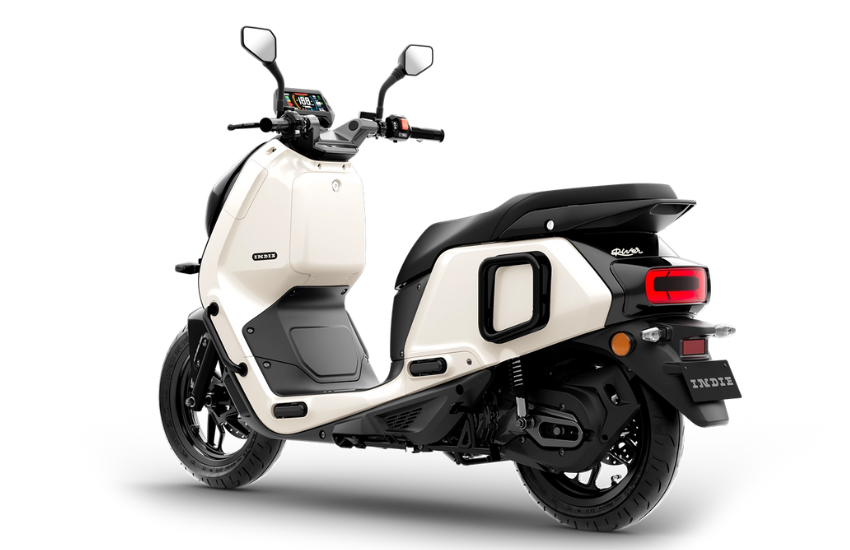
River Mobility entered the Indian electric scooter market with a clear brief: build a practical, no-nonsense machine that works like a tool rather than a gadget. The Indie arrived nearly three years ago as a bold debut from a startup. It won attention for its unusual proportions, massive storage, and a riding stance that felt more like a compact motorcycle than a conventional scooter. Early units had their share of teething issues, particularly a harsh front suspension and a limited dealer network. The 2026 model year brings a set of focused updates that address many of those pain points while keeping the core philosophy intact. This is River's second innings, and the question is whether the refined Indie can hold its ground against an increasingly crowded field of established and new rivals.
Design and Practicality
The Indie still looks like nothing else on the road. Its tall front apron with twin-pod LED headlamps, long wheelbase, and 14-inch alloy wheels at both ends give it an SUV-like stance. The floorboard is wide and flat, bordered by optional detachable side cages that add extra cargo capacity. Under the single-piece seat sits a 43-litre underseat compartment large enough for a full-face helmet, a backpack, or grocery bags. A 12-litre lockable glovebox ahead of the rider brings total lockable storage to 55 litres. The seat height is 787 mm, and ground clearance stands at 177 mm, allowing the scooter to clear tall speed breakers and rough patches without scraping. Five colour options — Monsoon Blue, Summer Red, Spring Yellow, Winter White, and Storm Grey — keep the visual appeal fresh. The design consistency earned the Indie Red Dot Awards for Concept Design in 2024 and Product Design in 2025, a rare double for an Indian two-wheeler brand.
Performance, Battery, and Real-World Range
Power comes from a mid-mounted PMSM motor producing 4.5 kW continuous and 6.7 kW peak with 26 Nm of torque. The 4 kWh lithium-ion battery (IP67 rated) is claimed to deliver 163 km per charge under the Indian Driving Cycle. Three riding modes — Eco (called Relax in some updates), Ride, and Rush — tailor throttle response and regenerative braking intensity. In Eco, the predicted range stretches to around 110 km; in Ride, about 90 km; and in Rush, roughly 70 km. Independent testing in mixed Eco and Ride conditions yielded around 115 km before a full recharge was needed, confirming that the range prediction algorithm — now updated to adapt to the rider's style — is among the most accurate in the segment. Top speed is 90 km/h. The 0-40 km/h sprint takes 3.7 seconds. Charging from a standard home socket takes 8 hours with the 480 W charger, or 5 hours with the optional 750 W unit that River recommends for daily commuters covering 50 km or more.
2026 Updates: Suspension, Drivetrain, and Refinement
The most significant mechanical change for 2026 is the switch from a belt drive to a chain drive. River says this reduces replacement cost and simplifies maintenance without adding audible chain noise — a claim borne out by testers who report the drivetrain remains silent in city traffic. The front suspension retains telescopic forks with twin hydraulic dampers, but the cast handlebar has been replaced by a tubular unit with a clamp that adds flex, absorbing the sharp jitter that plagued early models over repetitive bumps. A minor rear suspension retune complements this. The result is a ride that feels on par with mainstream scooters on bad roads, though the 2025 Suzuki Access 125 still sets a slightly higher benchmark for plushness. Regenerative braking now has three levels hardcoded to the riding modes: least aggressive in Eco, most in Rush. In Rush, the regen can bring the scooter to a near-halt at intersections, reducing brake lever effort. However, the interaction between hard acceleration, regen, and combined braking can still feel a touch clunky during spirited riding — an area where more software polish would help.
Features and Instrumentation
The 6-inch colour LCD cluster displays speed, state of charge, range, mode, trip meters, and odometer. Numbers are larger and white-on-black for better legibility, though direct sunlight at certain angles can make the screen appear dim. There is no built-in Bluetooth connectivity or navigation. River supplies a bolt-on phone holder that mounts below the cluster, letting riders use their own device for maps and calls. Other convenience features include a USB charging port, boot light, side-stand warning, low-battery alert, reverse assist, and a multi-function lock. The combined braking system (200 mm discs front and rear, 2-piston front caliper, 1-piston rear) delivers strong, progressive stopping power without ABS — testers note the wheels resist lock-up well, though hard stops in Rush mode can still provoke mild front-end judder.
Ride Quality, Handling, and Ergonomics
Despite a 135 kg kerb weight and a 1,996 mm length, the Indie feels surprisingly agile. The 14-inch wheels (110/80 front, 120/70 rear) and low-mounted battery give a low centre of gravity that inspires confidence in corners. The scooter tips in cleanly, holds its line, and encourages the rider to push harder — a trait rarely associated with utility-focused EVs. The feet-forward riding position, fold-out rider footpegs, and optional crash-bar toe rest allow a relaxed, cruiser-like posture on longer stretches. The pillion seat is wide and well-cushioned, with grab rails and rear footpegs as standard. Gradeability is rated at 18 degrees, so steep flyovers and basement ramps are handled without drama. The only ergonomic niggle remains a slight seat slope that some riders would prefer flatter.
Pricing, Availability, and Incentives
The Indie is sold in a single Standard variant. Ex-showroom price in Bangalore is ₹1,42,999; on-road in Delhi comes to approximately ₹1,64,600. The PM e-Drive subsidy of up to ₹5,000 is applicable till the end of July 2026. River's network has expanded beyond the initial Bangalore-Hyderabad footprint, with dealerships now operating in several major cities. Prospective buyers should check local availability and book a test ride, as the scooter's size and weight may not suit shorter riders. A 5-year or 50,000 km extended warranty is offered.
Competition Landscape
At its price point, the Indie squares off against the TVS iQube (₹1.20–1.89 lakh), Ather 450X (₹1.51 lakh), Bajaj Chetak (₹1.19 lakh), Ola S1 Pro (₹1.40–1.89 lakh), Honda Activa e (₹1.20 lakh), and Vida VX2 (₹1.10 lakh). The Yamaha EC-06, recently unveiled, is essentially a rebadged Indie with a higher price tag, smaller boot, and a slower 450 W charger — making the River the better value proposition. The Simple One offers a claimed 265 km range and 115 km/h top speed but costs nearly ₹50,000 more and comes from a younger brand with an even sparser service network. For buyers prioritising practicality, storage, and predictable real-world range over outright performance or tech features, the Indie remains a compelling outlier.
Final Verdict
River's second innings with the Indie is a textbook case of listening to early adopters and fixing the right things. The suspension overhaul, chain-drive switch, and smarter range algorithm transform the scooter from a promising but flawed debut into a genuinely easy recommendation for urban families and gig workers who need space, stability, and honesty in range claims. It still misses a few modern conveniences — Bluetooth, ABS, a touchscreen — but those omissions feel deliberate, keeping cost and complexity in check. If your daily routine involves carrying luggage, a pillion, or both, and you want an electric scooter that behaves like a well-sorted tool rather than a beta product, the 2026 Indie deserves a test ride. Just confirm your city has a service touchpoint before you commit.
FAQs
What is the real-world range of the River Indie in 2026?
In mixed Eco and Ride mode riding, testers recorded around 115 km on a full charge. The updated range prediction algorithm now adapts to individual riding patterns, making the displayed estimate more reliable than before.
Does the River Indie have Bluetooth or navigation?
No. The instrument cluster is a 6-inch colour LCD without built-in connectivity. River provides a bolt-on phone holder so riders can use their smartphone for navigation and calls.
Is the River Indie available outside Bangalore and Hyderabad?
Yes. River has expanded its dealership network to several more cities in 2025-26. Check the official website or contact the company via WhatsApp for the nearest outlet.
What changed mechanically for the 2026 model year?
The belt drive was replaced by a chain drive for lower maintenance cost. The front handlebar changed from cast to tubular with a clamp to absorb high-frequency vibrations, and the suspension was retuned for better comfort on rough roads.
How does the Indie compare to the Yamaha EC-06?
The Yamaha EC-06 is based on the Indie but costs more, offers a smaller boot, and comes with a slower 450 W charger. The River Indie provides better value for money with identical core hardware.