
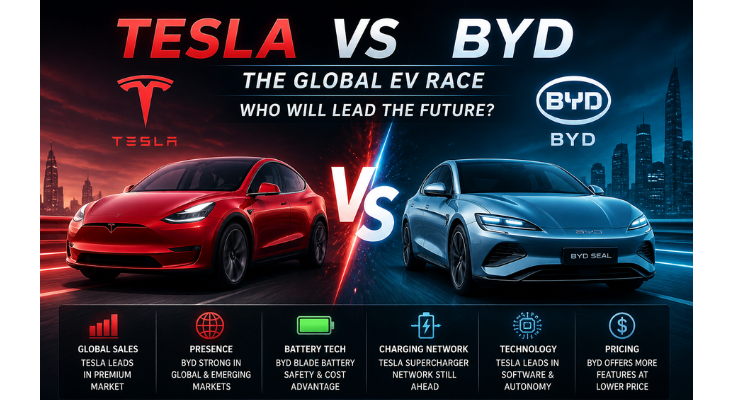
The global electric vehicle (EV) market is no longer a one-player game. What was once dominated by Tesla has now transformed into a high-stakes battle, with China’s BYD rapidly rising as a formidable rival. As 2026 unfolds, the competition between these two EV giants is not just about sales numbers—it’s about technology, pricing, infrastructure, and ultimately, global dominance.
For years, Tesla set the benchmark for EV innovation. From its early breakthroughs in battery efficiency to its global Supercharger network, the company built a strong ecosystem that redefined how the world views electric mobility. Even now, Tesla continues to hold a strong position in premium EV markets, backed by its brand value, software capabilities, and consistent push in autonomous driving technology.


However, BYD has rewritten the rules of the game—quietly but aggressively. Unlike Tesla, which largely focuses on premium vehicles, BYD has adopted a mass-market strategy. From affordable city EVs to premium sedans and SUVs, the company has created a diverse portfolio that appeals to a much wider audience. This approach has helped BYD scale rapidly, especially in China, the world’s largest EV market, and expand into Europe, Southeast Asia, and emerging markets.
One of BYD’s biggest strengths lies in its vertical integration. The company manufactures its own batteries, semiconductors, and key components, giving it better control over costs and supply chains. Its Blade Battery technology, known for safety and durability, has further strengthened its position. On the other hand, Tesla continues to push boundaries with software-led innovation, over-the-air updates, and advancements in AI-driven driving systems—areas where it still holds a competitive edge.
Pricing has become another critical battleground. BYD’s ability to offer feature-rich EVs at relatively lower prices has put pressure on Tesla across multiple markets. In response, Tesla has adjusted its pricing strategies globally, signaling that the competition is becoming increasingly intense. This price war is not just benefiting consumers but is also accelerating EV adoption worldwide.
In India, this rivalry is beginning to take shape. Tesla’s renewed push into the Indian market, coupled with BYD’s growing presence through models like the Seal and Atto 3, indicates that Indian consumers will soon witness this global battle up close. As infrastructure improves and government policies evolve, India could become a key battleground for both companies.
The bigger picture, however, goes beyond just Tesla and BYD. Their competition is driving innovation at an unprecedented pace, forcing the entire automotive industry to rethink its strategies. Traditional automakers are accelerating their EV plans, startups are entering the space, and consumers are getting better products at competitive prices.
As things stand, Tesla and BYD represent two different philosophies—premium innovation versus mass-market scale. Yet both are pushing the same vision: a future dominated by electric mobility. And if the current momentum continues, this rivalry may not just define the EV market—it could shape the future of transportation itself.
EV Cost Calculator & Compare Tool
EV Running Cost Calculator
Estimate your EV's running costs.
Calculation Type
Estimated Cost
₹--
Estimated Cost Per Kilometer
₹--
Calculations are estimates based on provided values.