
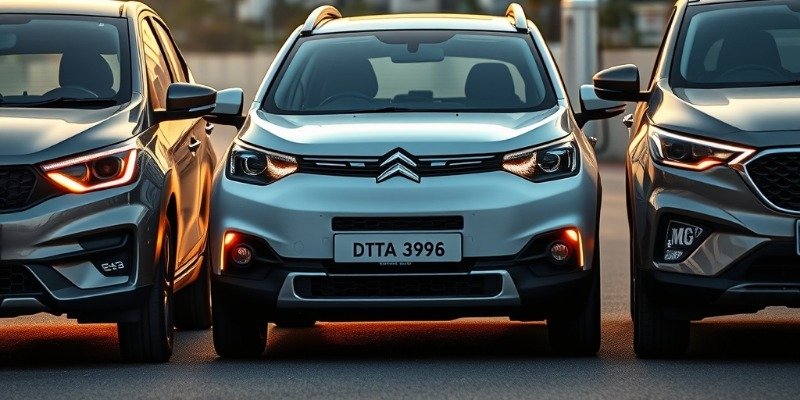
The Indian electric car market has become intensely competitive in the budget hatchback segment. Three models currently dominate buyer attention: the Tata Tiago EV, the Citroen eC3, and the MG Comet EV. Each targets a slightly different kind of urban driver, yet they overlap on price and practicality. This comparison breaks down their specifications, features, safety, charging, and ownership costs to help you decide which one fits your daily needs.
Price positioning and variant overview
The MG Comet EV starts lowest on paper at Rs. 6.41 lakh for the Executive 17.3 kWh variant. The Tata Tiago EV Smart 19.2 kWh begins at Rs. 6.99 lakh. The Citroen eC3 sits significantly higher; the older generation Live variant is priced at Rs. 11.97 lakh, while the newer eC3 X with the same 29.2 kWh battery starts at Rs. 9.54 lakh. Price gaps widen further at the top end. The Tiago EV Creative Plus 24 kWh tops out at Rs. 9.99 lakh, the Comet EV Exclusive EC reaches Rs. 10 lakh, and the eC3 ranges up to Rs. 13.41 lakh. Buyers should note that on-road prices, state subsidies, and dealer offers will shift these numbers.
Battery, range, and charging
All three use lithium-ion batteries placed under the floor, except the Comet EV which mounts its pack under the front seats. The Tiago EV offers two battery options: a 19.2 kWh unit with a MIDC Part 1+2 certified range of 226 km, and a larger 24 kWh pack rated at 285 km. The Comet EV uses a 17.3 kWh battery (17.4 kWh in higher variants) with an ARAI-certified 230 km range. The eC3 carries a single 29.2 kWh battery across all variants, delivering 246 km on the MIDC cycle for the older model and 330 km for the eC3 X.
Charging speed tells a different story. The Tiago EV supports 7.2 kW AC fast charging — 10 to 100 percent in 2.6 hours for the small pack and 3.5 hours for the big one — plus 30 kW DC fast charging that takes 10 to 80 percent in 35 minutes. The Comet EV also accepts 7.2 kW AC charging in 3.5 hours but lacks DC fast charging entirely, limiting its usefulness on highways. The eC3 relies on a 15 A plug for 10.5 hours to full charge, while its DC fast charger needs 57 minutes for 10 to 80 percent. For buyers who cannot install a wall box, the Comet’s missing DC port and the eC3’s slow AC time are practical drawbacks.
Performance and drivetrain
Power and torque figures reflect each car’s mission. The Tiago EV’s front-mounted motor produces 60 PS and 110 Nm with the 19.2 kWh battery, rising to 75 PS and 114 Nm with the 24 kWh pack. The Comet EV’s rear-mounted motor makes 42 PS and 110 Nm. The eC3’s front motor delivers 57 PS and a class-leading 143 Nm. All three use single-speed automatic transmissions with drive modes — City and Sport for the Tiago and Comet, Standard and Eco for the eC3 X. The Tiago EV’s claimed 0-60 km/h time of 6.2 seconds makes it the quickest off the line, while the Comet takes nearly 20 seconds to reach 100 km/h.
Dimensions, space, and practicality
Physical size defines who each car serves. The eC3 is the largest at 3,981 mm long, 1,733 mm wide, and 1,586 mm tall, with a 2,540 mm wheelbase and 315 litres of boot space. The Tiago EV measures 3,825 x 1,684 x 1,562 mm on a 2,400 mm wheelbase and offers 240 litres of luggage capacity. The Comet EV is tiny: 2,974 x 1,505 x 1,640 mm on a 2,010 mm wheelbase with no dedicated boot — cargo must share the cabin. All three seat five except the Comet, which is a strict four-seater with three doors. Ground clearance is similar: 165 mm for Tiago and Comet, 167 mm for eC3. Tyre sizes differ — 14-inch on the Tiago, 12-inch on the Comet, and 15-inch on the eC3.
Safety equipment
Safety is where the Tiago EV pulls ahead. It offers six airbags, electronic stability program, hill hold control, traction control, ISOFIX anchors, three-point seatbelts for all seats with reminders, 360-degree camera, blind view monitor, automatic LED headlamps, rain-sensing wipers, follow-me-home headlamps, and tyre pressure monitoring. The Comet EV matches many of these with dual airbags, ESP, hill hold, ISOFIX, three-point belts all round, follow-me-home lamps, TPMS, electronic parking brake, and all-disc brakes. The eC3 provides only dual airbags over the common ABS with EBD, rear parking sensors, rear camera, and day-night IRVM. Neither car has been crash-tested by Global NCAP or Bharat NCAP yet.
Features and technology
Common features across the trio include steering-mounted audio controls, multi-drive modes, electrically adjustable ORVMs, smart keyless entry, 10.25-inch touchscreen infotainment with wireless Android Auto and Apple CarPlay, and connected car technology. Beyond that, the Tiago EV adds cruise control, automatic climate control, shark-fin antenna with GPS, cooled glovebox, 65 W USB-C fast charger, floating digital instrument cluster, dual smartphone dock, front armrest with under-thigh support, rear AC vents, height-adjustable driver seat, cabin air filter, halo light bar across the tail lamps, smartwatch connectivity, and over-the-air updates. The Comet EV adds a floating digital cluster, smartwatch connectivity, connected LED DRLs and tail lamps, smart start system, and OTA updates. The eC3 adds only a height-adjustable driver seat. The Tiago EV’s feature list is clearly a segment above.
Battery warranty and ownership peace of mind
Warranty terms reveal manufacturer confidence. The Tiago EV’s 19.2 kWh pack carries an 8-year or 1.6 lakh km warranty, while the 24 kWh pack gets a lifetime, unlimited-kilometre warranty for the first registered private owner — a benefit usually reserved for far pricier EVs like the Nexon EV, Harrier EV, and Mahindra BE 6e. If ownership changes, the warranty reverts to 8 years or 1.6 lakh km. The Comet EV covers its battery for 8 years or 1.2 lakh km. The eC3 offers 7 years or 1.4 lakh km. Motor warranties are 8 years or 1.6 lakh km for the Tiago, 5 years or 1 lakh km for the eC3 X, and not separately stated for the Comet. Vehicle warranty is 3 years or 1.25 lakh km for both Tata and Citroen; MG does not specify a separate vehicle warranty.
Design and interior quality
The 2026 Tiago EV facelift brings a sharp front end with multi-chamber LED headlamps, eyebrow-style integrated DRLs, a body-coloured closed grille, and a connected halo light bar at the rear. Inside, a slim dashboard, floating 10.25-inch screen, two-spoke steering wheel with matte finish, dual-tone interior, and under-thigh support create a premium feel unusual at this price. The Comet EV embraces a boxy, futuristic aesthetic with slim connected DRLs, 12-inch wheels, and a single side door on the passenger side. Its cabin impresses with a large touchscreen and island cluster but feels utilitarian. The eC3 mirrors the ICE C3 with a muscular boxy stance, chrome grille, roof rails, 15-inch alloys, and a black-themed interior that looks neat but less modern than the Tata.
Which one should you buy
If your priority is a balanced package with strong safety, rich features, fast charging, and an industry-leading battery warranty, the Tata Tiago EV makes the most sense for a small family that drives both in the city and on occasional highway trips. The Citroen eC3 suits buyers who want maximum cabin space, the largest boot, highest torque, and the longest certified range, provided they can accept fewer safety features, slower AC charging, and a higher price. The MG Comet EV is purpose-built for solo city commuters who value ultra-compact dimensions, a tight turning radius, and a futuristic look, but its lack of boot space, no DC fast charging, and limited rear-seat comfort rule it out for family use. Each car excels in its niche; the Tiago EV simply covers the broadest set of needs.
FAQs
What is the starting price of each electric hatchback
The MG Comet EV starts at Rs. 6.41 lakh, the Tata Tiago EV at Rs. 6.99 lakh, and the Citroen eC3 at Rs. 9.54 lakh for the eC3 X or Rs. 11.97 lakh for the older generation Live variant. All prices are ex-showroom.
Which car offers the longest driving range
The Citroen eC3 X with its 29.2 kWh battery claims a MIDC-certified range of 330 km, higher than the Tiago EV’s 285 km (24 kWh pack) and the Comet EV’s 230 km.
Does the MG Comet EV support DC fast charging
No, the MG Comet EV does not support DC fast charging. It can only be charged via AC, which takes about 3.5 hours from 0 to 100 percent on a 7.2 kW charger.
How many airbags does each car get
The Tata Tiago EV offers six airbags, the MG Comet EV gets dual airbags, and the Citroen eC3 also gets dual airbags.
Which electric hatchback has the best battery warranty
The Tata Tiago EV’s 24 kWh variant comes with a lifetime, unlimited-kilometre battery warranty for the first private owner. The 19.2 kWh variant gets 8 years or 1.6 lakh km. The Comet EV covers 8 years or 1.2 lakh km, and the eC3 covers 7 years or 1.4 lakh km.