
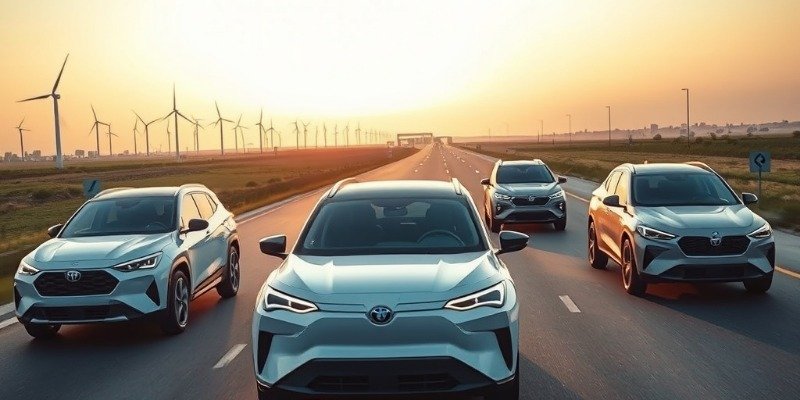
India’s mid-size SUV segment is on the cusp of its biggest transformation yet. Over the next two years, a wave of new electric models will hit the market, giving buyers more choice than ever before. From homegrown contenders like the Mahindra BE.07 to global heavyweights such as the Toyota C-HR+ Electric and BMW iX3, the period between early 2027 and late 2028 will rewrite the rules of this hotly contested space. This article maps out the confirmed and expected launches, their platforms, battery options, pricing bands, and what they mean for the Indian buyer.
The early movers: February to March 2027
The first quarter of 2027 brings three very different propositions. The Toyota C-HR+ Electric is slated to arrive on 24 February 2027 with an expected price window of ₹25–35 lakh. Toyota has kept technical details close to its chest, but the C-HR+ is expected to use the company’s e-TNGA platform and offer a single-motor front-wheel-drive layout aimed at urban families who want a distinctive coupe-SUV silhouette without stepping into the luxury bracket.
Two weeks earlier, on 18 February 2027, the BMW iX3 is expected to land with a price tag of ₹40–50 lakh. The iX3 will ride on BMW’s CLAR architecture adapted for electric drive, likely packing a single rear motor and a battery around 80 kWh usable capacity. Positioning is clear: a premium badge, rear-wheel-drive dynamics, and a more conventional SUV shape than the iX1 LWB that precedes it.
The Mahindra BE.07 follows on 19 March 2027, priced between ₹30–35 lakh. This is the production version of the BE.07 concept shown in August 2022 and the fourth model in Mahindra’s Born Electric lineup after the BE 6, XEV 9e and XEV 9S. It sits on the INGLO platform, offers 60 kWh and 80 kWh battery packs, supports 175 kW DC fast charging for a 0–80 percent top-up in roughly 30 minutes, and will be sold in both rear-wheel-drive and all-wheel-drive guises. Real-world range on the larger pack is expected to exceed 500 kilometres. Inside, a wide triple-screen dashboard and panoramic sunroof echo the concept, though Mahindra may add more physical controls based on customer feedback. Rajesh Jejurikar, Executive Director and CEO of Mahindra’s Auto and Farm division, has called the BE.07 a “very big volume driver” for the brand, building on the 41,000-plus units that the BE 6 and XEV 9e have already delivered in their first ten months.
The mid-year wave: April to July 2027
April sees the Tata Avinya arrive on 14 April 2027 at an estimated ₹25–30 lakh. The Avinya is Tata’s first model on the new Gen 3 architecture, promising a flat floor, a minimalist cabin with a single large display, and a target range above 500 kilometres. It is expected to use a 60–70 kWh battery with 150 kW charging capability.
Mahindra adds two more concepts-turned-production around the same time. The Vision T, a compact electric SUV priced ₹12–20 lakh, is due on 20 May 2027, while the Vision X, a mid-size offering at ₹20–25 lakh, is slated for 27 August 2027. Both will share the INGLO platform and are expected to use the same 60–80 kWh battery band as the BE.07, though with different body styles and feature sets to address distinct buyer groups.
From the premium side, the Skoda Enyaq iV arrives on 13 May 2027 at ₹50–55 lakh, bringing the Volkswagen Group’s MEB platform to India in a practical SUV shape with a 77 kWh net battery and up to 520 kilometres WLTP range. The Genesis GV 90 follows on 27 May 2027 at ₹30–35 lakh, likely using Hyundai Motor Group’s E-GMP platform with 800-volt architecture and 350 kW charging peak.
The Xiaomi YU7 enters on 21 May 2027 at ₹50–55 lakh, marking the Chinese tech giant’s second Indian EV after the SU7. Details are scarce, but the YU7 is expected to be a mid-size SUV with dual-motor all-wheel drive and a 100 kWh-class battery.
Hyundai’s new-generation Tucson goes electric on 10 August 2027 with an expected price of ₹25–35 lakh. The electric Tucson will sit on the E-GMP platform, offer 77 kWh and 84 kWh battery options, and support 800-volt ultra-fast charging. It aims to retain the Tucson’s strong brand recall while moving the nameplate fully electric.
The late-2027 cluster: August to December
August 2027 is unusually crowded. The Lexus RZ Electric arrives on 5 August at ₹3–3.5 crore, positioned as a flagship luxury EV with a 90 kWh battery and direct-drive steer-by-wire on higher trims. The Nissan New Terrano follows on 15 August at ₹50–60 lakh, likely using the Renault-Nissan-Mitsubishi Alliance’s CMF-EV platform shared with the Renault Mégane E-Tech and Nissan Ariya. The Tesla Model X lands on 26 August at ₹1–1.5 crore, bringing its falcon-wing doors and triple-motor Plaid variant to a very narrow slice of buyers.
Mahindra’s Vision X, already mentioned, arrives on 27 August. September adds the VinFast VF9 on 18 September at ₹65–68 lakh, a three-row electric SUV from Vietnam’s VinFast on a dedicated platform with a 106 kWh battery and claimed range over 500 kilometres. The Leapmotor B10 arrives on 23 September at ₹15–20 lakh, a compact-to-mid-size crossover from the Stellantis-backed Chinese brand, expected to use a 60 kWh LFP pack and 400-volt architecture. Tesla’s Model S refresh lands the same day at ₹1.5–2 crore. The Genesis GV 60 follows on 24 September at ₹20–30 lakh, a smaller sibling to the GV 90 on the same E-GMP underpinnings. Mahindra’s Vision S, a sub-4-metre electric SUV at ₹9.5–16 lakh, rounds out September on the 25th.
October brings the Volkswagen ID Cross on 23 October at ₹30–35 lakh, a coupe-SUV derivative of the ID.4 on the MEB platform with a 77 kWh battery. The BMW New M3 Electric appears on 24 October at ₹70–80 lakh, a high-performance sedan-derived SUV with dual motors and track-focused tuning. Honda’s Zero Alpha debuts on 29 October at ₹20–30 lakh, the first model on Honda’s new “Zero” EV series with a dedicated platform, 800-volt charging, and a focus on aerodynamic efficiency.
The year closes with two MG models on 20 December: the MG ZS HEV at ₹20–25 lakh and the MG HS PHEV at ₹23–28 lakh. Both are electrified versions of existing ICE models rather than ground-up EVs, using a 1.5-litre turbo-petrol engine paired with a hybrid or plug-in hybrid system. They address buyers who want lower running costs but are not ready for a full EV.
The 2028 horizon
Only two mid-size SUV EVs are currently visible for 2028. The Mahindra Vision SXT arrives on 28 August 2028 at ₹1.3–2 crore, a flagship electric SUV on the next-generation INGLO platform with Level 3 autonomous capability teased by the company. The Hyundai Nexo follows on 24 September 2028 at ₹60–65 lakh, a hydrogen fuel-cell SUV that remains a niche proposition until refuelling infrastructure expands.
What this means for buyers
The sheer volume of launches compresses the decision cycle. A buyer planning a purchase in early 2027 can choose between a value-focused Toyota C-HR+ Electric, a premium BMW iX3, or a feature-packed Mahindra BE.07 — all within a ₹10 lakh price band. By mid-2027, the field widens to include Tata’s Gen 3 architecture, Skoda’s MEB practicality, Genesis’s 800-volt charging, and Xiaomi’s tech-first approach. Late 2027 adds legacy luxury names, new Chinese entrants, and Honda’s fresh EV philosophy.
For the mass-market buyer, the Mahindra BE.07, Toyota C-HR+ Electric, Tata Avinya, Hyundai Tucson Electric, and Volkswagen ID Cross form the core shortlist. All promise 450–550 kilometres real-world range, 150–350 kW charging, and prices between ₹25–35 lakh. The differentiators will be service network depth, software maturity, and residual value confidence.
For premium buyers, the BMW iX3, Genesis GV 60 and GV 90, Skoda Enyaq iV, and Tesla Model X offer brand cachet, faster charging architectures, and higher equipment levels, but at a steep price premium.
The plug-in hybrids from MG and the fuel-cell Nexo from Hyundai remain outliers for buyers with specific use cases — long intercity runs without reliable fast charging, or corporate fleets with hydrogen access.
FAQs
When will the Mahindra BE.07 launch in India?
The Mahindra BE.07 is expected to launch on 19 March 2027. Mahindra has officially confirmed a 2027 timeline during its quarterly earnings call, and the date appears in the industry launch calendar tracked by carandbike.
What is the expected price of the Toyota C-HR+ Electric?
The Toyota C-HR+ Electric is expected to be priced between ₹25 lakh and ₹35 lakh (ex-showroom) when it launches on 24 February 2027.
Which platform does the BMW iX3 use?
The BMW iX3 will use BMW’s CLAR architecture adapted for electric drive. It is not based on the newer Neue Klasse platform that underpins the upcoming iX3 successor for global markets.
What battery options will the Mahindra BE.07 offer?
The Mahindra BE.07 will be offered with 60 kWh and 80 kWh battery packs on the INGLO platform. Both rear-wheel-drive and all-wheel-drive variants are anticipated.
Which mid-size electric SUVs will offer 800-volt charging in 2027?
The Hyundai Tucson Electric, Genesis GV 90, and Genesis GV 60 are expected to feature 800-volt architecture supporting up to 350 kW DC fast charging. The Honda Zero Alpha also targets 800-volt charging.