
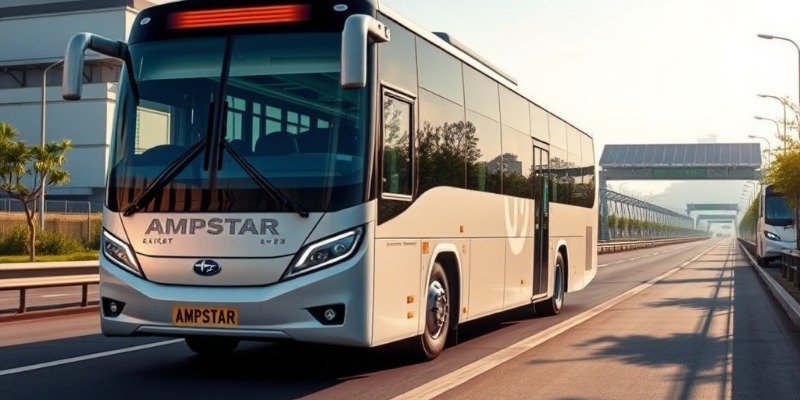
JSW Group has officially stepped into India's electric commercial vehicle market with a new brand called AMPSTAR. The company plans to manufacture and sell electric buses and heavy-duty trucks through this new venture, which operates under JSW Greentech Limited. This move signals a major push by one of India's leading business groups into the growing electric mobility space for commercial transport.
What makes AMPSTAR stand out is its integrated approach. Instead of just selling vehicles, JSW is building an entire ecosystem around electric mobility. This includes large-scale manufacturing, battery integration, charging infrastructure, and flexible ownership models like leasing and Battery-as-a-Service (BaaS). These services are all part of a strategy aimed at making the switch to electric vehicles easier for fleet operators.
The company has committed around ₹2,500 crore to set up a manufacturing plant in Chhatrapati Sambhajinagar, Maharashtra. Spanning about 90 acres, the greenfield facility has an initial annual production capacity of 15,000 units, split between 10,000 electric buses and 5,000 electric trucks. The plant is planned with integrated battery capabilities and an automated line for truck cabins. JSW also operates an R&D center in Pune, supporting ongoing development of electric drivetrain technology.
AMPSTAR is not planning to start small. The company aims to produce at least 10,000 electric commercial vehicles by FY28. Already, JSW has deployed its first 100 electric buses at JSW Steel's Dolvi plant for employee transport. Around 100 electric trucks are also expected to serve JSW Steel and JSW Cement operations soon. This internal demand gives AMPSTAR a strong foundation and a real-world testing ground for its vehicles before expanding to external customers.
The product strategy is broad. AMPSTAR's electric bus range will span from 7-meter to 18-meter vehicles, covering applications like city transport, intercity travel, staff mobility, and school transport. Power outputs across the lineup are expected to range from 150 kW to 500 kW. The trucks start with a 55-tonne electric tractor-trailer, with plans to follow up with electric tippers and fixed-body dump trucks.
JSW's decision to enter this space is backed by real operational experience. Through its cement business, the company tested electric trucks on select routes and found meaningful cost savings. According to Parth Jindal, the trucks cost ₹465 per tonne compared to ₹580 for diesel trucks. This translates to a saving of ₹115 per tonne, proving that electric trucks can offer a strong total cost of ownership case.
Government support adds further momentum to the electric commercial vehicle market in India. Under the PM E-DRIVE scheme, the government has allocated significant funds for electric buses and trucks. Around ₹4,391 crore has been set aside for 14,028 electric buses, with thousands already deployed across major cities. Another ₹500 crore is dedicated to electric truck incentives, helping offset the higher upfront costs of these vehicles.
AMPSTAR also addresses affordability through flexible ownership options. Buyers can choose outright purchase, leasing, or Battery-as-a-Service models. These approaches reduce the financial burden on fleet operators and convert capital costs into manageable operating expenses. The average price of an AMPSTAR vehicle is estimated at around ₹80 lakh, though this varies significantly between different bus and truck configurations.
Local manufacturing is a key focus for JSW. The company reports that buses already have 75% localization, with most components sourced domestically except for the battery and motor. For trucks, JSW expects localization to reach 50% within six months and 75% within nine to twelve months. This aligns with India's tightening local content requirements for electric vehicles.
JSW is positioning AMPSTAR as a full-stack solution that goes beyond just manufacturing vehicles. The brand promises to support customers across the entire lifecycle with financing, charging infrastructure, and after-sales service. This end-to-end approach is designed to appeal to fleet operators who need reliable, cost-effective alternatives to diesel vehicles.
The company plans to sell between 500 and 1,000 units in its first year, scaling up to 5,000 to 7,000 units annually. It aims to utilize 75% of the plant's capacity within five years and has indicated it could double capacity to 30,000 units with an additional ₹1,500 to 2,000 crore investment if demand supports it.
Competition in India’s electric bus and truck market is already growing. Companies like JBM Auto, Olectra Greentech, Switch Mobility, and Tata Motors are already active players. Electric bus registrations in the country reached 4,556 units between January and August 2026, while electric heavy-duty trucks saw around 1,637 registrations in the same period. These numbers show a strong upward trend from a relatively small base.
Ampstar enters a rapidly expanding market at an important time. India's electric bus market grew 40% year-on-year in the first half of 2026, and the overall electric commercial vehicle sector is showing similar momentum. Fleet operators are increasingly open to adopting electric alternatives as costs come down and infrastructure improves.
JSW’s unique advantage lies in its ability to generate demand from its own industrial operations while building manufacturing scale. The group's diverse businesses rely heavily on transport and logistics, making captive adoption of AMPSTAR vehicles a natural fit. This internal customer base helps the company gather valuable operating data and demonstrate real-world performance before pitching to external fleets.
By combining manufacturing scale, captive demand, and a comprehensive mobility ecosystem, JSW is creating a distinct strategy in India’s electric commercial vehicle space. Whether AMPSTAR can successfully transition from internal use to broader market leadership remains to be seen, but the groundwork is certainly strong.
The company has already laid the foundation with a ₹2,500 crore investment, a 15,000-unit annual capacity facility, and plans to expand further if demand grows. With supportive government policies and rising interest in sustainable transport, AMPSTAR is positioned to become a significant player in India's evolving commercial vehicle industry.
JSW Group's entry into the commercial EV segment through AMPSTAR brings a fresh and well-capitalized approach to electric buses and trucks. With strong internal demand from its own businesses, a clear plan to scale production, and a full suite of ownership models, the company is well-positioned to compete in this space. While challenges remain in terms of competition and scaling quickly enough to meet growing demand, JSW's ecosystem strategy could give it an edge. If the company can execute effectively, AMPSTAR could become a defining name in India’s transition to electric commercial mobility.
FAQs
What vehicles does AMPSTAR offer?
AMPSTAR currently offers electric buses and trucks. The bus range spans from 7 meters to 18 meters, suitable for city transport, intercity travel, staff mobility, and school applications. The truck lineup begins with a 55-tonne electric tractor-trailer, with plans to add electric tippers and fixed-body dump trucks later. Vehicle power outputs range from 150 kW to 500 kW depending on configuration.
Where is the AMPSTAR manufacturing plant located?
AMPSTAR vehicles are manufactured at a greenfield facility in Chhatrapati Sambhajinagar, Maharashtra. The plant covers about 90 acres and has an annual production capacity of 15,000 units. It includes integrated battery capabilities and an automated line for truck cabins. JSW plans to potentially double capacity to 30,000 units with further investment.
What ownership models does AMPSTAR provide?
AMPSTAR offers several flexible ownership options to make adoption easier for fleet operators. These include outright vehicle purchase, leasing, and a Battery-as-a-Service (BaaS) model. These options help reduce upfront capital costs and allow customers to treat expenses as operational rather than capital expenditures.
How much does an AMPSTAR vehicle cost?
The average price of an AMPSTAR vehicle is around ₹80 lakh. However, this is a rough estimate that varies significantly based on the specific model, bus size, truck configuration, and chosen ownership model. The actual cost will depend on these factors.
Is AMPSTAR already using its vehicles?
Yes, AMPSTAR vehicles are already in use. The company has deployed 100 electric buses at JSW Steel's Dolvi plant for employee transportation. Plans are underway to deploy around 100 electric trucks with JSW Steel and JSW Cement as well. This internal use gives AMPSTAR a captive customer base and valuable operating data before expanding to external markets.