
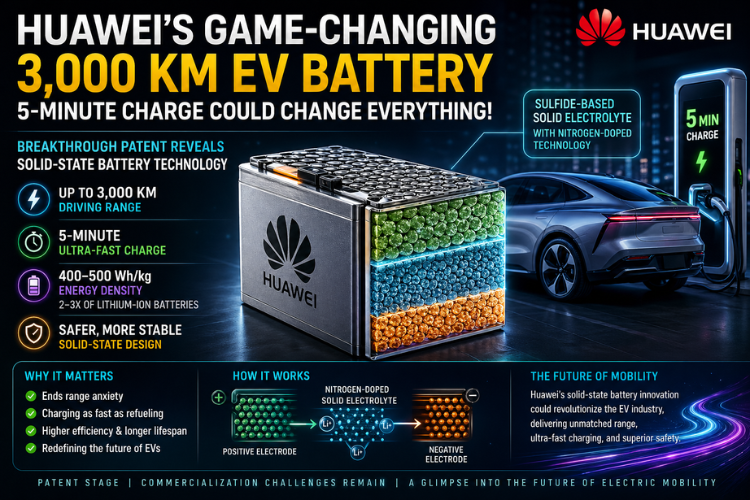
In a major leap for electric mobility, Huawei has revealed a groundbreaking patent that could redefine how we think about electric vehicles. The company’s latest concept outlines a solid-state EV battery capable of delivering up to 3,000 km driving range with an astonishing five-minute charging time.
What Makes This Battery So Revolutionary?
At the core of this breakthrough is a sulfide-based solid-state battery combined with a nitrogen-doped solid electrolyte. This advanced chemistry promises significant improvements over traditional lithium-ion batteries.
Key Technical Highlights:
- Energy Density: ~400–500 Wh/kg
- Charging Time: ~5 minutes (claimed)
- Driving Range: Up to 3,000 km
- Battery Type: Solid-state (safer & more stable)
To put this into perspective, today’s mainstream lithium-ion batteries typically offer 150–250 Wh/kg, meaning Huawei’s design could deliver 2–3x higher energy density.
Why Solid-State Batteries Are the Future
Solid-state batteries are widely considered the next big leap in EV technology. Unlike conventional lithium-ion batteries, they replace liquid electrolytes with solid materials, offering:
- Improved safety (lower fire risk)
- Faster charging speeds
- Higher energy storage capacity
- Longer battery lifespan
Huawei’s nitrogen-doped electrolyte could further enhance ion conductivity, enabling ultra-fast charging without degrading battery health.
While the claims are exciting, it’s important to note that this is currently a patent-stage innovation.
Challenges ahead include:
- Scaling production of solid-state batteries
- High manufacturing costs
- Real-world durability testing
- Performance under different conditions
Many companies, including Toyota and QuantumScape, are also racing to commercialize solid-state technology—but mass adoption is still a few years away.
This development signals that the EV industry is moving toward a future where charging time and range will no longer be limitations.
Huawei’s entry into advanced battery innovation also shows that:
- Tech giants are becoming key players in EV ecosystems
- Battery technology will define the next phase of competition
The real winners will be consumers—who can expect faster, safer, and more powerful EVs in the coming years.
EV Cost Calculator & Compare Tool
EV Running Cost Calculator
Estimate your EV's running costs.
Calculation Type
Estimated Cost
₹--
Estimated Cost Per Kilometer
₹--
Calculations are estimates based on provided values.