
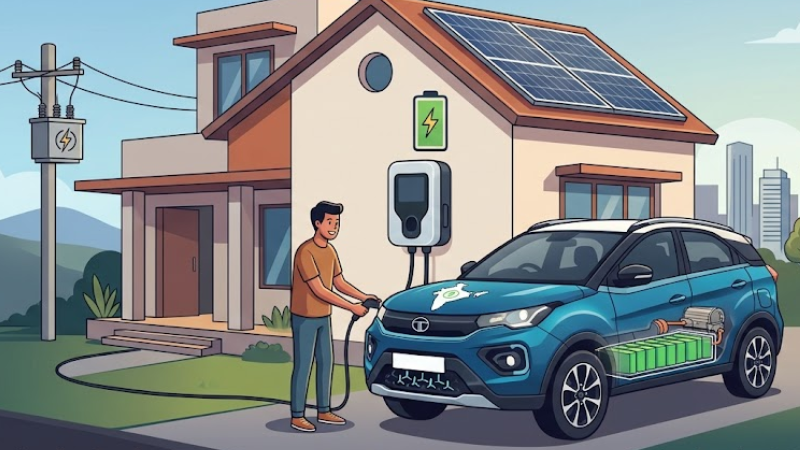
For an average passenger car in India, plugging in at home costs between ₹250 and ₹450 for a full charge. This translates to a real-world running cost of roughly ₹1.00 to ₹1.50 per kilometer.
Compared to a standard petrol SUV—which easily drains ₹7.50 to ₹9.00 per kilometer at current fuel prices—running an EV is nearly 6 to 7 times cheaper. Here is exactly how that monthly bill shakes out, without the textbook jargon.
The Real-World Math
Calculating your charging cost is simple: look at your car’s battery size (measured in kWh) and multiply it by your local electricity rate per unit.
Because home AC charging loses about 10% of its energy to heat while pumping power into the battery, you add a tiny buffer to your calculation.
The 40 kWh Battery (e.g., Tata Nexon EV): Takes about 44 units of electricity to fill from empty. At an average home rate of ₹8 per unit, a full tank costs roughly ₹352.
The 60 kWh Battery (e.g., Mahindra BE 6 / Maruti e Vitara): Takes about 66 units to fill. At that same ₹8 rate, a full charge sits right around ₹528.
Watch Out for the “Slab Inflation” Trap
Residential electricity in India works on a tiered system. The more units your household consumes, the higher your rate per unit climbs.
If your regular home appliances already push you into the middle tiers, adding an EV can add 150 to 200 units a month to your bill (assuming a standard 1,200 km monthly commute). This extra load can easily push your entire household into the highest luxury consumption tier—where rates can spike to ₹9 to ₹12 per unit in states like Maharashtra or Punjab.
The Fix: Dedicated EV Tariffs
To avoid this, many state electricity boards offer a workaround: you can apply for a separate, flat-rate EV meter that bypasses your domestic household slabs entirely.
Delhi: ~₹4.50 per unit (Flat rate)
Gujarat: ~₹4.10 per unit
Uttar Pradesh: ~₹5.50 per unit
Maharashtra: ~₹6.00 – ₹6.90 per unit
Upfront Hardware & Setup Costs
While your car comes with a standard 15A three-pin wall charger that plugs into any regular socket for free, it only adds about 15–20 km of range per hour. For practical overnight charging, most owners upgrade to a 7.4 kW AC Wall-box.
Here is what that setup actually costs to pull off:
The Charger: Usually bundled for free with your vehicle purchase. If bought separately, expect to pay ₹25,000 to ₹50,000.
Wiring & Installation: Running heavy-duty cables from your main meter room to your parking spot, along with safety switches (MCB/RCCB), typically runs between ₹5,000 and ₹15,000.
Sanctioned Load Upgrade: A 7.4 kW charger draws a massive amount of power. You will need to apply to your local power DISCOM to upgrade your home’s sanctioned load to at least 10 kW. The official processing fee varies by state, usually lands between ₹5,000 and ₹15,000.
Pro-Tips to Lower Your Monthly Charging Bill
Charge While You Sleep: Use your vehicle app to schedule charging between midnight and 6 AM. Many state grids offer Time-of-Day (ToD) discounts during these off-peak hours, slashing your charging rate by 15–20%.
Install a Digital Sub-Meter: If you live in an apartment complex where a dedicated company meter isn’t allowed, install a basic digital sub-meter (around ₹1,000) on your line. It keeps your consumption transparent and avoids arguments with the housing society management.
Go Solar: Pairing your vehicle with a standard 3kW rooftop solar setup lets you charge for free during peak sunny hours, effectively dropping your driving cost to under ₹0.40 per kilometer.
EV Cost Calculator & Compare Tool
EV Running Cost Calculator
Estimate your EV's running costs.
Calculation Type
Estimated Cost
₹--
Estimated Cost Per Kilometer
₹--
Calculations are estimates based on provided values.