
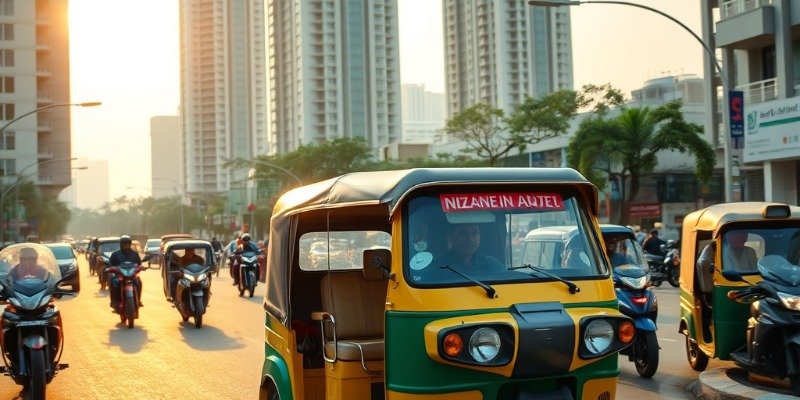
India's electric three-wheeler segment has reached a historic milestone. In 2024, electric models accounted for 50 percent of all new three-wheeler sales in the country. This achievement places India far ahead of other vehicle categories in the transition to electric mobility. While electric two-wheelers made up nearly 60 percent of new sales, their overall fleet share remained at just 5 percent. Electric cars lag further behind with only 30 percent projected adoption by 2030 according to government think tank NITI Aayog.
The numbers tell a compelling story. India sold more than 580,000 electric three-wheelers in 2025, surpassing China's 320,000 units to become the world's largest market. The country alone accounted for 60 percent of global electric three-wheeler sales, which reached nearly one million units that year. China and India together represent over 95 percent of the global market. This dominance stems from a unique combination of policy support, commercial economics, and urban transport needs.
The policy engine driving adoption
The FAME II scheme launched in December 2021 has been the primary catalyst. Purchase subsidies under this program significantly reduced upfront costs for buyers. Lower goods and services tax on electric vehicles compared to petrol and diesel models further improved the value proposition. State-level incentives in several regions added another layer of support. These measures addressed the main barrier identified by researchers: price-sensitive buyers in India prioritize upfront cost above all else.
The International Energy Agency calls electric two- and three-wheelers the most affordable and accessible entry point into electric mobility. They do not require extensive charging infrastructure since many can charge using standard household sockets. This practical advantage matters in a country where public charging stations numbered only 25,000 and battery-swapping kiosks just 2,600 as of April 2024.
Commercial fleets lead the charge
Unlike private car buyers, three-wheeler operators make decisions based on total cost of ownership. Studies confirm that the five-year cost of electric three-wheeler ownership is lower than fossil fuel equivalents. Battery capacity-based subsidies from central and state governments reduce the purchase gap. Electricity costs remain stable compared to volatile fuel prices. Electric motors require less maintenance with fewer moving parts.
This economic logic explains why commercial fleet operators have embraced electrification faster than individual consumers. Companies like Yamaha's leasing arm Moto Business Service India have partnered with Omega Seiki and Hero Electric to deploy hundreds of electric three-wheelers for last-mile delivery in Tamil Nadu. The leasing company plans to manage over 2,000 electric vehicles in that state alone.
Product innovation accelerates
Manufacturers have responded with rapid product development. Bajaj Auto launched its RE E-Tec 9.0 passenger model and Maxima XL Cargo E-Tec 12.0 in June 2023, selling over 8,600 units combined. These vehicles offer ranges of 178 km and 183 km respectively on a single charge. Mahindra Last Mile Mobility introduced the Treo Plus L5 in January 2025 with a 10.5 kWh lithium-ion battery delivering 150 km range.
Piaggio Vehicles India partnered with Sun Mobility in February 2025 to integrate swappable battery technology across its Ape E-City and Ape E-Xtra range. This enables sub-three-minute battery swaps at urban hubs, eliminating charging downtime for commercial drivers. Euler Motors secured $25 million in Series C funding in May 2025 to scale production of its HiLoad EV commercial three-wheeler and expand charging infrastructure.
Terra Motors unveiled a heavy-duty electric cargo three-wheeler with 1,000 kg payload capacity in November 2025, targeting e-commerce logistics with claimed 40 percent lower operating costs than diesel alternatives. TVS Motor Company entered the segment in January 2026 with its King EV line featuring advanced telematics and fleet management software.
Battery technology shifts toward lithium-ion
Lithium-ion batteries now dominate the market, replacing lead-acid units that powered early e-rickshaws. Higher energy density enables longer ranges and faster charging. Lightweight construction improves vehicle efficiency. Companies like Neuron Energy and Urja Mobility are introducing battery leasing models in Kolkata, aiming to convert a target fleet of 50 lakh e-rickshaws nationwide. Monthly lease rentals starting at Rs 4,500 make lithium-ion technology accessible without high upfront battery costs.
Fast-charging innovations are addressing range anxiety. Omega Seiki Mobility, collaborating with Exponent Energy, launched the OSM Stream City Qik with an 8.8 kWh battery offering 126 km city range and 15-minute charging capability. Such developments are critical for commercial operators who cannot afford extended downtime.
The road ahead
NITI Aayog and the Rocky Mountain Institute project that 80 percent of two- and three-wheeled vehicles sold in India could be electric by 2030. Domestic production capacity is expected to increase by 70 percent as manufacturers expand facilities. The global electric three-wheeler market, valued at USD 2.9 billion in 2025, is forecast to reach USD 8.23 billion by 2034 at a 12.3 percent compound annual growth rate.
Challenges remain. Public charging infrastructure outside major cities is inadequate. Long charging times and limited range still concern some business owners. The upfront cost gap, though narrowing, persists for buyers without access to financing. Regulatory clarity varies across states. Yet the fundamental economics favor electrification for high-utilization commercial vehicles.
India's three-wheeler revolution demonstrates that electric mobility succeeds first where the math works hardest. With only 7.5 percent of Indians owning four-wheel cars, the path to sustainable transport runs through auto-rickshaws and delivery trikes, not luxury sedans. The tuk-tuk is leading the charge.
FAQs
What percentage of new three-wheeler sales in India are electric?
Electric three-wheelers accounted for 50 percent of all new three-wheeler sales in India during 2024, making it the most electrified vehicle segment in the country.
How many electric three-wheelers did India sell in 2025?
India sold more than 580,000 electric three-wheelers in 2025, surpassing China to become the world's largest market and representing 60 percent of global sales.
What government policy supports electric three-wheeler adoption in India?
The FAME II scheme launched in December 2021 provides purchase subsidies that lower upfront costs. Electric vehicles also attract lower goods and services tax compared to petrol and diesel models.
Why are commercial fleets adopting electric three-wheelers faster than private buyers?
Commercial operators base decisions on total cost of ownership. Studies show five-year ownership costs for electric three-wheelers are lower due to stable electricity prices, reduced maintenance, and government subsidies.
Which companies are leading the electric three-wheeler market in India?
Key players include Mahindra Last Mile Mobility, Bajaj Auto, Piaggio Vehicles India, TVS Motor Company, Euler Motors, Omega Seiki Mobility, Terra Motors, Kinetic Green, Atul Auto, and Lohia Auto Industries.