
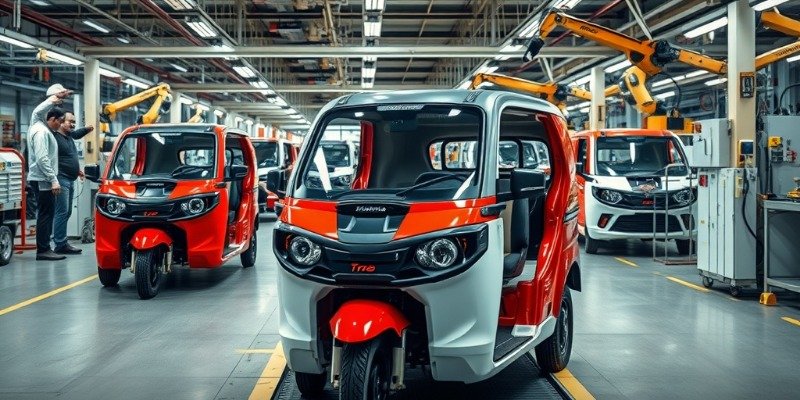
India's three-wheeler market is undergoing a quiet revolution. In September 2026, more than half of all new three-wheelers sold in the country were electric. This figure stands in sharp contrast to passenger cars at 8.5 percent and two-wheelers at 11.6 percent. At the center of this shift sits Mahindra Last Mile Mobility, a company that has grown its electric vehicle penetration six times over the last five years.
The Zaheerabad Factory Floor
Located in Telangana's Zaheerabad, the Mahindra Last Mile Mobility plant runs at a pace that underscores the demand. Every 90 seconds, a finished electric three-wheeler rolls off the assembly line. Workers and robots operate side by side, fitting battery cells into packs, mounting body panels on frames, and securing wheels. The facility is one of three manufacturing sites for the company, with the others in Bengaluru and Haridwar.
Suman Mishra, Managing Director and CEO of Mahindra Last Mile Mobility, describes the acceleration as a combination of government subsidies, better vehicle quality, and lower running costs. She notes that adoption has picked up sharply over the past two years. The company now holds roughly 40 percent share of the L5 electric three-wheeler category, up from 12 percent just two years ago.
From Roadside Workshops to Factory Scale
Electric rickshaws first appeared in Delhi over a decade ago. Early versions were often assembled in small workshops using imported batteries fitted to modified pedal tricycles. Those rudimentary beginnings have given way to a structured industry. Mahindra's current lineup includes the Treo range, Zor Grand, e-Alfa Super, e-Alfa Cargo, UDO, and ZEO, serving both passenger and cargo needs.
The numbers tell the story of scale. In the 2026 financial year, Mahindra Last Mile Mobility became the first electric commercial vehicle maker in India to cross 100,000 units sold in a single year. By August 2026, cumulative sales passed 4 lakh units. These vehicles have collectively covered more than 9 billion electric kilometres, avoiding an estimated 1.85 lakh metric tonnes of carbon dioxide emissions.
Economics Drive the Switch
For drivers, the decision to go electric comes down to daily earnings. Afroz Alam, a 31-year-old driver in Hyderabad, switched from a gas-powered model this year. He says charging costs save him several hundred rupees each day, which helps repay the higher upfront loan for the electric vehicle. The Council on Energy, Environment and Water estimated in 2025 that petrol three-wheelers cost more than twice as much per kilometre to run over their lifetime compared to electric equivalents.
This economic logic extends to fleet operators and policymakers. India imports most of its oil and gas, and global price shocks have made energy security a priority. The shift to electric three-wheelers reduces oil demand at the margin while creating a domestic manufacturing base for batteries and motors.
Unicorn Status and the Road Ahead
In November 2026, Mahindra & Mahindra raised INR 3.22 billion (about US$35.4 million) for Mahindra Last Mile Mobility at a valuation of INR 108.22 billion (US$1.19 billion), giving the unit unicorn status. Lightrock led the round with participation from the International Finance Corporation and the India-Japan Fund. The capital supports a target of one million electric vehicles on Indian roads by 2031.
Rajesh Jejurikar, Executive Director and CEO of Mahindra's Auto and Farm Sector, notes the business has led India's electric commercial vehicle market for four consecutive years. The company has logged 6 billion cumulative electric kilometres to date.
Challenges in the Last Mile
Despite the momentum, hurdles remain. Adoption is uneven across cities. In Lucknow, electric rickshaws are common. In Mumbai, limited parking and charging infrastructure slow uptake. Suman Mishra points out that a driver can park a fuel vehicle on the roadside, but an electric one needs a charging point, which is scarce in dense urban areas.
Supply chain risks also persist. China's restrictions on rare-earth magnet exports in 2025 forced several Indian automakers to cut or pause production. The government is promoting domestic cell manufacturing, though most battery cells still come from China and South Korea. Mishra says two Indian players are close to commercialising locally made cells, but patience is needed.
The Bigger Picture
The success of electric three-wheelers raises a larger question: can this model work for private cars and trucks? Analysts believe commercial fleets, especially taxis and delivery vehicles, could be the next catalyst. As more fleets go electric, charging networks will expand and consumer confidence will grow.
For now, drivers like Mohammad Ali, 26, who bought an e-rickshaw this year, have a simple message for skeptics. He says people warn that the battery will fail, but a single day's trial shows how much money is saved. The environmental benefits follow the economics, not the other way around.
Mahindra Last Mile Mobility's journey from a niche player to a unicorn-valued leader mirrors India's broader electric transition. The Zaheerabad factory, humming at one vehicle every 90 seconds, is both a symbol and an engine of that change.
FAQs
What is Mahindra Last Mile Mobility's current market share in electric three-wheelers?
Mahindra Last Mile Mobility holds about 40 percent share of the L5 electric three-wheeler category in India, up from 12 percent two years ago.
How many electric three-wheelers does the Zaheerabad factory produce?
The factory produces one electric three-wheeler every 90 seconds, operating alongside plants in Bengaluru and Haridwar.
What milestone did Mahindra Last Mile Mobility reach in August 2026?
The company crossed 4 lakh cumulative electric vehicle sales, becoming India's first commercial EV manufacturer to reach this figure.
Why are drivers switching to electric three-wheelers?
Drivers report saving several hundred rupees per day on charging compared to fuel costs, which helps offset the higher purchase price and improves daily earnings.
What challenges does the electric three-wheeler segment face in India?
Key challenges include uneven charging infrastructure across cities, limited parking in metros like Mumbai, and reliance on imported battery cells and rare-earth magnets.