
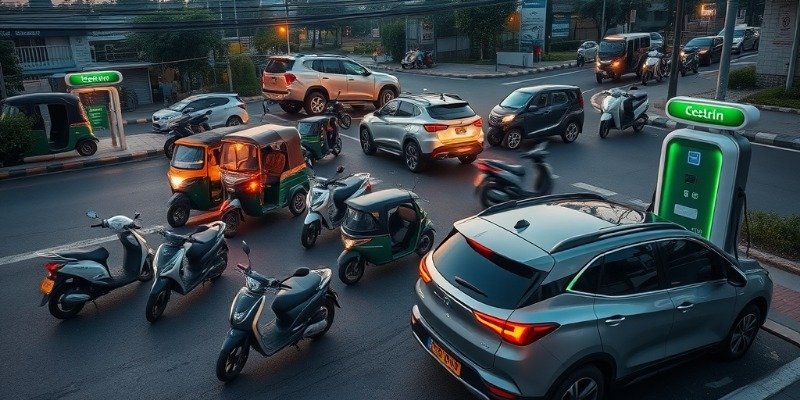
India's electric vehicle market hit a new milestone in October 2026. According to data released by the Federation of Automobile Dealers Associations (FADA), total EV retail touched 3.55 lakh units, marking a 45 percent jump compared to the same month last year. Overall EV penetration climbed to 11.5 percent from just 6 percent in October 2025. Every segment — two-wheelers, three-wheelers, passenger vehicles, and commercial vehicles — recorded its highest-ever October registrations. Yet beneath the headline growth lies an uneven story. Sequential penetration dipped in key categories as supply struggled to keep pace with demand.
Record volumes across the board
FADA data collated from 1,468 of 1,469 regional transport offices shows electric two-wheelers led the surge with 2,24,064 units, up 48.49 percent year-on-year. Their market share doubled to 9.7 percent from 4.7 percent a year earlier. Electric passenger vehicles posted 37,049 units, a 76.47 percent increase, lifting their share to 7.3 percent from 3.5 percent. Three-wheelers grew 24.76 percent to 88,570 units, while commercial vehicles more than doubled to 4,492 units, a 162 percent jump. FADA President Sai Giridhar called it the best-ever October for electric two-wheelers, three-wheelers, passenger vehicles, and commercial vehicles alike.
The sequential dip: supply, not demand
Despite record volumes, the share of EVs in total retail fell compared to September 2026. Electric passenger vehicle penetration slipped to 7.3 percent from 8.5 percent. Electric two-wheeler penetration dropped to 9.7 percent from 11.6 percent. Three-wheeler share fell to 62.6 percent from 64.9 percent. FADA attributed this to supply constraints. Giridhar stated that demand ran ahead of supply this month, with petrol and diesel prices remaining elevated. He added that EV driving ranges have materially improved and prices are increasingly at par with comparable petrol and diesel models. Buyer pull has strengthened to the point where availability, not demand, has become the binding constraint.
What is driving demand
Three structural factors are pushing buyers toward electric. First, fuel prices have stayed high after crude oil jumped nearly 50 percent, and India imports close to 90 percent of its oil. Second, driving ranges on new electric models have improved significantly, reducing range anxiety. Third, upfront price gaps between electric and internal combustion models are narrowing, especially in the two-wheeler and premium car segments. The NITI Aayog noted in its August 2025 report that India's EV penetration was 7.66 percent in 2024 against a global average of 16.48 percent, with a target of 30 percent by 2030. The October numbers suggest the curve is steepening.
Segment dynamics: two-wheelers lead, cars catch up
Two-wheelers remain the volume engine. JMK Research data for FY2025-26 shows electric two-wheelers accounted for nearly 58 percent of total EV sales. Legacy OEMs — TVS Motor, Bajaj Auto, and Hero MotoCorp — now control 61 percent of the e-2W market, leveraging dealer networks and service reach. In passenger vehicles, FY2025-26 saw 86 percent year-on-year growth, the fastest among all segments. Tata Motors retained leadership but its share fell from roughly 57 percent to 39 percent as JSW MG Motor, Mahindra, Hyundai, VinFast, and Maruti Suzuki expanded the field, especially in the 12 lakh to 25 lakh rupee SUV band. Public charging infrastructure crossed 27,000 stations by March 2026, making electric SUVs more practical for highway use.
Policy tailwinds and structural hurdles
The upcoming CAFE-3 norms, effective April 2027, will tighten corporate average fuel efficiency targets and impose binding penalties, giving manufacturers a stronger push toward electrification. Several states, including Delhi, have drafted policies to phase out new ICE two- and three-wheeler registrations by 2027. However, charging infrastructure remains thin — India has roughly 10,000 public chargers versus China's 20 million. The NITI Aayog report highlights that 75 percent of India's vehicle fleet is two-wheelers while cars are only 13 percent, so measuring progress by car penetration alone understates the transition. Financing for electric buses and trucks remains difficult due to high upfront costs and fragmented small-owner fleets. Battery supply chains depend heavily on imported critical minerals, with China controlling 70 to 80 percent of lithium and cobalt refining.
The road ahead
FADA's data shows the transition is broadening. Three-wheelers are now close to 63 percent electric. Alternative fuels — CNG, hybrid, and electric — have nudged past petrol in the passenger vehicle mix. JMK Research projects FY2026-27 penetration at 9.5 to 10 percent, with PM E-Drive incentive extensions for two- and three-wheelers providing near-term support. Nomura expects passenger vehicle EV penetration to reach 9 percent by 2030. The immediate challenge is unlocking supply — scaling battery production, easing charging deployment, and fixing financing for commercial EVs — so that the next record month does not come with a sequential share decline.
India's electric transition is no longer directional but substantive. The October numbers confirm that buyer intent is strong across segments. The bottleneck has shifted from demand to supply. Solving that will decide whether the 30 percent by 2030 target stays aspirational or becomes achievable.