
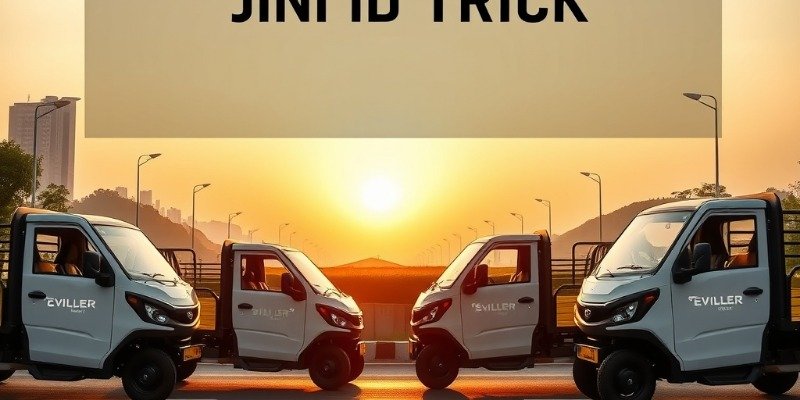
The Indian commercial vehicle market is shifting fast. Rising diesel prices, stricter emission norms and the boom in e-commerce have pushed small businesses and fleet operators toward electric mini-trucks. In 2026, buyers have more choices than ever before. Established brands and new entrants are competing aggressively on price, payload and driving range. All of this is happening in the sub-₹15 lakh price bracket, which makes these vehicles accessible to a wide range of operators.
Four players stand out in this race. Tata Motors leads with its trusted Ace platform and a nationwide service network. Mahindra brings affordable, technology-driven solutions backed by its fleet management ecosystem. Eicher has surprised many with segment-leading range and premium cabin comfort. Euler Motors has built a reputation for high-payload electric cargo vehicles that balance capacity with range. Each brand targets a slightly different customer need, creating a diverse market where the right choice depends on the specific business application.
Tata Motors: The Trusted Leader
Tata Motors continues to dominate the mini electric truck segment with multiple models under the Ace and Intra names. The Tata Ace EV is priced between ₹10.53 lakh and ₹11.43 lakh. It offers a payload of 600 to 1,000 kg, a 36 kWh battery and a claimed range of 154 km. Its biggest strengths are the Tata brand trust, extensive service network, battery-swappable variants and strong resale value. This makes it a safe pick for courier companies, e-commerce operators and municipal fleets.
For businesses needing more payload, the Tata Ace EV 1000 raises capacity to 1,000 kg with a 21.3 kWh battery and 161 km range. It is priced between ₹11.40 lakh and ₹11.50 lakh. At the top end, the Tata Intra EV Pickup offers the highest payload in this price segment at 1,750 kg. Priced at ₹12.98 lakh, it targets agricultural transporters, industrial suppliers and construction material distributors. Its range is 125 to 140 km, which suits intra-city operations.
Mahindra: Affordable Tech for Fleet Buyers
Mahindra has positioned the Zeo as an affordable entry point for first-time EV buyers and smaller fleet operators. Priced between ₹7.88 lakh and ₹8.37 lakh, it carries a payload of 765 kg. The 18.4 kWh battery delivers a real-world range of 135 to 160 km. The Zeo stands out with ADAS alerts, driver fatigue monitoring, 32 percent gradeability and a 7-year battery warranty. Mahindra's NEMO telematics platform adds fleet management capabilities that appeal to organised operators.
For even tighter budgets, the Mahindra Zor Grand starts at ₹4.08 lakh. It offers 400 kg payload and up to 153 km range. The Treo Zor, a three-wheeler cargo variant, starts at ₹3.13 lakh with 550 kg payload. These lower-priced models help Mahindra cover a wide spectrum of last-mile delivery needs.
Eicher: Range and Comfort Surprise
Eicher's Pro X has emerged as a strong challenger with one of the longest claimed ranges in the segment. Priced from ₹8.85 lakh, it offers a 32 kWh battery and a claimed range of 206 to 249 km. The payload is 1,445 kg. The Pro X also brings premium cabin features and comfort that are rare in this category. This makes it ideal for businesses running longer city routes with minimal charging downtime. Eicher's partnership with Pickkup for 100 Pro X EVs in Delhi-NCR and Bengaluru shows early fleet adoption in retail, e-commerce and perishable logistics.
Euler Motors: High Payload Specialist
Euler Motors has focused on cargo capacity without compromising range. The StormEV LongRange200 offers 1,250 kg payload, a 30 kWh battery and 200 km claimed range. Its price band is wide at ₹9 lakh to ₹13 lakh, reflecting multiple variants. The comfortable cabin, durable construction and strong road performance suit demanding commercial operations. The HiLoad EV, a three-wheeler cargo model, offers up to 768 kg payload with DC fast charging that adds 50 km in 15 minutes. The Turbo EV 1000 sits in the middle with 1,000 kg payload and 135 to 180 km range, priced between ₹6 lakh and ₹8.35 lakh.
How Pricing Strategies Differ
Tata Motors uses a tiered approach. The Ace EV starts near ₹10.5 lakh for standard last-mile work. The Ace EV 1000 adds payload for a small premium. The Intra EV Pickup commands ₹12.98 lakh for maximum capacity. Mahindra attacks the entry-level with the Zor Grand under ₹4.5 lakh and the Zeo under ₹8.5 lakh, making electric ownership accessible to smaller operators. Eicher prices the Pro X aggressively at ₹8.85 lakh given its range and comfort, undercutting many rivals with lower specifications. Euler spreads its range from ₹6 lakh for the Turbo EV 1000 to ₹13 lakh for the top-end StormEV, letting buyers choose the payload-range mix they need.
Payload Wars: Who Carries More
Payload is a critical differentiator. The Tata Intra EV Pickup leads at 1,750 kg, followed by the Eicher Pro X at 1,445 kg. The EKA 2.5T, a newer entrant, offers 1,500 kg at ₹10.12 lakh. Euler's StormEV LongRange200 and Switch Mobility's IeV3 both offer 1,250 kg. The Tata Ace EV 1000 and Jupiter Jem Tez sit at 1,000 kg. Mahindra Zeo carries 765 kg. For businesses moving heavy goods like LPG cylinders, milk cans or construction materials, the higher payload models justify their premium. For lighter e-commerce parcels, the lower payload models reduce upfront cost.
Range Realities for City Operations
Most mini electric trucks claim between 120 km and 200 km per charge. The Eicher Pro X leads with 206 to 249 km. Jupiter Jem Tez and Euler StormEV LongRange200 claim 200 km. The Montra Eviator, a larger electric truck, claims 245 km certified range but sits above ₹15 lakh. Real-world range is typically 10 to 20 percent lower than claimed figures, especially with full payload and air conditioning. For intra-city delivery loops of 80 to 120 km per day, most models work well with overnight depot charging. Longer routes need fast-charging access or battery-swapping support.
Service Network and Resale Value
Tata Motors holds a clear advantage with its nationwide dealership and service network. This translates to higher uptime and better resale value, which matters for fleet owners planning a three-to-five-year ownership cycle. Mahindra leverages its last-mile mobility experience and the NEMO telematics platform. Eicher and Euler are expanding their networks but currently have fewer touchpoints. Switch Mobility, backed by the Hinduja Group and Ashok Leyland, benefits from an established commercial vehicle service backbone. Newer brands like EKA, Jupiter and OSM are still building their service footprint.
Total Cost of Ownership Advantage
Electric mini-trucks reduce running costs to roughly ₹1 to ₹2 per kilometre compared to ₹6 to ₹8 per kilometre for diesel equivalents. Maintenance is lower due to fewer moving parts, no engine oil changes and no clutch replacements. Over a five-year period, the savings on fuel and maintenance can offset the higher purchase price. The PM E-DRIVE subsidy scheme, launched in July 2025, offers up to ₹9.6 lakh for eligible electric trucks, though disbursement has been slow. State-level EV policies add further incentives in Maharashtra, Tamil Nadu, Karnataka, Delhi and Haryana.
Charging Infrastructure Considerations
Depot charging remains the primary model for most fleets. Standard AC charging takes 6 to 8 hours. DC fast charging can bring batteries to 80 percent in 60 to 105 minutes for compatible models. Battery swapping is emerging for heavy-duty applications at ports and on fixed corridors like Mumbai-Pune, but is not yet widespread for mini-trucks. Operators must assess charging access at their base and along daily routes before committing.
The mini electric truck segment under ₹15 lakh has matured significantly in 2026. Tata Motors offers the broadest range and strongest support network. Mahindra delivers the most affordable tech-enabled options. Eicher surprises with class-leading range and comfort at a competitive price. Euler Motors specialises in high-payload configurations. There is no single best truck for every business. The right choice depends on daily distance, cargo weight, charging access, service proximity and total cost of ownership over the intended holding period. Matching the vehicle to the actual duty cycle will deliver better returns than buying on price alone.
FAQs
Which electric mini-truck offers the highest payload under ₹15 lakh?
The Tata Intra EV Pickup offers the highest payload at 1,750 kg with a price of ₹12.98 lakh. The Eicher Pro X follows at 1,445 kg for ₹8.85 lakh.
What is the real-world range of these electric mini-trucks?
Most models deliver 10 to 20 percent less than claimed range in real conditions. Expect 100 to 130 km for trucks claiming 125 to 160 km, and 160 to 200 km for those claiming 200 km plus.
Are electric mini-trucks cheaper to run than diesel trucks?
Yes. Electric trucks cost roughly ₹1 to ₹2 per kilometre to run versus ₹6 to ₹8 per kilometre for diesel. Maintenance is also lower due to fewer moving parts.
Which brand has the best service network for electric mini-trucks?
Tata Motors has the largest nationwide service network, followed by Mahindra. Eicher, Euler and Switch Mobility are expanding but have fewer touchpoints currently.
Do these trucks qualify for government subsidies?
Many models qualify under the PM E-DRIVE scheme which offers up to ₹9.6 lakh for N2 and N3 category trucks. State EV policies in Maharashtra, Tamil Nadu, Karnataka, Delhi and Haryana provide additional incentives.