
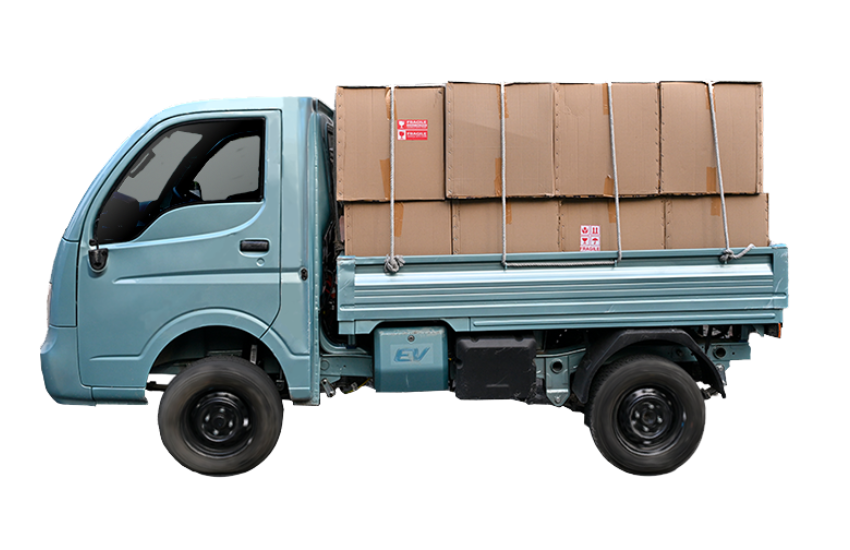
Electric mini trucks are gaining attention in India as fleet operators look for ways to lower operating costs and meet sustainability goals. The small commercial vehicle segment, which includes popular models like the Tata Ace EV and Mahindra Treo, plays a vital role in last-mile delivery and intra-city logistics. While diesel variants have dominated this space for decades, new research shows that battery-electric options are becoming financially viable much faster than expected. This article examines the total cost of ownership for electric mini trucks against their diesel counterparts, using data from recent studies by the International Council on Clean Transportation, Lawrence Berkeley National Laboratory, and industry sources.
Current TCO comparison for mini trucks
Recent analysis of 1-tonne gross vehicle weight trucks reveals a clear pattern in cost structure. Diesel mini trucks carry a total fixed cost of approximately Rs 3.8 per kilometer, covering items such as tax, insurance, and cost of capital. Their variable cost stands at Rs 11.35 per kilometer, driven mainly by fuel, maintenance, tyres, urea, and engine oil. In contrast, electric mini trucks show a higher fixed cost of Rs 6.62 per kilometer but a significantly lower variable cost of Rs 7.34 per kilometer. The difference stems from the battery pack, which accounts for nearly half the vehicle price, pushing up capital-related fixed costs. However, electricity at Rs 6-10 per kWh is far cheaper than diesel at Rs 80-90 per litre, and electric drivetrains have fewer moving parts, reducing maintenance needs by roughly 30 percent.
Upfront cost gap and projected decline
Studies indicate that in 2023, the upfront price of battery-electric trucks in the 12-tonne, 16-tonne, and 28-tonne categories was 4 to 6 times higher than equivalent diesel models. For the 7.5-tonne and 12-tonne segments, which are closer to the mini truck class, the capital cost premium ranged from 67 percent to 169 percent at a battery pack price of $135 per kWh. This gap is expected to narrow sharply. Battery prices are projected to fall 65 percent between 2023 and 2040, while improvements in fuel economy will allow smaller battery packs for the same range. By 2040, the upfront cost multiple is forecast to drop to 1.2 to 1.4 times for 12-tonne, 16-tonne, and 28-tonne trucks. For lighter segments, parity could arrive even sooner.
Break-even timeline for operators
The payback period for the higher upfront investment depends heavily on daily utilisation. Research on 12-tonne trucks shows a base-case payback of 3.1 years at $135 per kWh battery cost, improving to 2.5 years on average. Sensitivity analysis reveals the range can vary from 1.3 to 5 years depending on diesel price, electricity tariff, annual distance, and battery price. For 7.5-tonne trucks, the payback stretches to 4.1 years. Operators running 300 km per day over 300 days a year see the fastest returns. Higher daily distances amplify fuel savings, offsetting the larger battery cost. At $100 per kWh, which is approaching current global averages, the 12-tonne electric truck delivers an 18 percent lower TCO per kilometer than diesel, with undiscounted lifetime savings of Rs 72 lakh over 15 years.
Policy incentives that change the math
Government support can bring forward the break-even point by several years. A purchase subsidy of Rs 20,000 per kWh capped at Rs 50 lakh, matching the FAME II bus incentive, combined with a 5 percent interest subvention, 100 percent road tax waiver, 100 percent toll exemption, and a 2-tonne gross vehicle weight relaxation, closes the TCO gap entirely for 12-tonne, 16-tonne, and 28-tonne segments in model year 2023. For the 42-tonne class, the gap nearly closes. These measures reduce the TCO of electric trucks by 25 to 37 percent. Stringent fuel consumption regulations for diesel trucks would raise their upfront cost by 62 to 89 percent for lighter segments by 2030, making electric variants 20 to 37 percent cheaper on a TCO basis even without subsidies.
Payload penalty and lightweighting
Battery weight remains a concern. A 12-tonne electric truck with a 222 kWh pack is roughly 12 percent heavier at the curb than its diesel equivalent, reducing payload capacity. Lightweighting strategies such as substituting steel with aluminium or composite materials for the cab and body can cut this penalty in half to about 5 percent. For 25-tonne trucks, the curb weight penalty is 30 percent without lightweighting and 13 percent with it. A 2-tonne GVW relaxation, as adopted in the European Union, eliminates the payload loss for 12-tonne and 16-tonne electric trucks and reduces it to 11-13 percent for heavier classes. This regulatory adjustment alone advances TCO parity by two to four years across segments.
Charging infrastructure and operational strategy
The availability of high-power DC fast chargers along freight corridors is critical. Studies show that electric trucks relying on en-route charging with optimally sized batteries achieve lower TCO than those carrying batteries large enough for the full daily range. A fleet simulation of 44 electric trucks in the 25-tonne class demonstrated that strategic scheduling with 320 kW chargers at each terminus reduced the per-kilometer charging infrastructure cost from Rs 7.1 to Rs 1.3. The Ministry of Power has identified 25 national highways for priority charging deployment, and the Ministry of Heavy Industries has allocated Rs 1,000 crore for about 10,000 chargers. Preferential electricity tariffs of Rs 4-9 per kWh for EV charging, already offered by several states, further improve the economics.
Environmental and energy security benefits
Beyond direct cost savings, electric mini trucks deliver substantial environmental gains. At India's current grid average emissions intensity, battery-electric trucks emit 9 to 35 percent less lifecycle greenhouse gas per kilometer across weight classes. The 7.5-tonne segment sees a 35 percent reduction, while the 40-tonne segment sees 9 percent. Charging during peak solar hours can make operations nearly carbon-free. Electric trucks also eliminate tailpipe nitrogen oxides and particulate matter, which account for over 90 percent of road transport emissions. With India importing 88 percent of its crude oil, shifting freight to domestically generated electricity enhances energy security and reduces exposure to global fuel price volatility.
Electric mini trucks are no longer a distant prospect for Indian fleet operators. The numbers show that for high-utilisation urban and regional routes, the total cost of ownership already favors electric variants when battery prices are near global averages. Policy incentives available today can make the switch immediately profitable for the 12-tonne and lighter segments. As battery costs continue their downward trajectory and charging networks expand along key corridors, the break-even point will move earlier for a wider range of applications. Operators who evaluate the full lifecycle cost rather than the sticker price will find that electric mini trucks offer a compelling path to lower operating expenses, stable energy costs, and cleaner operations.