
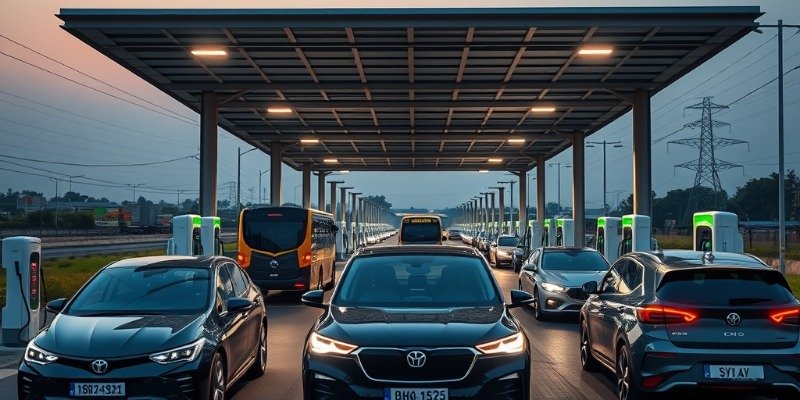
India's electric vehicle revolution is accelerating but the charging infrastructure needed to support it remains a critical bottleneck. Government data shows that as of March 2026 only 71 percent of FAME-II sanctioned public charging stations were actually operational. This means nearly one in three chargers exists only on paper while drivers face unreliable networks and persistent range anxiety. The gap between sanctioned and working chargers has become the most pressing challenge for EV adoption in the country.
The scale of the problem is clear from recent numbers. India had installed 29,151 public charging stations by December 2025 according to Ministry of Heavy Industries data. Of these 8,805 were fast chargers and 20,346 were slow chargers. Yet by March 2026 only 22,753 of 27,737 installed stations were operational delivering an 82 percent uptime rate. For commercial viability operators typically need 97 to 99 percent uptime. The PM E-DRIVE scheme launched in October 2024 aims to deploy 72,000 new chargers with ₹2,000 crore allocated but sanctioning chargers and making them work are two very different milestones.
Why Chargers Fail On The Ground
Three main factors drive charger downtime across India. Poor maintenance tops the list. On NH-44 in Haryana seven of 22 charging points sat defunct due to missing internet connectivity outdated connectors and lack of upkeep. In Chandigarh 23 stations remained broken for nearly a year because of an administrative dispute between the Municipal Corporation and UT Administration not technical faults. These examples show how non-technical issues can keep hardware offline for months.
Grid reliability is the second major challenge. India's power grid hit a record peak demand of about 256 GW in 2026 with evening shortages reaching roughly 5.4 GW. Solar power drops after sunset gas plants face fuel shortages and coal nuclear capacity goes offline for repairs. A charger on a strained feeder inherits that instability. Studies show a 31 percent chance of shortages in summer months making grid readiness a prerequisite for reliable charging.
The third issue is lack of standardized protocols. While Ministry of Power guidelines mandate OCPP and OCPI support for backend communication many charge point operators still run older setups or skip certificate checks. Without shared protocols operators cannot remotely diagnose faults before drivers encounter them. This fragmentation means a single network outage can disable multiple stations across different operators.
Ultra-Fast Charging Technology Landscape
The global trend is shifting decisively toward high power charging. EV rich countries are moving from slow chargers under 22 kW to fast 7 to 22 kW and rapid chargers above 50 kW. India's current fleet is dominated by two and three wheelers that need only 3 to 12 kW but four wheeler battery capacities are growing rapidly. Top selling models like Tata Nexon EV Hyundai Kona and MG ZS EV now pack 30 to 45 kWh batteries with 50 kW DC fast charging via CCS2. This demands infrastructure that can deliver 50 kW to 350 kW consistently.
Several ultra-fast technologies are emerging. Dual gun charging uses two connectors simultaneously to deliver up to 500 kW halving charge time for e-buses. Pantograph systems with overhead arms can deliver 600 kW enabling opportunity charging at bus stops in minutes. The Megawatt Charging System MCS pushes this further to 3.75 MW for heavy trucks. Split charging architecture separates power cabinets from dispensing guns allowing flexible power distribution across up to 12 vehicles from a single 480 kW cabinet. These technologies represent the 6000kW class infrastructure that could transform highway and depot charging.
Grid Integration And Smart Charging Requirements
Ultra-fast chargers cannot simply plug into existing low tension grids. A 350 kW charger needs a dedicated 11 kV high tension connection exclusive transformer and significant civil works. The DST roadmap highlights that high power charging requires 11 to 33 kV connections vacuum circuit breakers power transformers and extensive cable trenches. Grid impact studies show that uncontrolled fast charging can overload distribution transformers increase losses and degrade voltage profiles. Smart charging with dynamic load management OCPP 2.0.1 compliance and time of use tariffs becomes essential to balance demand.
Battery energy storage systems at charging stations can buffer peak loads. Pilot projects in Bengaluru and Kolkata demonstrate solar PV plus battery microgrids powering DC fast chargers with dynamic algorithms that follow solar generation. These systems reduce grid draw during peak hours and improve project economics. Vehicle to grid capability though still nascent in India could eventually let aggregated EV fleets provide ancillary services to the grid.
Policy And Implementation Gaps
State policies vary widely in effectiveness. Delhi has addressed land bottlenecks by offering concessional rates for charging stations and mapping high utilization sites. It introduced one of the lowest EV tariffs and established a State Charging Infrastructure Committee for fast decisions. Karnataka focused on intercity corridors installing chargers on Bangalore Mysore and Bangalore Chennai highways. Tamil Nadu created India's first state specific public charging guidelines with ITDP support. However most states lack digitized land allocation platforms streamlined single window approvals and predictable EV tariff structures.
The FAME II allocation itself was non optimal. Delhi with 3,000 four wheelers got only 72 stations while Chandigarh with 100 four wheelers received 70 stations. Subsidies favor high power chargers for four wheelers but 80 percent of EV sales are two and three wheelers needing only slow charging. Building bye laws mandating EV ready parking remain unimplemented in most states. Battery swapping lacks financial support under FAME II despite MoP guidelines. Interoperability standards for light EV connectors are still evolving with IS 17017 Part 2 Section 7 for combined AC DC charging only recently published.
The Path Forward
Closing the operational gap requires treating uptime as a managed metric not an afterthought. Remote monitoring with real time fault alerts predictive maintenance and automated diagnostics must become standard. The Unified Energy Interface UEI built on the BECKN protocol promises to solve network interoperability by letting any app discover and pay at any charger like UPI for payments. Pilot programs are underway to test this framework.
For ultra-fast chargers to be viable India needs coordinated action on three fronts. First grid upgrades at strategic highway and depot locations with dedicated high tension infrastructure. Second standardized multi connector hardware supporting CCS2 Type 2 Bharat DC-001 and GB/T from day one. Third financial models that account for demand charges land costs and utilization rates with viability gap funding for early corridor deployment. The PM E-DRIVE target of 22,100 four wheeler DC fast chargers 1,800 e-bus chargers and 48,400 two three wheeler chargers provides the policy framework but execution depends on state level coordination and private sector participation.
India's charging infrastructure moment is now. The technology exists the policy framework is in place and the market demand is proven. What remains is bridging the last mile between a sanctioned charger on a spreadsheet and a working charger that starts a session every time a driver plugs in.