
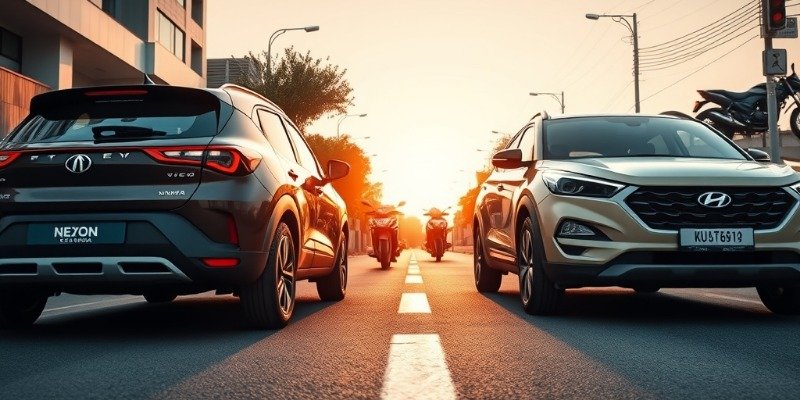
The total cost of ownership debate between electric and petrol vehicles has shifted in 2026. New durability data, updated fuel prices, and real-world maintenance records now give buyers a clearer picture than ever before. But the answer depends heavily on which vehicle segment you are looking at, how much you drive, and which assumptions you trust. This article breaks down the latest numbers for cars, scooters, and motorcycles so you can decide what fits your budget.
Cars: the compact SUV showdown
Two recent studies compared the Tata Nexon EV against the Hyundai Creta petrol and the Tata Nexon petrol, but they reached different conclusions because their assumptions differed.
EVSelect.in compared the Nexon EV Max with the Creta 1.5 petrol manual over five years at 12,000 kilometres per year. They used Delhi electricity at ₹8 per unit and Mumbai petrol at ₹104.15 per litre. The EV Max had an on-road price of about ₹22 lakh after the FAME III subsidy and RTO waiver, while the Creta came in at ₹20.2 lakh. Over five years, the EV spent ₹81,600 on electricity versus ₹4.46 lakh on petrol for the Creta. Maintenance was ₹34,000 for the EV against ₹81,100 for the petrol car. Insurance and resale value were also factored in. The net result: the EV came out roughly ₹3 lakh cheaper over five years, with a break-even point at 3.1 years.
Acko took a different approach. They compared the Nexon EV Prime (base variant) with the Nexon XE petrol and Nexon XM diesel, all at 10,000 kilometres per year. They assumed electricity at ₹7 per unit and petrol at ₹100 per litre. Crucially, they did not include resale value or government subsidies in the final total. Their five-year totals came to ₹18.7 lakh for the EV, ₹13.8 lakh for petrol, and ₹16 lakh for diesel. Acko notes that the EV ownership cost drops sharply if you keep the car beyond five years because efficiency stays near 90 percent while petrol and diesel engines lose efficiency and need more maintenance as they age.
The key differences are usage, subsidies, and resale. EVSelect assumed higher annual mileage, included the FAME subsidy and zero RTO, and counted resale value. Acko used lower mileage, excluded subsidies and resale, and compared base variants. If you drive more than 12,000 kilometres a year and live in a state with strong EV incentives, the car EV case gets stronger. If you drive less and plan to sell at five years, the gap narrows.
Scooters: the daily commuter calculus
The scooter segment shows the widest spread in running cost per kilometre, but battery replacement timing changes the five-year answer.
BikesKnowledge compared the TVS iQube ST (₹1.1 lakh ex-showroom) with the Honda Activa 6G (₹79,900 ex-showroom) at 10,000 kilometres per year. The electric scooter cost about ₹0.80 to ₹1.00 per kilometre for electricity, while the Activa cost ₹5.00 to ₹6.50 per kilometre for petrol. Annual fuel or electricity came to ₹2,000 for the EV versus ₹23,300 for petrol. Service was ₹1,800 versus ₹8,500. Even with a ₹30,100 higher purchase price, the iQube ST was ₹1.14 lakh cheaper over five years. Break-even arrived at 18 to 24 months.
AskFilo ran a similar comparison with the Ather 450X (₹1.5 lakh including subsidy) against the Activa 6G (₹75,000) at 10,000 kilometres per year. They added a ₹40,000 battery replacement at year four for the EV. With that cost included, the Ather reached ₹2.45 lakh total over five years (₹4.90 per kilometre) while the Activa hit ₹2.1 lakh (₹4.20 per kilometre). In this model, petrol won on cost per kilometre.
The difference comes down to battery warranty and replacement assumptions. BikesKnowledge did not factor in a battery swap within five years, while AskFilo assumed a graphene pack replacement at year four. Most current OEMs now offer three-year or 40,000–60,000 kilometre battery warranties, and some extend to eight years on premium models. If your electric scooter warranty covers the five-year window, the EV advantage holds. If you buy a model with a shorter warranty or plan to keep it beyond the warranty period, the replacement cost can flip the math.
Motorcycles: the performance premium
Ultraviolette compared its F77 SuperStreet (around ₹3.2 to ₹4.5 lakh on-road) with a generic sporty petrol bike (₹2 to ₹3 lakh) at 1,000 kilometres per month. They assumed electricity at ₹3 per unit, which is lower than typical residential rates but possible with off-peak or solar charging. The petrol bike at 40 kilometres per litre and ₹100 per litre cost ₹1.5 lakh in fuel over five years. The F77 needed about 186 charges at ₹30 each, totalling ₹5,580. Maintenance was ₹10,000 for the EV versus ₹60,000 for petrol. Insurance and tax added ₹10,000 for the EV and ₹30,000 for petrol. The five-year totals: ₹3.25 lakh for the F77 versus ₹4.9 lakh for the petrol bike.
Ultraviolette also highlights an eight-year or 8,00,000 kilometre battery warranty, which removes the replacement risk from the five-year window. The analysis assumes home charging and does not factor in public fast-charging costs, which would raise the EV running cost somewhat.
What the numbers agree on
Across all segments, electricity per kilometre is a fraction of petrol per kilometre. Maintenance is consistently lower for EVs because there are far fewer moving parts — no engine oil, spark plugs, timing belts, or fuel filters. Regenerative braking reduces brake wear. Insurance tends to be lower for EVs due to green vehicle discounts. Registration and road tax are often waived or reduced for EVs in many states.
The main variables that change the verdict are purchase price premium, annual mileage, electricity rate, battery warranty length, resale value, and whether government subsidies are applied. Higher mileage favours EVs. Lower electricity rates favour EVs. Longer battery warranties favour EVs. Strong state incentives favour EVs. Including resale value favours EVs in cars but is still evolving for two-wheelers.
How to decide for your situation
If you are a car buyer driving 12,000 kilometres or more per year in a metro city with home charging and good state incentives, the latest data supports the EV choice on a five-year horizon. If you drive under 8,000 kilometres, keep cars for only three to four years, or live where incentives are weak, the petrol case remains competitive.
For scooter commuters doing 20 to 80 kilometres daily with home charging, an electric scooter with a three-year-plus battery warranty will almost certainly beat petrol on five-year cost. If you ride over 100 kilometres daily, lack home charging, or need a scooter for seven to ten years, factor in a potential battery replacement and the petrol option may look better.
For motorcycle enthusiasts, the maths now favours electric if you can charge at home and the model offers a long battery warranty. The performance gap has also narrowed, with electric motorcycles offering instant torque and advanced electronics that petrol bikes in the same price bracket cannot match.
FAQs
Which electric car has the lowest five-year ownership cost in India right now?
The Tata Nexon EV Prime and EV Max consistently appear in studies as the most cost-effective electric cars over five years because of their relatively low purchase price, strong efficiency, and wide service network. The exact ranking depends on your state subsidies and annual mileage.
Do electric scooters really need a battery replacement within five years?
Most current electric scooters from major brands come with a battery warranty of three years or 40,000 to 60,000 kilometres. Some premium models now offer up to eight years. If your usage stays within the warranty window, you are unlikely to face a replacement cost in five years. Heavy daily users should check the warranty terms carefully.
How does resale value affect the five-year calculation for electric cars?
EVSelect.in estimated the Nexon EV Max would retain about ₹9.25 lakh after five years versus ₹9 lakh for the Creta petrol. Resale data for EVs is still maturing, but models with documented battery health above 85 percent are commanding a premium in the used market. Including resale value typically improves the EV case by ₹25,000 to ₹50,000 over five years.
Is home charging essential for the electric advantage to hold?
Yes. Public charging rates in India range from ₹10 to ₹25 per unit, which can double or triple the per-kilometre cost compared to home charging at ₹7 to ₹8 per unit. If you cannot install a home charger, the break-even period extends significantly, especially for cars.
Which segment shows the clearest electric advantage today?
Electric scooters show the most consistent advantage for urban commuters with home charging. The per-kilometre cost gap is the widest, maintenance savings are immediate, and break-even often occurs within 18 to 24 months. Electric motorcycles are close behind if you can charge at home and the model offers a long battery warranty. Electric cars require higher annual mileage and strong incentives to win on a strict five-year basis, but they pull ahead decisively over longer ownership periods.