
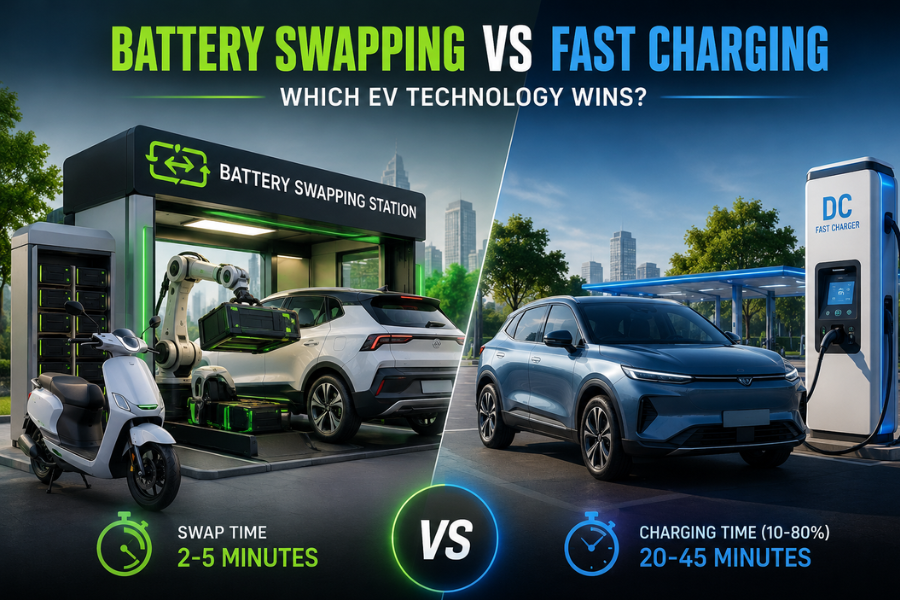
As electric vehicles become more popular across India, one question continues to generate interest among EV buyers: Is battery swapping better than fast charging?
Both technologies aim to solve one of the biggest concerns for EV owners—charging time. While fast charging allows drivers to recharge their battery quickly, battery swapping replaces a depleted battery with a fully charged one in just a few minutes.
What Is EV Battery Swapping?
Battery swapping is a process where an electric vehicle’s discharged battery is removed and replaced with a fully charged battery at a dedicated swapping station.
Instead of waiting for the battery to charge, drivers simply exchange batteries and continue their journey.
The process can typically take between 2 to 5 minutes, making it comparable to refueling a petrol vehicle.
How Does Battery Swapping Work?
The battery swapping process is simple:
- Drive to a battery swapping station.
- The discharged battery is removed.
- A fully charged battery is installed.
- The vehicle is ready to continue its journey.
Many battery-swapping systems are automated, reducing waiting times and improving convenience.
Battery Swapping vs Fast Charging
| Feature | Battery Swapping | Fast Charging |
|---|---|---|
| Time Required | 2-5 Minutes | 20-45 Minutes |
| Infrastructure Cost | High | Moderate |
| Convenience | Very High | High |
| Battery Ownership | Often Subscription-Based | Vehicle Owner Owns Battery |
| Suitable for Fleets | Excellent | Good |
| Suitable for Private Cars | Limited Currently | Excellent |
| Battery Standardization Needed | Yes | No |
| Availability in India | Growing | Widely Expanding |
Advantages of Battery Swapping
1. Extremely Fast Turnaround
The biggest advantage is speed.
A battery swap can be completed in just a few minutes, eliminating long charging waits.
2. Lower Vehicle Purchase Cost
Many battery-swapping business models separate the battery from the vehicle purchase.
This reduces the upfront cost of buying an electric vehicle.
3. Ideal for Commercial Fleets
Delivery companies, ride-sharing services, and fleet operators benefit greatly because vehicles spend less time idle.
4. Reduced Charging Queue Issues
Instead of occupying a charging station for 30 minutes or longer, vehicles can quickly swap batteries and leave.
Disadvantages of Battery Swapping
1. Battery Standardization Challenges
Different manufacturers use different battery designs.
Without industry-wide standards, large-scale battery swapping becomes difficult.
2. Expensive Infrastructure
Building and maintaining battery-swapping stations requires significant investment.
Operators must also maintain large inventories of batteries.
3. Battery Condition Concerns
Users may receive batteries with varying levels of wear and degradation.
Managing battery health becomes a critical challenge.
4. Limited Availability
Battery swapping stations are still relatively limited compared to charging infrastructure.
Advantages of Fast Charging
1. Growing Charging Network
India’s public charging infrastructure is expanding rapidly, making fast charging increasingly accessible.
2. No Battery Compatibility Issues
Each vehicle uses its own battery, eliminating standardization concerns.
3. Better for Private EV Owners
Most electric car owners prefer retaining ownership of their battery.
4. Easier Adoption Across Brands
Automakers can continue developing unique battery technologies without needing a universal battery format.
Disadvantages of Fast Charging
1. Charging Still Takes Time
Even the fastest chargers require more time than a battery swap.
2. Grid Dependency
Fast charging stations require strong power infrastructure and reliable electricity supply.
3. Potential Battery Stress
Frequent fast charging may accelerate battery degradation compared to slower charging methods.
Future of Battery Swapping in India
Battery swapping is expected to grow rapidly in the two-wheeler and commercial vehicle segments.
Government support, fleet electrification, and urban mobility solutions could drive wider adoption over the coming years.
However, for passenger electric cars, fast charging is likely to remain the dominant technology due to greater flexibility and easier scalability.
EVMovz Verdict
Battery swapping and fast charging are not direct competitors—they solve different problems.
Battery swapping is ideal for commercial fleets, delivery services, and electric two-wheelers where downtime must be minimized.
Fast charging remains the preferred solution for most private EV owners because it offers flexibility, compatibility, and a rapidly expanding charging network.
For India’s EV ecosystem, the future will likely include both technologies working together, each serving different types of vehicles and users.
EV Cost Calculator & Compare Tool
EV Running Cost Calculator
Estimate your EV's running costs.
Calculation Type
Estimated Cost
₹--
Estimated Cost Per Kilometer
₹--
Calculations are estimates based on provided values.