
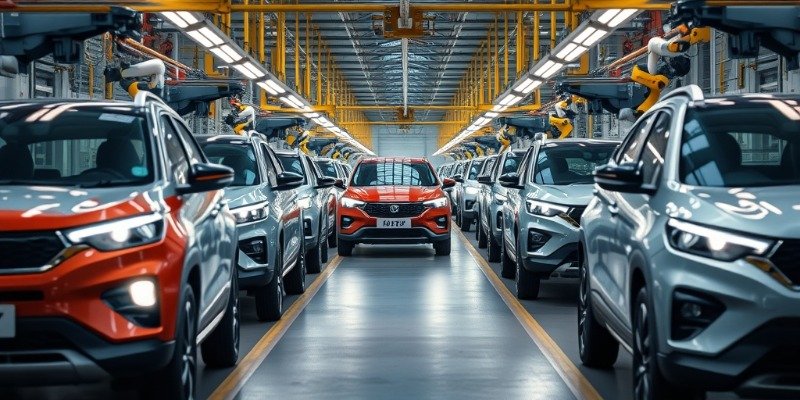
Tata Motors is witnessing an extraordinary surge in electric vehicle demand that has caught even the company by surprise. Bookings for its electric cars have grown nearly three times over the past six months, creating a significant gap between what customers want and what the company can build. This situation marks a dramatic shift from the early days of EV adoption in India, when the main challenge was convincing buyers to switch from petrol and diesel cars.
The numbers tell a clear story. In July 2026, Tata registered 13,578 electric passenger vehicles, marking its highest-ever monthly EV retail volume. This represented more than 100 percent year-on-year growth and gave Tata approximately 42 percent of India's electric passenger vehicle market. July was also the second consecutive month where Tata crossed the 12,000-unit EV retail mark. However, behind these impressive sales figures lies a growing problem: the company cannot produce cars fast enough to meet the flood of orders.
The Scale of the Demand Surge
According to Tata Passenger Electric Mobility Chief Commercial Officer Vivek Srivatsa, EV bookings have increased around three-fold in just six months. Shailesh Chandra, Managing Director of Tata Motors Passenger Vehicles and Tata Passenger Electric Mobility, confirmed that real demand measured through actual bookings has jumped three times compared to earlier periods. In May 2026, electric vehicles accounted for nearly 30 percent of Tata's total bookings, a remarkable figure for a segment that was niche just a few years ago.
This surge is not happening in isolation. India's overall electric passenger vehicle market expanded approximately 77 percent year-on-year during the first quarter of 2026, while the broader passenger vehicle market grew around 46 percent. July saw more than 32,000 electric passenger vehicles registered across India, making it the second consecutive month with EV retail volumes exceeding 30,000 units. Electric cars are steadily moving from a small alternative category to a meaningful part of the mainstream market.
Why Demand Is Accelerating So Quickly
Several factors are driving this rapid adoption simultaneously. First, Indian buyers now have electric options across substantially more segments and price points. Tata's current portfolio spans from the affordable Tiago.ev and Punch.ev to the Nexon.ev, Curvv.ev, Harrier.ev, and Sierra.ev, covering hatchbacks, compact SUVs, midsize SUVs, and premium SUVs. This breadth allows Tata to serve buyers looking for an economical urban runabout as well as families wanting a primary vehicle capable of highway trips.
Second, new-generation EVs offer real-world ranges suitable for intercity travel, not just city commuting. Models like the Harrier.ev and Sierra.ev come with larger battery packs that address range anxiety, a major barrier in earlier years. Third, India's charging network continues to expand while faster DC charging reduces the inconvenience of long-distance EV travel. Fourth, rising fuel prices make the operating cost advantage of electric vehicles increasingly attractive, especially for high-mileage users. The ongoing geopolitical tensions in West Asia and concerns around crude oil prices have accelerated this shift, with Tata noting that buyers are reassessing powertrain choices based on long-term running costs. Finally, longer battery warranties and greater familiarity with EV ownership are reducing concerns about long-term durability.
Production Capacity: The Critical Bottleneck
The core problem is that Tata's production capability is preventing the company from fully converting demand into retail sales. Currently, the company supplies about 9,000 to 10,000 EVs per month. Shailesh Chandra has stated that EVs make up around 15 percent of Tata's total sales, but this share is constrained more by supply than demand. He noted that if Tata could immediately match supply with demand, EV sales could theoretically double from current levels.
This is an unusual position for an automaker. Typically, manufacturers face the opposite challenge: manufacturing capacity exists but consumer demand is insufficient. Tata now finds itself in a phase where at least part of its EV business has strong demand but needs greater production throughput. The primary bottleneck lies on the supplier side, with some vendors requiring additional investments to increase output. While Tata's internal manufacturing capacity at its Sanand plant remains flexible enough to shift production between powertrains, supplier constraints limit how quickly overall output can rise.
Tata's Plan to Close the Gap
To address this, Tata Motors is working with suppliers to increase EV production capacity by around 50 percent over the next three to four months. The target is to raise monthly output from the current 10,000 units to nearly 15,000 units. This ramp-up comes amid the sharp increase in bookings over recent months, which the company attributes partly to rising fuel prices and growing consumer preference for lower running-cost mobility solutions.
The timing of this expansion is critical. Tata expects the September to December 2026 festive period to remain particularly strong, potentially delivering one of the largest quarters ever for the passenger vehicle industry. However, the company also plans a price increase from September 2026, and the post-festive period will reveal how sensitive EV consumers have become to higher acquisition prices. Purchase price parity with equivalent combustion-engine cars remains an important consideration for many mainstream buyers.
Risks of Prolonged Waiting Periods
If bookings continue to grow faster than production, customers could face longer waiting periods on popular EV variants. This creates a significant risk in an increasingly competitive market. Mahindra has expanded aggressively with new-generation electric SUVs. Maruti Suzuki is entering the EV market with considerably greater scale. MG continues expanding its electric portfolio, while Hyundai and Kia are introducing EVs across additional price segments. Premium manufacturers are also increasing their electric offerings.
A customer unwilling to wait several months for a Tata EV may simply migrate to a competing model. This means Tata's production bottleneck could become an opportunity for rivals. Conversely, if Tata manages to increase production sufficiently quickly, the additional capacity could translate almost directly into higher deliveries because a strong order pipeline already exists. That makes manufacturing capacity increasingly important to Tata's competitive position.
The Broader Market Context
India's EV market has entered a new phase of growth during 2026, helped by wider product choice, stronger consumer confidence in EV technology, and greater acceptance of electric cars beyond traditional urban commuters. The buyer profile is changing: earlier, electric cars were primarily purchased as economical second vehicles or for urban commuting. Now, the market increasingly includes buyers considering an EV as their primary family vehicle. Products such as the Harrier.ev and Sierra.ev allow Tata to participate in categories where higher range, performance, cabin space, and highway usability matter just as much as running costs.
Tata's product strategy is clearly helping. Few manufacturers currently cover as much of the Indian EV market as Tata, ranging from the Tiago.ev and Punch.ev to the Nexon.ev, Curvv.ev, Harrier.ev, and Sierra.ev. The company has been gaining EV market share over recent months and its lead over the second-largest EV manufacturer has widened. EVs currently account for about 20 percent of Tata's passenger vehicle revenue mix, and the company remains on track for EVs to account for over 30 percent of volumes within the next three to four years.
The three-fold increase in EV bookings may be more significant than the headline sales numbers themselves. For much of India's early electric car era, the central question was whether enough consumers were willing to buy EVs. That question is gradually changing. For Tata, the problem increasingly appears to be how quickly it can manufacture enough EVs to satisfy the demand already being generated. The next phase of India's electric car battle may therefore be determined not just by who can generate demand, but by who can actually build and deliver enough cars.
FAQs
How much have Tata Motors EV bookings increased recently?
Tata Motors EV bookings have grown nearly three times over the past six months, according to company officials. In May 2026, EVs accounted for almost 30 percent of Tata's total bookings.
What is Tata's current EV production capacity?
Tata Motors currently produces around 9,000 to 10,000 electric vehicles per month. The company plans to increase this by 50 percent to nearly 15,000 units monthly over the next three to four months.
Why is Tata unable to meet EV demand?
The main constraint is supplier-side capacity. While Tata's own manufacturing at the Sanand plant is flexible, some vendors need additional investment to raise their output, creating a bottleneck in the supply chain.
Which Tata EV models are driving the demand surge?
Demand is strong across Tata's portfolio, from the affordable Tiago.ev and Punch.ev to the Nexon.ev, Curvv.ev, Harrier.ev, and Sierra.ev. Entry-level models like the Punch.ev and Tiago.ev have seen particularly phenomenal growth.
How does this affect customers looking to buy a Tata EV?
Customers may face longer waiting periods for popular variants. With competitors like Mahindra, MG, Maruti Suzuki, Hyundai, and Kia expanding their EV offerings, some buyers might switch brands if wait times become too long.