
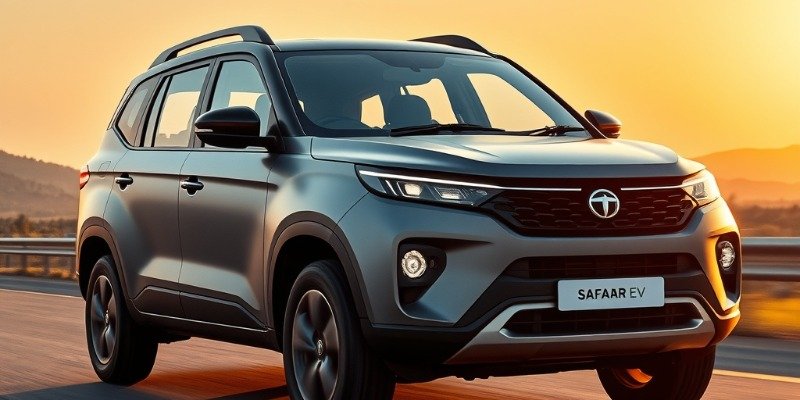
Tata Motors is preparing its most ambitious electric SUV yet. The Safari EV will be the brand's first three-row electric vehicle and its new flagship EV. Expected to launch in January 2027, it aims to fill a gap in the Indian market for a genuine family-sized electric SUV with long range, all-wheel drive, and a premium cabin. The vehicle is codenamed Tayrona and will sit on the Acti.ev+ platform that also underpins the Harrier EV.
Platform and Battery Options
The Safari EV uses Tata's Acti.ev+ architecture, which is an evolution of the platform seen on the Harrier EV. This platform supports multiple battery sizes and both single and dual-motor layouts. The SUV is expected to be offered with 65kWh and 75kWh LFP battery packs in regular variants, while the top-spec version could receive a larger 80kWh unit. The 65kWh rear-wheel-drive version is likely to deliver a claimed range of around 538km, while the 75kWh rear-wheel-drive and all-wheel-drive variants could offer 627km and 622km respectively under the MIDC cycle. With the 80kWh pack, the claimed range is expected to exceed 600km, making it suitable for inter-city travel without frequent charging stops.
Powertrain and Driving Modes
Buyers will be able to choose between rear-wheel-drive and all-wheel-drive configurations. The rear-wheel-drive version uses a single motor on the rear axle producing approximately 238PS and 315Nm. The all-wheel-drive version adds a front motor with 158PS, taking combined torque to around 504Nm. This dual-motor setup will make the Safari EV one of the most powerful electric SUVs in Tata's lineup. The vehicle will also support multiple terrain and drive modes, and it could feature a multi-link rear suspension with frequency-dependent dampers for improved ride comfort across varied road conditions.
Charging and Bidirectional Capabilities
The Safari EV will support DC fast charging at up to 120kW, allowing a significant top-up in a short time. A key highlight is the inclusion of Vehicle-to-Load (V2L) and Vehicle-to-Vehicle (V2V) bidirectional charging. This means the SUV can power external appliances or even charge another electric vehicle, a feature that adds practical value for outdoor activities and emergencies.
Triple-Screen Dashboard and Cabin Technology
Both the Safari EV and the updated ICE Safari will share a new triple-screen dashboard layout first seen on the Tata Sierra. The setup consists of a 10.25-inch digital instrument cluster for the driver, a 12.3-inch central infotainment touchscreen running the latest Arc.os software with wireless Apple CarPlay and Android Auto, and a 12.3-inch front passenger display for independent media and navigation access. The system also integrates dual-zone climate control and connected car features. The cabin will get a smart digital rear-view mirror with built-in dashcam functionality and a 540-degree surround-view camera system.
Seating Layouts and Interior Features
The Safari EV will be offered in both six-seat and seven-seat configurations. The six-seater gets captain seats in the second row with ventilation, while the seven-seater uses a bench layout. Other expected interior highlights include a panoramic sunroof, ventilated front seats, premium audio, powered tailgate, wireless smartphone charging, and multiple driving modes. The SUV will also come with six airbags as standard (seven on top trims), ABS with EBD, Electronic Stability Control, Hill Launch Assist, ISOFIX mounts, and Level 2 ADAS with Adaptive Cruise Control, Autonomous Emergency Braking, and Lane Keep Assist.
Design and Dimensions
Exterior changes over the ICE Safari include a closed-off grille, revised bumpers, aerodynamic alloy wheels, and EV-specific badging. Dimensionally, the EV is expected to mirror the current Safari at 4,668mm long, 1,922mm wide, and 1,795mm tall, preserving the three-row space that makes the Safari a family favourite.
Expected Price and Rivals
Tata is likely to position the Safari EV between Rs 22 lakh and Rs 32 lakh (ex-showroom). At this price, it will directly rival the Mahindra XEV 9S and the MG Hector Tomahawk EV. The Safari EV differentiates itself with three-row seating, the availability of an 80kWh battery, and an all-wheel-drive option — features that are not combined in its immediate competitors.
Launch Timeline
Production is expected to begin around August 2026, with market launch targeted for January 2027, likely around the Bharat Mobility Global Expo. The ICE Safari facelift with the same triple-screen dashboard is expected earlier, by the end of 2026.
Final Thoughts
The Tata Safari EV arrives at a time when Indian buyers are looking for electric vehicles that can replace a family diesel SUV without compromise. With a large battery option, all-wheel drive, three rows of seats, and a tech-heavy cabin, it ticks most boxes for a practical long-distance family EV. If the real-world range and pricing hold close to claims, the Safari EV could become the default choice for buyers who need space, safety, and zero emissions in one package.
FAQs
When is the Tata Safari EV expected to launch in India?
The Tata Safari EV is expected to launch in January 2027. Production may start around August 2026, with the market debut likely timed around the Bharat Mobility Global Expo.
What battery options will the Tata Safari EV offer?
The Safari EV is expected to come with 65kWh and 75kWh battery packs on regular variants, while the top-spec version could get a larger 80kWh unit. All use LFP chemistry.
Will the Tata Safari EV get all-wheel drive?
Yes. The Safari EV will be offered in both rear-wheel-drive and all-wheel-drive configurations. The AWD version uses a dual-motor setup with combined torque of around 504Nm.
How many seats will the Tata Safari EV have?
The SUV will be sold in both six-seat and seven-seat layouts. The six-seater gets second-row captain seats with ventilation, while the seven-seater uses a bench seat.
What is the expected price range of the Tata Safari EV?
The expected ex-showroom price range is between Rs 22 lakh and Rs 32 lakh, positioning it against the Mahindra XEV 9S and MG Hector Tomahawk EV.