
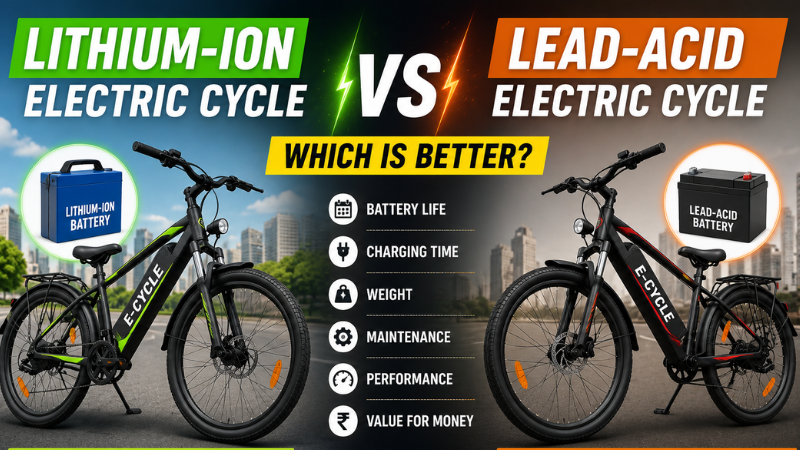
Choosing the right battery is one of the most important decisions when buying an electric cycle. While both lithium-ion and lead-acid batteries power electric bicycles, they differ significantly in terms of performance, lifespan, charging time, maintenance, and overall value.
Although lead-acid batteries are cheaper upfront, most modern electric cycles now use lithium-ion technology because it offers better efficiency and a superior riding experience. If you’re confused about which battery type is right for you, this detailed comparison will help you make an informed decision.
What Is a Lithium-Ion Battery?
A lithium-ion battery is a lightweight, rechargeable battery that stores more energy while occupying less space. It has become the preferred battery technology for modern electric cycles because of its high efficiency, longer lifespan, and faster charging.
Most premium and mid-range electric cycles available in India now come equipped with lithium-ion batteries.
What Is a Lead-Acid Battery?
Lead-acid batteries are one of the oldest rechargeable battery technologies. They are commonly found in older electric cycles and budget-friendly models due to their lower manufacturing cost.
However, they are much heavier, require more maintenance, and generally have a shorter lifespan than lithium-ion batteries.
Lithium-Ion vs Lead-Acid Electric Cycle: Comparison
| Feature | Lithium-Ion Battery | Lead-Acid Battery |
|---|---|---|
| Weight | Lightweight | Heavy |
| Battery Life | 3–5 Years | 1–2 Years |
| Charging Time | 3–5 Hours | 6–8 Hours |
| Riding Range | Longer | Shorter |
| Energy Efficiency | High | Moderate |
| Maintenance | Very Low | Higher |
| Battery Size | Compact | Bulky |
| Initial Cost | Higher | Lower |
| Running Cost | Lower | Higher |
| Overall Value | Excellent | Average |
From the comparison above, lithium-ion batteries outperform lead-acid batteries in nearly every category except initial purchase price.
Weight Comparison
One of the biggest differences between the two battery types is weight.
Lithium-ion batteries are much lighter, making the electric cycle easier to ride, carry, and maneuver. The reduced weight also improves acceleration, handling, and overall comfort.
Lead-acid batteries are considerably heavier, which makes the cycle feel less responsive and more difficult to pedal when the battery is low.
Winner: Lithium-Ion
Battery Life
Battery lifespan directly affects long-term ownership costs.
A lithium-ion battery typically lasts 3 to 5 years or around 800–1,000 charging cycles when properly maintained.
Lead-acid batteries generally last only 1 to 2 years and usually require replacement much sooner.
Although lithium-ion batteries cost more initially, they often prove more economical over time.
Winner: Lithium-Ion
Charging Time
Charging speed is another major advantage of lithium-ion technology.
Most lithium-ion batteries charge fully within 3–5 hours, making them ideal for daily commuters.
Lead-acid batteries usually require 6–8 hours or even longer to reach a full charge.
If you rely on your electric cycle every day, faster charging can be a significant convenience.
Winner: Lithium-Ion
Maintenance
One of the biggest reasons people choose lithium-ion batteries is their low maintenance.
Lithium-ion batteries require very little attention beyond regular charging and proper storage.
Lead-acid batteries may require additional care and are generally more susceptible to performance loss if not maintained correctly.
For riders looking for a hassle-free ownership experience, lithium-ion is the better option.
Winner: Lithium-Ion
Running Cost
Both battery types are inexpensive to charge compared to petrol vehicles.
However, lithium-ion batteries consume electricity more efficiently and last significantly longer, reducing replacement costs over time.
Although the initial investment is higher, the total cost of ownership is usually lower.
Winner: Lithium-Ion
Performance in Daily Commuting
If you ride your electric cycle every day, lithium-ion batteries offer several practical advantages.
They provide:
- Better acceleration
- Smoother power delivery
- More consistent performance
- Reduced overall weight
- Longer daily range
Lead-acid batteries are better suited for occasional use where minimizing the purchase price is the main priority.
Environmental Impact
Lithium-ion batteries are generally more energy-efficient and have a longer service life, which means fewer battery replacements over time.
While both battery types require responsible recycling at the end of their life, the longer lifespan of lithium-ion batteries can reduce waste generated from frequent replacements.
When Should You Choose a Lithium-Ion Electric Cycle?
A lithium-ion electric cycle is the best choice if you:
- Ride every day
- Want longer battery life
- Need faster charging
- Prefer lightweight bicycles
- Travel longer distances
- Want lower long-term maintenance costs
Although the purchase price is higher, the overall value is significantly better.
When Should You Choose a Lead-Acid Electric Cycle?
A lead-acid electric cycle may still be suitable if you:
- Have a limited budget
- Ride only occasionally
- Need a basic electric cycle for short distances
- Don’t mind extra battery weight
However, keep in mind that maintenance and replacement costs may be higher over the long run.
When comparing Lithium-Ion Electric Cycle vs Lead-Acid, the winner is clear for most riders. Lithium-ion batteries deliver better performance, longer battery life, faster charging, lighter weight, and lower maintenance, making them the preferred choice for modern electric cycles.
While lead-acid batteries may appeal to buyers with a tight budget, their shorter lifespan, heavier weight, and lower efficiency often result in higher ownership costs over time.
If you’re planning to use your electric cycle regularly for commuting, fitness, or everyday travel, investing in a lithium-ion electric cycle is the smarter long-term decision. It offers a smoother riding experience, greater convenience, and better value, making it well worth the additional upfront cost.
EV Cost Calculator & Compare Tool
EV Running Cost Calculator
Estimate your EV's running costs.
Calculation Type
Estimated Cost
₹--
Estimated Cost Per Kilometer
₹--
Calculations are estimates based on provided values.