
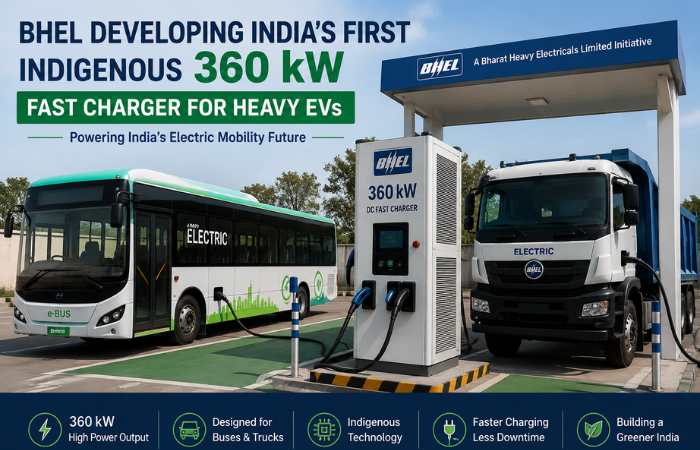
India’s electric vehicle (EV) industry is taking another significant step forward. Bharat Heavy Electricals Limited (BHEL), one of India’s leading engineering companies, is developing the country’s first indigenous 360 kW DC fast charger designed specifically for heavy-duty electric vehicles such as electric buses and electric trucks.
As commercial EV adoption grows across India, charging infrastructure has become one of the biggest challenges. While most existing fast chargers are suitable for electric cars and two-wheelers, heavy commercial vehicles require much higher charging power to minimize downtime.
The new 360 kW charger aims to address this need by enabling significantly faster charging for large battery packs used in buses and trucks.
Why Does India Need a 360 kW EV Charger?
Electric buses and heavy trucks carry much larger batteries than passenger cars.
A typical electric car may have a battery between 30 kWh and 80 kWh, whereas electric buses and trucks often use battery packs ranging from 200 kWh to over 500 kWh.
Charging these large batteries using conventional chargers can take several hours. A 360 kW DC fast charger can dramatically reduce charging time, making commercial EV operations more practical.
What Makes This Charger Special?
According to available information, BHEL’s project focuses on developing an indigenous high-power charging solution.
That means key technologies and manufacturing are expected to be developed within India, supporting the government’s “Make in India” initiative and reducing dependence on imported charging equipment.
Developing domestic charging technology can also help:
- Lower equipment costs over time
- Improve service and maintenance
- Strengthen India’s EV supply chain
- Encourage local manufacturing
- Create new engineering and manufacturing jobs
Benefits for India’s Commercial EV Sector
Faster Fleet Operations
Commercial vehicles earn revenue only when they are moving. Reducing charging time allows buses and trucks to spend more time transporting passengers or goods.
Lower Operating Costs
Shorter charging sessions improve fleet utilization and can reduce operational downtime.
Better Public Transport
State transport corporations deploying electric buses could schedule more trips each day if charging becomes quicker and more efficient.
Support for Long-Distance Logistics
High-power charging infrastructure can make electric trucks more practical for intercity freight movement.
Encouraging EV Adoption
Reliable fast charging is one of the biggest factors influencing fleet operators when deciding whether to switch from diesel to electric vehicles.
Frequently Asked Questions (FAQs)
What is the BHEL 360 kW EV charger?
It is an indigenous high-power DC fast charger being developed by BHEL for heavy-duty electric vehicles such as buses and trucks.
Which vehicles will use this charger?
The charger is intended primarily for electric buses, electric trucks, and other heavy commercial EVs that support high-power DC charging.
Is the charger available today?
No. The charger is currently under development, and commercial deployment details have not yet been officially announced.
Why is a 360 kW charger important?
It can significantly reduce charging time for large commercial EV batteries, helping fleets improve operational efficiency.
Will this support India’s EV growth?
Yes. High-power charging infrastructure is considered a key requirement for expanding electric public transport and commercial freight across the country.
EV Cost Calculator & Compare Tool
EV Running Cost Calculator
Estimate your EV's running costs.
Calculation Type
Estimated Cost
₹--
Estimated Cost Per Kilometer
₹--
Calculations are estimates based on provided values.