
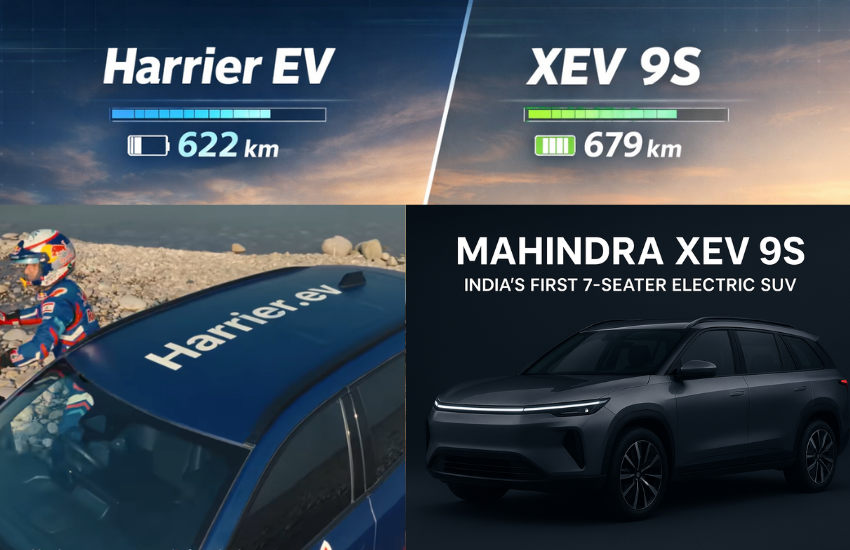
India’s premium electric SUV space is heating up, and two top-spec models stand out clearly — Tata Harrier EV Empowered AWD ST 75 ACFC and Mahindra XEV 9S Pack Three Above 79 kWh. Both sit at the top of their respective line-ups and target buyers looking for performance, range, technology, and premium features.
Price & Positioning
Tata Harrier EV Empowered AWD: ₹30.23 lakh
Mahindra XEV 9S Pack Three (79 kWh): ₹29.45 lakh
The XEV 9S undercuts the Harrier EV slightly on price, while offering a larger battery and longer claimed range. The Harrier EV, however, positions itself as a more performance-focused AWD electric SUV.
Battery, Range & Performance
Battery & Range
Harrier EV: 75 kWh battery with 622 km range
XEV 9S: 79 kWh battery with 679 km range
Mahindra XEV 9S clearly leads in range, making it more suitable for long highway drives and fewer charging stops.
Power & Torque
Harrier EV:
Max Power: 390 kW
Torque: 504 Nm
Dual-motor AWD setup
XEV 9S:
Max Power: 282 kW
Torque: 380 Nm
Single-motor RWD setup
With significantly higher power and torque, the Harrier EV delivers stronger acceleration and better traction, especially in challenging road conditions.
Acceleration & Speed
Harrier EV: 0–60 km/h in 6.3 seconds, top speed 180 km/h
XEV 9S: Acceleration and top speed not specified
Verdict (Performance): Tata Harrier EV clearly dominates with AWD and higher output.
Drivetrain & Driving Experience
Harrier EV: AWD with 2 motors
XEV 9S: RWD with 1 motor
The AWD setup on the Harrier EV adds confidence on highways, bad roads, and light off-road conditions, while the XEV 9S focuses more on efficiency and rear-wheel dynamics.
Charging & Battery Tech
Harrier EV Charger Output:
120 kW DC
7.2 kW AC
XEV 9S Charging Time (0–100%):
8 hrs (11.2 kW)
11.7 hrs (7.2 kW)
Both support fast charging, regenerative braking, and CCS-II charging infrastructure, making them practical for daily and long-distance use.
Dimensions, Space & Practicality
| Aspect | Harrier EV | XEV 9S |
|---|---|---|
| Length | 4607 mm | 4737 mm |
| Wheelbase | 2741 mm | 2762 mm |
| Ground Clearance | 205 mm | 201 mm |
| Boot Space | 502 L | — |
| Seating Capacity | 5 | 7 |
The XEV 9S offers 7-seat practicality, while the Harrier EV focuses on a spacious 5-seat layout with a larger boot.