
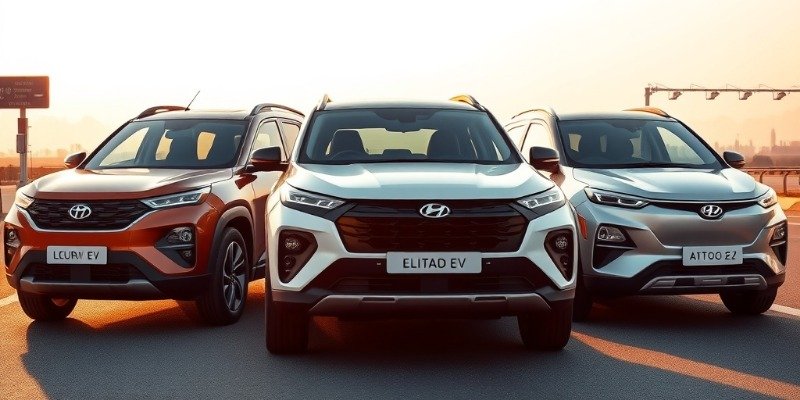
The electric SUV segment in India is heating up around the Rs 20 lakh price point. Three distinct contenders are vying for the attention of mainstream buyers: the Tata Curvv EV, the Hyundai Creta Electric, and the upcoming BYD Atto 2. Each brings a different philosophy to the table. The Curvv EV leads with bold coupe-SUV styling and a five-star safety rating. The Creta Electric leverages Hyundai's proven EV technology from the Ioniq 5 and a familiar practical package. The BYD Atto 2, expected to arrive in 2027, promises Blade Battery technology and aggressive pricing. This comparison breaks down how they stack up on design, interior space, performance, range, charging, features, safety, and value.
Design and Styling
The Tata Curvv EV is the most distinctive of the three. Its coupe-SUV roofline, flush door handles, and sharp character lines give it a futuristic stance. The design feels fresh, though some critics note Tata has used similar cues across its lineup. It rides on larger 18-inch aero alloy wheels and offers five dual-tone colour options.
The Hyundai Creta Electric plays it safe. It borrows heavily from the ICE Creta, with EV-specific touches like a pixelated grille graphic, aero wheels, and a closed-off front fascia. It looks familiar, which may appeal to traditional SUV buyers. Hyundai offers over ten colour choices, giving it an edge in personalisation.
The BYD Atto 2, based on global specifications, follows BYD's "Dragon Face" design language with a sleek front end, connected LED light bar, and clean surfacing. It sits on a similar footprint — 4,310 mm long, 1,830 mm wide, and 1,675 mm tall — making it dimensionally close to the Curvv EV (4,310 x 1,810 x 1,637 mm) and Creta Electric (4,340 x 1,790 x 1,655 mm). Ground clearance stands at 200 mm for the Atto 2, 186 mm for the Curvv EV, and 175 mm for the Creta Electric.
Cabin Space, Practicality, and Features
Inside, the differences sharpen. The Curvv EV's cabin feels modern with a 12.3-inch touchscreen, 10.25-inch digital cluster, and a minimalist dashboard. However, it carries over switchgear and the centre console from the Nexon EV, which feels less premium for the price. Front seat support is average due to short backrests, and there are no front cup holders. The coupe roofline cuts into rear headroom, and the raised floor (battery underneath) forces a knees-up posture. Boot space is 500 litres plus an 11.6-litre frunk.
The Creta Electric feels more spacious, thanks to its longer 2,610 mm wheelbase (vs 2,560 mm on the Curvv EV) and a floating centre console that frees up legroom. Rear passengers get adjustable recline, seatback tables, a centre armrest with cup holders, sunshades, and a three-pin power outlet. Dual-zone climate control, ventilated front seats, a powered co-driver seat with boss mode, and a welcome function add polish. The 10.25-inch screens are shared with the ICE Creta, but wireless Android Auto and Apple CarPlay are missing. Boot space is 433 litres plus a 22-litre frunk.
The BYD Atto 2's India-spec interior details are not fully confirmed. Global versions feature a rotating 12.8-inch touchscreen, a minimalist dashboard, and a column-mounted gear selector. The Nepal-spec model lists a 380-litre boot, six airbags, and a 51.13 kWh battery. Expect a feature-loaded cabin with BYD's signature attention to equipment levels.
On features, the Curvv EV leads with a larger 12.3-inch touchscreen, Arcade.ev app suite, wireless phone integration, gesture-controlled power tailgate, vehicle-to-vehicle (V2V) charging, and 70 kW DC fast charging support. The Creta Electric counters with dual-zone climate, rear seatback tables, powered co-driver seat, memory function, and a three-pin outlet. Both get Level 2 ADAS, six airbags, 360-degree camera, panoramic sunroof, ventilated front seats, and V2L functionality.
Performance, Driving Dynamics, and Range
The Curvv EV's 55 kWh battery (top variant) produces 165 bhp and 215 Nm. It hits 0-100 km/h in 8.6 seconds with a 160 km/h top speed. The ride is well-sorted for Indian roads — supple yet controlled. Steering is light, visibility is good despite the sloping roofline, and the car feels "India-ready." Regenerative braking has four levels, but the highest setting can feel jerky on lift-off. Crucially, it lacks a true one-pedal driving mode.
The Creta Electric's long-range 51.4 kWh variant makes 171 bhp and 255 Nm, with a claimed 0-100 km/h time of 7.9 seconds. The smaller 42 kWh version produces 135 bhp. Its one-pedal driving mode (activated via paddle shifters) is a highlight — smooth, intuitive, and borrowed from the Ioniq 5. Power delivery is linear and refined, suspension is slightly stiffer, and the steering is neutral. It feels more polished in urban conditions.
The BYD Atto 2 (Nepal spec) uses a 51.13 kWh Blade Battery with a 100 kW (134 bhp) motor and 290 Nm of torque. It is front-wheel drive like the other two. The Blade Battery's thermal stability and longevity are BYD's key selling points. Performance figures for the India-spec model are awaited.
Real-world range testing by carandbike showed both the Curvv EV (55 kWh) and Creta Electric (51.4 kWh) delivering approximately 400 km on a mixed route. The Curvv EV claims 502 km (MIDC), while the Creta Electric claims 473 km (ARAI) for the long-range variant. The Atto 2's Nepal listing shows 345 km, but India-specific ARAI/MIDC figures will likely differ.
Charging Speed and Ecosystem
The Curvv EV supports 70 kW DC fast charging (10-80% in 40 minutes) and 7.2 kW AC charging (10-100% in 7.9 hours). It also offers V2V and V2L.
The Creta Electric maxes out at 50 kW DC (10-80% in 58 minutes) but supports 11 kW AC charging (10-100% in 4.5 hours), which is faster on a wall box. It also gets V2L.
The Atto 2's India charging specs are unconfirmed. Globally, BYD's 400V architecture supports up to 88 kW DC on the Atto 3; the Atto 2 may offer similar or slightly lower peak rates. The Blade Battery's chemistry allows frequent fast charging with less degradation.
Safety
The Curvv EV holds a five-star Bharat NCAP rating (adult and child occupant protection), making it the only one of the three with a confirmed Indian crash-test score. The Creta Electric has not been tested yet; the ICE Creta scored three stars in Global NCAP. The Atto 2 has no India-specific rating yet, though BYD's global models generally perform well in Euro NCAP and ANCAP.
All three offer six airbags, ESC, hill hold, hill descent, TPMS, and Level 2 ADAS suites (AEB, lane keep, adaptive cruise, blind spot monitoring, rear cross-traffic alert).
Price and Value Proposition
The Tata Curvv EV is priced between Rs 17.19 lakh and Rs 19.69 lakh (ex-showroom) for the 55 kWh variants. The on-road price in Delhi for the Empowered X 55 Dark variant is approximately Rs 20.74 lakh.
The Hyundai Creta Electric ranges from Rs 18.02 lakh to Rs 25.22 lakh (ex-showroom). The long-range 51.4 kWh variant tested in comparisons sits roughly Rs 2 lakh above the equivalent Curvv EV.
The BYD Atto 2 is expected to launch in 2027 with an estimated ex-showroom price around Rs 17 lakh, per CarDekho. If it arrives at that price with a 51 kWh Blade Battery and a well-equipped cabin, it could disrupt the value equation significantly.
Hyundai's wider service network, lower maintenance costs, and stronger resale value give the Creta Electric a long-term ownership edge. Tata's value-for-money proposition is strong upfront, but service experience inconsistency remains a concern for some buyers. BYD's India network is still expanding, and parts availability for the Atto 3 has been a pain point — a risk factor for the Atto 2.
The Verdict
As of 2025, the Tata Curvv EV and Hyundai Creta Electric are the only two real choices for buyers ready to purchase. The Curvv EV wins on style, safety rating, charging speed, tech features, and upfront value. The Creta Electric wins on rear-seat comfort, cabin polish, driving refinement, one-pedal driving, dual-zone climate, and long-term ownership peace of mind. Both deliver around 400 km real-world range.
The BYD Atto 2 is a genuine wildcard — but it is two years away. If BYD prices it aggressively, delivers the Blade Battery's durability promise, and scales its service network, it could reset expectations for the segment. For now, buyers must decide between the Curvv EV's emotional, feature-packed boldness and the Creta Electric's rational, polished familiarity. The Atto 2 is one to watch for 2027.
FAQs
What is the expected launch timeline for the BYD Atto 2 in India?
The BYD Atto 2 is expected to launch in India in 2027, according to multiple industry sources. It is not currently available for sale or booking.
Which electric SUV offers the best real-world range among the three?
Both the Tata Curvv EV (55 kWh) and Hyundai Creta Electric (51.4 kWh) delivered approximately 400 km in identical real-world testing. The BYD Atto 2's India-spec range is not yet verified; its Nepal variant lists 345 km.
Does the Tata Curvv EV have a five-star safety rating?
Yes, the Tata Curvv EV has received a five-star rating for both adult and child occupant protection under Bharat NCAP. The Hyundai Creta Electric has not been tested yet, and the BYD Atto 2 has no India-specific crash-test rating.
Which car has the fastest DC charging capability?
The Tata Curvv EV supports 70 kW DC fast charging (10-80% in 40 minutes). The Hyundai Creta Electric maxes out at 50 kW DC (10-80% in 58 minutes). The BYD Atto 2's India charging specifications are not yet confirmed.
Is the Hyundai Creta Electric more expensive than the Tata Curvv EV?
Yes, the comparable long-range variant of the Hyundai Creta Electric is approximately Rs 2 lakh more expensive than the Tata Curvv EV's 55 kWh top variant. The Creta Electric's price range extends higher due to multiple trim levels.