
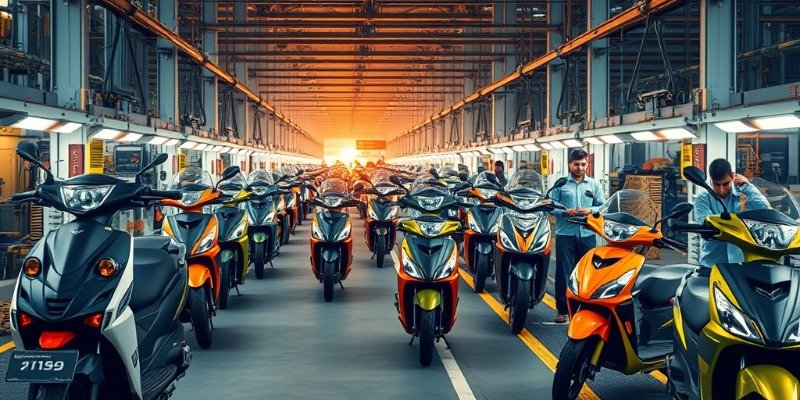
India's electric two-wheeler market is facing a severe supply crunch as customer demand races ahead of factory output. In July 2026, electric scooter penetration hit a record 11.2 percent of total two-wheeler sales, up from 7.7 percent a year earlier. This surge has left major manufacturers struggling to keep up, with unfulfilled orders running at 20 to 30 percent and average waiting periods stretching beyond four weeks. The Federation of Automobile Dealers Associations expects this bottleneck to persist through the first half of 2027.
Record Sales Drive Expansion Plans
The numbers tell a clear story. Electric two-wheeler retail sales reached 1.28 million units in calendar year 2025, growing 11.36 percent year-on-year. By FY2026, the industry crossed 1.4 million units. March 2026 saw a peak of nearly 191,000 units sold in a single month, capturing 9.8 percent market share. Even as penetration moderated to 7.8 percent in April 2026, volumes grew 61 percent year-on-year to approximately 148,000 units.
Rising fuel prices linked to geopolitical tensions, including the Iran conflict, have accelerated the shift toward electric mobility. The government's PM E-DRIVE subsidy scheme, extended through July 2026, continues to lower acquisition costs for buyers.
TVS Motor Leads the Capacity Race
TVS Motor Company, the current market leader, is operating at 60,000 to 65,000 units per month and has drawn up plans to reach 80,000 units monthly by March 2027. The company's iQube electric scooter registered nearly 370,000 units in FY2026, a 33 percent year-on-year increase. In the second quarter alone, TVS more than doubled its EV sales to 186,186 units from 80,009 units a year earlier, outpacing the industry's 84 percent growth rate.
CEO KN Radhakrishnan noted that electric vehicles now account for 11-12 percent of the overall two-wheeler market, while their penetration in the scooter segment has exceeded 20 percent. He expects TVS to continue growing "much ahead of the market" in coming quarters.
Bajaj Auto and Ather Energy Scale Up
Bajaj Auto is matching TVS's ambition, working to raise Chetak electric scooter production capacity to 80,000 units per month. The Chetak has gained strong traction across urban and semi-urban markets, driving Bajaj's retail sales to 269,847 units in 2025, up 39.34 percent year-on-year.
Ather Energy is taking a two-pronged approach. The company is expanding its existing facility to over 41,000 units monthly while simultaneously developing a new Factory 3.0 with an annual capacity of 10 lakh units, scheduled to come online from Q3 FY27. Ather's retail sales jumped 58.91 percent to 200,797 units in 2025, powered by the family-oriented Rizta scooter alongside the 450X and 450S models. The company nearly doubled its experience centres from 351 to 700 in one year, expanding into new markets like Gujarat, Odisha, Rajasthan, and Himachal Pradesh.
Hero MotoCorp's Rapid Catch-Up
Among legacy manufacturers, Hero MotoCorp posted the fastest growth rate in 2025. Its Vida electric scooter lineup, including the VX2 models with a Battery-as-a-Service option, drove retail sales up 149.74 percent to 109,168 units. For FY26, Hero's EV brand grew 196 percent to nearly 1.44 lakh units. The company's vast distribution network across rural and urban India provides a strong platform for further scaling.
Ola Electric's Turbulent Year
The landscape has shifted dramatically for Ola Electric. After holding 48.6 percent market share in Q1 FY25, the company saw volumes collapse to just 3,968 units by February 2026, with market share dropping to 4.6 percent. Full-year 2025 retail sales fell 51.11 percent to 199,318 units. Service delays stretching to nine days eroded customer trust, pushing buyers toward more established brands.
Ola has since undertaken a serious reset. Operating expenses were cut, average repair time reduced from nine days to one day, and the Gen 3 platform received PLI certification, potentially saving ₹40,000-45,000 per vehicle. The company is also developing in-house LFP battery cells to reduce import dependence. Recovery is visible – May 2026 sales reached 15,139 units, nearly 4x the February low. Operating cash flow turned positive in Q4 FY26 for the first time.
The Profitability Divide
A clear divide exists between legacy manufacturers and pure-play EV startups. TVS and Bajaj fund their EV expansion from profitable internal combustion engine businesses. TVS reported a 13.1 percent operating EBITDA margin and record quarterly revenue of ₹12,808 crore in Q4 FY26. Their EV businesses don't face the same cash burn pressure.
Pure-play companies operate differently. Ather Energy narrowed its loss from ₹812 crore in FY25 to ₹517 crore in FY26, with Q4 EBITDA margin improving to -2.5 percent, nearing operating breakeven. Production cost per scooter fell 9 percent year-on-year. Ola Electric's full-year FY26 operating EBITDA margin stood at approximately -53.4 percent, though the company estimates breakeven at 20,000-25,000 units monthly.
Interestingly, Ola's gross margin of 38.5 percent exceeds Ather's 25 percent, indicating stronger product economics. The challenge remains operating leverage – fixed costs crush margins at low volumes but improve sharply as utilization rises.
Risks on the Horizon
Industry analysts flag two key risks. First, commodity price volatility for lithium, copper, aluminium, and rare earth metals could squeeze margins across the board. Second, simultaneous capacity expansion by all major players – TVS, Bajaj, Hero, Ather, and Ola – could trigger price wars if supply outpaces demand, compressing margins industry-wide.
Ather's upcoming EL platform, targeting the ₹1-1.25 lakh mass-market segment with the EL01 scooter, represents a critical inflection point. Success here could unlock significant volume growth for the premium-focused brand.
What This Means for Buyers
For consumers, the capacity crunch translates to waiting periods of four weeks or more for popular models. The festive season is likely to worsen delays. However, the aggressive expansion plans signal that relief is coming. By March 2027, combined monthly capacity across top manufacturers is expected to exceed 150,000 units, nearly double current levels.
Buyers should also note that electric scooter penetration in the scooter segment has crossed 20 percent, indicating mainstream acceptance. With improving charging infrastructure, better product offerings, and continued policy support, the transition to electric mobility is accelerating across urban and semi-urban markets.
FAQs
Why are electric two-wheeler waiting periods so long right now
Demand has surged past 11 percent penetration in July 2026, while factory capacity has not caught up. Unfulfilled orders stand at 20-30 percent across major brands, with average waits exceeding four weeks. FADA expects this to continue through the first half of 2027.
Which company has the highest electric scooter production capacity today
TVS Motor currently operates at 60,000-65,000 units per month, the highest among Indian EV two-wheeler makers. The company plans to reach 80,000 units monthly by March 2027. Bajaj Auto is targeting the same 80,000-unit capacity for its Chetak lineup.
Is Ola Electric recovering from its sales collapse
Yes, Ola has shown meaningful recovery. After falling to 3,968 units in February 2026, sales rebounded to 15,139 units in May 2026. The company cut repair times from nine days to one day, reduced operating costs, and achieved positive operating cash flow in Q4 FY26. However, monthly volumes remain well below the 20,000-25,000 units needed for EBITDA breakeven.
How does Hero MotoCorp's EV growth compare to rivals
Hero posted the fastest year-on-year growth among established OEMs in 2025 at 149.74 percent, reaching 109,168 retail units. For FY26, the Vida brand grew 196 percent to nearly 1.44 lakh units. The Battery-as-a-Service option on VX2 models helps lower upfront costs for buyers.
What government policies support electric two-wheeler adoption
The PM E-DRIVE subsidy scheme has been extended through July 2026, providing purchase incentives. Rising fuel prices, expanding charging infrastructure, and state-level EV policies further support adoption. Electric scooter penetration in the scooter segment has now exceeded 20 percent.