
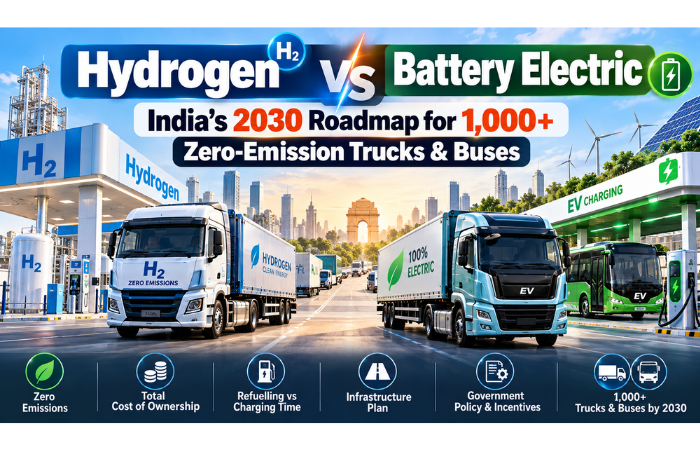
India is moving fast on zero-emission freight. The government has set a target to deploy at least 1,000 hydrogen-powered trucks and buses by 2030. At the same time, battery-electric trucks are already hitting the roads in growing numbers. A major OECD and International Transport Forum study from 2024, along with recent RMI analysis, shows that both technologies will play a role but their economics and timelines differ sharply.
The 1,000 Hydrogen Vehicle Target
The National Green Hydrogen Mission, approved in January 2023 with an outlay of INR 17,490 crore, backs this push. In March 2025, the Ministry of New and Renewable Energy approved INR 208 crore for five pilot projects covering 37 hydrogen buses and trucks. These pilots will run over 18 to 24 months. Early movers include Tata Motors and Adani Enterprises, which began trials of hydrogen fuel cell and hydrogen internal combustion engine trucks on key freight routes around Mumbai, Pune, and Delhi in early 2025. Road Transport Minister Nitin Gadkari has also launched India's first hydrogen highways initiative with a ₹500 crore allocation for 10 freight routes and nine refuelling stations.
Battery Electric Takes the Early Lead
The OECD/ITF report finds that battery-electric trucks (BETs) are projected to reach total cost of ownership (TCO) parity with diesel trucks much sooner than hydrogen fuel cell trucks (FCETs) or hydrogen ICE trucks. Globally, BETs have emerged as the dominant zero-emission technology due to faster battery cost declines and higher technology maturity. In India, RMI estimates at least 500 BETs were deployed or in the pipeline by end of 2025, supported by the PM E-Drive scheme and expanding model availability from major OEMs like Tata Motors, Ashok Leyland, and Volvo-Eicher.
TCO Comparison: 18T and 55T Segments Show Promise
The OECD/ITF study analysed four Indian truck segments using a WRI India–UC Davis tool. For model year 2030, the 55-tonne tractor-trailer BET becomes 9 percent cheaper than its diesel counterpart on a lifetime TCO basis. The 18-tonne rigid truck BET remains 18 percent costlier than diesel, signalling a need for policy support. The 12-tonne and 28-tonne segments show wider gaps at 56 percent and 46 percent higher TCO respectively. Distance travelled per trip is the most sensitive parameter — higher daily utilisation narrows the TCO gap significantly.
Hydrogen's Cost Challenge
RMI's seven-year TCO analysis across 2025, 2030, and 2040 shows FCETs may become cheaper than diesel in long-haul heavy-duty applications by 2040, but are unlikely to match BETs without a sharp drop in hydrogen fuel cost. The delivered hydrogen price at refuelling stations is driven by three factors: production cost (about 40 percent), refuelling station hardware and operations (which can double the production cost), and the 18 percent GST on hydrogen. For FCETs to reach parity with BETs by 2030, hydrogen prices need to fall to INR 300–400 per kg, roughly half the current projected level. Recent SECI green ammonia tenders in 2025 suggest such declines are possible with scale and policy support.
Operational Trade-offs
Hydrogen trucks offer faster refuelling — 10 to 15 minutes versus hours for charging — and avoid the payload penalty of large battery packs. This makes them viable for fleets with tight schedules and long daily ranges. Battery-electric trucks, however, benefit from higher energy efficiency (over twice that of hydrogen pathways) and lower per-kilometre energy costs where depot charging is feasible. The OECD/ITF report notes depot charging can cover 80 percent of energy needs for urban and regional delivery in Europe, and 35–77 percent in the US for trucks with 300-mile range.
Policy Roadmap: Four Pillars
The OECD/ITF study structures India's transition around four pillars. On technology, it recommends a clear ZET definition that includes green hydrogen ICE trucks with a phase-out timeline, and a technology readiness framework scored jointly by industry and government. On infrastructure, it calls for zero-emission freight corridors along high-volume routes, a mandate for 2 MW charging pools every 100 km on highways, and industry joint ventures for charging networks — similar to Europe's Milence venture. On financing, it proposes interest subvention for ZET loans, scaled pilots to de-risk lending, shipper-led demand aggregation, and innovative models like pay-per-mile leasing. On policy, it urges a 30 percent CO2 reduction target for MHDVs by 2035 under CAFE norms, a 10 percent ZET sales mandate for manufacturers by 2030, differentiated GST and road tax for ZETs, and sub-national action including zero-emission zones and toll exemptions.
Current Deployments and State Action
Two states — Telangana and Goa — have endorsed the Global MoU on Zero-Emission MHDVs targeting 30 percent ZEV sales by 2030. The E-FAST programme under NITI Aayog saw commitments for 7,700 electric trucks across segments by 2030 from shippers including Amazon, IKEA, and DHL. India's electric bus aggregation model is seen as a template for transitioning public truck fleets in municipal, drayage, and heavy industry operations.