
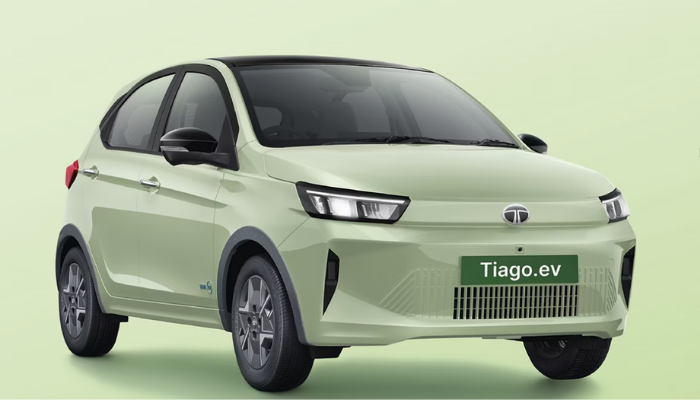
The Tata Tiago EV has become one of the most popular electric hatchbacks in India since its launch. Buyers are drawn to its affordable price and the promise of zero-emission commuting. But the most common question remains: how far can it actually go on a single charge in real Indian driving conditions?
Brochure numbers often look impressive. The 19.2 kWh variant carries an ARAI-certified range of up to 223 km, while the larger 24 kWh variant is rated at up to 293 km according to Tata Motors. Some earlier specifications even mentioned a MIDC figure of 315 km for the long-range version. However, standardized lab tests rarely match what drivers experience on actual roads with traffic, air conditioning, and varying speeds.
Multiple independent tests and owner reports now give a clear picture of what to expect. The real-world range depends heavily on which battery pack you choose, how you drive, and where you drive.
Real-world range figures from independent tests
Autocar India tested the 24 kWh variant on a combined city and highway cycle in April 2026. Their instrumented test returned a real-world range of 187 km with an efficiency of 7.77 km per kWh. The test was conducted after the 2025 update that raised the claimed MIDC range to 293 km.
Zigwheels tested the same 24 kWh variant in November 2024, primarily on city roads with moderate to dense traffic. They recorded a real-world range of 215 km. Their test kept the air conditioning running, which reflects typical urban usage.
IndianTorque conducted an extreme range test in December 2022 with the long-range 24 kWh version. Driving with the air conditioning on across highway and city roads, they managed approximately 185 km from 100 percent down to 2 percent charge. This represents roughly 60 to 65 percent of the claimed 315 km MIDC figure at that time.
CarDekho compiled data from multiple road tests and verified owner reports in 2025. Their analysis shows the 24 kWh variant typically delivers between 220 and 250 km in city traffic, 190 to 230 km in mixed driving, and 170 to 210 km on highways. The smaller 19.2 kWh variant returns 170 to 190 km in city traffic and 150 to 180 km in mixed conditions.
What affects the range in daily driving
Air conditioning has a noticeable impact during Indian summers. When temperatures climb above 35 degrees Celsius, battery consumption increases significantly. All major tests noted that air conditioning was kept on during their evaluations.
Driving speed plays a major role. A Tiago EV cruising at 70 km/h consumes less energy than one maintained at 100 km/h. Highway driving at sustained speeds above 90 km/h typically increases energy consumption and reduces range.
Heavy acceleration creates additional energy demand. Smooth driving habits with gentle throttle inputs often produce better efficiency. Regenerative braking helps recover energy during frequent slowing and stopping, which is why city traffic often produces better efficiency than highway cruising.
Tyre pressure influences range as well. Underinflated tires increase rolling resistance and reduce efficiency. Regular pressure checks can help maintain optimal range.
Passenger load and road gradients also contribute to variations. These factors explain why the Tiago EV real-world range varies between drivers even when they own identical cars.
City versus highway performance
City driving often produces better efficiency because regenerative braking recovers energy during frequent slowing and stopping. The CarDekho data shows the 24 kWh variant achieving 220 to 250 km in city traffic with efficiency between 8.5 and 10.0 km per kWh.
Mixed driving, which combines city commutes with some highway stretches, returns 190 to 230 km for the larger battery. Pure highway driving at sustained speeds drops the range further to 170 to 210 km with efficiency between 6.5 and 8.0 km per kWh.
The 19.2 kWh variant follows a similar pattern but with proportionally lower figures. It remains suitable for buyers whose daily running is strictly within city limits.
Practical usability for Indian buyers
For many urban households, the real-world range is sufficient. The average Indian private car covers well below 50 km per day. Even conservative real-world estimates allow several days of commuting before charging becomes necessary.
Owners who regularly travel between nearby cities report positive experiences when they plan charging stops in advance. The larger battery variant can comfortably manage short intercity drives, especially on routes with DC fast chargers.
Long-term owners mention that range predictions become easier after a few weeks of driving. Drivers learn how their routes, climate conditions, and habits affect battery usage. This predictability reduces range anxiety over time.
The Tiago EV is priced between Rs 7.99 lakh and Rs 11.14 lakh, making it one of the most accessible electric cars in India. For buyers with daily travel within typical urban commuting distances, it provides dependable range, low running costs, and a straightforward ownership experience.
FAQs
What is the real-world range of the Tata Tiago EV 24 kWh variant?
Independent tests show the 24 kWh variant delivers between 187 km and 215 km on combined cycles. In city traffic, owners report 220 to 250 km, while mixed driving returns 190 to 230 km. Highway driving at sustained speeds reduces this to 170 to 210 km.
How does the 19.2 kWh variant perform in real conditions?
The smaller battery variant typically returns 170 to 190 km in city traffic and 150 to 180 km in mixed driving. It is best suited for buyers with daily commutes under 100 km who charge regularly.
Does air conditioning significantly reduce the range?
Yes. All major tests were conducted with air conditioning on, reflecting real Indian conditions. When temperatures exceed 35 degrees Celsius, battery consumption increases noticeably, reducing the achievable range.
Can the Tiago EV handle weekend highway trips?
The 24 kWh variant can manage short intercity drives of 150 to 180 km on highways. Planning charging stops in advance is essential, as charging infrastructure varies across regions. The 19.2 kWh variant is less suited for highway trips.
How does driving style affect the range?
Smooth acceleration, maintaining moderate speeds around 70 km/h, using regenerative braking in traffic, and keeping tyres properly inflated can improve efficiency by 15 to 20 percent compared to aggressive highway driving.