
Electric vehicles (EVs) are significantly cheaper to run than petrol or diesel vehicles, but one question every buyer asks is:
“How much does it actually cost to charge an EV in my state?”
The answer isn’t the same across India.
Electricity tariffs vary from state to state because every State Electricity Regulatory Commission (SERC) approves its own tariff structure. As a result, charging an EV in Delhi can cost much less than charging the same vehicle in Maharashtra or Kerala. The Government of India also encourages states to introduce dedicated EV charging tariffs so that public charging stations remain affordable.
Why EV Charging Costs Differ Across India
Unlike petrol or diesel, electricity prices are regulated at the state level.
Several factors affect charging costs:
- Residential electricity tariff
- Consumer slab (100 units, 200 units, etc.)
- Fixed charges
- Fuel surcharge adjustments
- State subsidies
- Time-of-day tariffs (where applicable)
How to Calculate EV Charging Cost
The formula is simple:
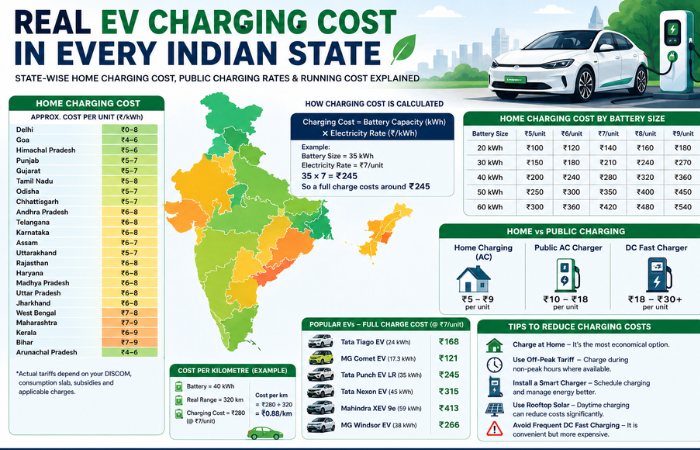
Charging Cost = Battery Capacity (kWh) × Electricity Rate (₹/kWh)
Example
Battery Size = 35 kWh
Electricity Rate = ₹7/unit
35 × 7 = ₹245
So a full charge costs around ₹245.
| State | Approx Home Tariff (₹/Unit)* |
|---|---|
| Andhra Pradesh | ₹6–8 |
| Arunachal Pradesh | ₹4–6 |
| Assam | ₹6–7 |
| Bihar | ₹7–9 |
| Chhattisgarh | ₹5–7 |
| Delhi | ₹0–8 (depending on subsidy/slab) |
| Goa | ₹4–6 |
| Gujarat | ₹5–7 |
| Haryana | ₹6–8 |
| Himachal Pradesh | ₹5–6 |
| Jharkhand | ₹6–8 |
| Karnataka | ₹6–8 |
| Kerala | ₹6–9 |
| Madhya Pradesh | ₹6–8 |
| Maharashtra | ₹7–9 |
| Odisha | ₹5–7 |
| Punjab | ₹5–7 |
| Rajasthan | ₹6–8 |
| Tamil Nadu | ₹5–8 |
| Telangana | ₹6–8 |
| Uttar Pradesh | ₹6–8 |
| Uttarakhand | ₹5–7 |
| West Bengal | ₹7–8 |
| Battery Size | ₹5/unit | ₹6/unit | ₹7/unit | ₹8/unit | ₹9/unit |
|---|---|---|---|---|---|
| 20 kWh | ₹100 | ₹120 | ₹140 | ₹160 | ₹180 |
| 30 kWh | ₹150 | ₹180 | ₹210 | ₹240 | ₹270 |
| 40 kWh | ₹200 | ₹240 | ₹280 | ₹320 | ₹360 |
| 50 kWh | ₹250 | ₹300 | ₹350 | ₹400 | ₹450 |
| 60 kWh | ₹300 | ₹360 | ₹420 | ₹480 | ₹540 |
Home Charging vs Public Charging
| Charging Type | Typical Cost |
|---|---|
| Home Charging | ₹5–9/unit |
| AC Public Charger | ₹10–18/unit |
| DC Fast Charger | ₹18–30+/unit |
Public charging is more expensive because operators recover equipment, maintenance, land, network and electricity costs. Many states have introduced dedicated EV tariffs for public charging stations to encourage infrastructure development.
How Much Does It Cost to Charge Popular EVs?
| EV | Battery | Estimated Home Charging Cost (₹7/unit) |
|---|---|---|
| Tata Tiago EV | 24 kWh | ₹168 |
| MG Comet EV | 17.3 kWh | ₹121 |
| Tata Punch EV LR | 35 kWh | ₹245 |
| Tata Nexon EV | 45 kWh | ₹315 |
| Mahindra XEV 9e | 59 kWh | ₹413 |
| MG Windsor EV | 38 kWh | ₹266 |
Actual charging cost depends on usable battery capacity and local electricity tariff.
Frequently Asked Questions
Which state has the cheapest EV charging?
It depends on subsidies, domestic tariff slabs and DISCOM rules. Delhi (for eligible subsidised consumers) and several states with lower domestic tariffs can offer among the lowest charging costs.
Does every state have a separate EV electricity tariff?
Many states have notified dedicated tariffs for public EV charging stations, while home charging typically uses standard residential tariffs.
Is charging at home cheaper than petrol?
Yes. In most cases, charging an EV at home costs less than ₹1.50 per km, whereas petrol cars usually cost several times more per kilometre, depending on fuel prices and mileage.
Are public chargers more expensive?
Yes. Public charging includes infrastructure and operational costs, making it more expensive than residential charging.
EV Cost Calculator & Compare Tool
EV Running Cost Calculator
Estimate your EV's running costs.
Calculation Type
Estimated Cost
₹--
Estimated Cost Per Kilometer
₹--
Calculations are estimates based on provided values.