
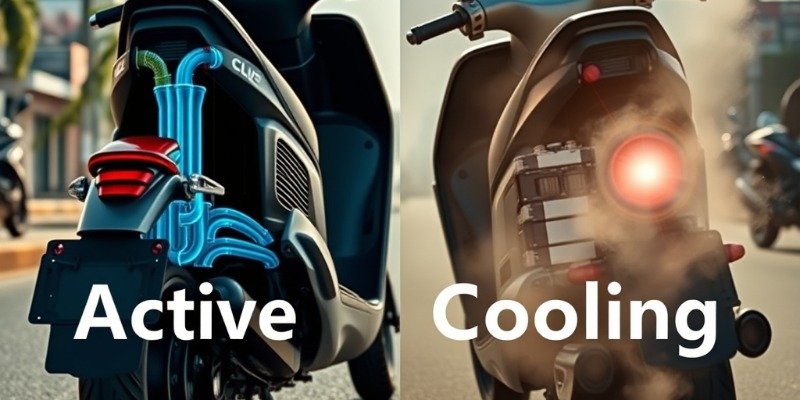
Indian summers push ambient temperatures past 45 degrees Celsius in many cities. For electric scooter owners, this is not just a comfort issue. It is a safety question. Lithium-ion cells work best between 15 and 35 degrees. Once pack temperatures cross 70 degrees, the risk of thermal runaway rises sharply. Thermal runaway is a self-feeding chain reaction where one overheating cell triggers its neighbours. Government investigations into the 2022 fire incidents pointed to faulty cells, weak battery management systems, and cooling designs that were never stress-tested for Indian heat.
The cooling architecture of a battery pack decides whether those few critical degrees are managed or missed. Broadly, there are two approaches: passive air cooling and active liquid cooling. A third hybrid path is now emerging. This article breaks down how each works, what the research shows about real-world performance, and which scooters fall into which camp based on publicly available technical information.
Why a few degrees decide everything
Battery temperature is not uniform. During fast charging, hill climbs, or stop-and-go traffic in peak summer, some cells run hotter than others. Large temperature differences across a pack accelerate degradation and increase the chance of a single cell crossing the thermal runaway threshold. Research from Hinduja Tech notes that air has roughly one-quarter the specific heat capacity of water and over twenty times lower thermal conductivity. That means air carries away far less heat per unit volume. In contrast, liquid cooling can hold pack temperatures below 40 degrees through standard drive cycles, though sustained high-current loads can still push them to around 46 degrees. Immersion cooling with dielectric fluids has shown peak temperature rise reductions of over 90 percent compared to natural air cooling in lab studies.
Passive air cooling: simple but limited
Passive air cooling relies on convection. Ambient air flows over the pack, sometimes assisted by a fan. It is inexpensive, lightweight, leak-free, and mechanically simple. That is why it remains the default for entry and mid-segment scooters built for short urban hops. However, basic physics limits its capacity. During fast charging or long afternoon rides, temperature gradients across the pack widen. Notably, several scooters involved in the 2022 fire incidents had no dedicated cooling system at all. At the same time, at least one major Indian brand that engineered fan-forced air cooling from the outset reported no known overheating failures at the time. This shows that even basic cooling, if properly designed and validated for Indian conditions, can be effective for typical city commuting.
Active liquid cooling: precise but complex
Liquid cooling circulates coolant through cold plates pressed against battery modules or, in advanced designs, immerses cells directly in dielectric fluid. Because liquids absorb and move heat far more efficiently, cell-to-cell temperature variation stays tight even under demanding conditions. This is why liquid cooling dominates in high-performance EVs built around larger packs, fast-charging ambitions, and longer-range targets. The trade-off is added weight, cost, and complexity. Pumps, radiators, hoses, and coolant introduce new failure modes like leaks that a simpler air-cooled scooter never faces.
Hybrid architectures: the pragmatic middle ground
The industry is increasingly blending both approaches. Designs that use phase-change materials or air channels for everyday baseline cooling, and activate a targeted liquid loop only on the hottest cells or during high-load events such as fast charging, are gaining ground. This segment-tuned approach balances cost, weight, and thermal performance rather than maximising one at the expense of the others. With FY2026 seeing roughly 1.4 million electric two-wheelers sold in India, this hybrid path looks like the scalable way forward.
What the research tells us about specific models
Public technical data on cooling systems is uneven across brands. The Drivio analysis of summer performance notes that Ather uses liquid-cooled battery packs. When pack temperature rises above 35 to 40 degrees, the battery management system redirects energy from propulsion to cooling, which reduces available range but protects the cells. Ola, TVS iQube, and Bajaj Chetak are also engineered for Indian conditions, but the research does not specify their cooling architecture in detail. The Hinduja Tech article references one major Indian brand with fan-forced air cooling that reported no overheating failures, though it does not name the brand. The Matter Energy electric bike — not a scooter — is explicitly marketed with active cooling technology and a 5 kWh liquid-cooled pack. Sokudo lists smart fireproof LFP batteries and CANBUS monitoring across its Select 2.2, Rapid 2.2, and Plus models, but does not disclose whether the cooling is passive or active in its public literature.
How to read the spec sheet
When comparing scooters, look for these terms in official brochures or technical datasheets: liquid-cooled battery pack, active thermal management, liquid cooling loop, cold plate, or immersion cooling. These indicate active systems. Terms like fan-assisted air cooling, forced convection, or thermal management system without liquid references usually mean passive or fan-forced air cooling. If no cooling system is mentioned at all, treat it as passive natural convection only. Remember that battery chemistry also matters. LFP (lithium iron phosphate) cells are inherently more thermally stable than NMC (nickel manganese cobalt) cells, so an LFP pack with good air cooling can be safer than an NMC pack with marginal liquid cooling.
Summer ownership habits that complement any cooling system
No cooling system can overcome poor habits. Park in shade whenever possible. A scooter left in direct sun can reach 50 to 55 degrees before you even start riding. Let the pack rest for 30 to 45 minutes after a hot ride before plugging in. Charge overnight between 9 PM and 7 AM when ambient temperatures are lower. Keep daily state of charge between 20 and 80 percent. Use only the manufacturer-supplied charger. These habits reduce the thermal load on whatever cooling system your scooter has and extend battery life significantly.
The choice between active and passive cooling is ultimately a segmentation question. A budget commuter doing 20 kilometres a day in a moderate climate rarely needs the cost and weight of a full liquid loop. A delivery rider covering 120 kilometres through a Delhi or Rajasthan summer, or an owner who relies on 30-minute fast charging, almost certainly does. Hybrid architectures that activate liquid cooling only when needed are likely to become the new standard across segments. For now, check the spec sheet, ask the dealer for the cooling architecture in writing, and match the system to your actual riding profile. That is the most reliable way to keep thermal runaway risk where it belongs — in the engineering lab, not on your daily commute.
FAQs
What is thermal runaway in an electric scooter battery?
Thermal runaway is a chain reaction where one overheating cell generates enough heat to trigger neighbouring cells to fail in sequence. It typically starts when internal cell temperatures exceed 150 degrees, far above what ambient summer heat alone can cause in a properly built pack.
Which cooling system is better for Indian summers — air or liquid?
Liquid cooling handles high loads and fast charging better because it moves heat more efficiently. However, well-engineered fan-forced air cooling has proven sufficient for many city commuters. The best choice depends on your daily distance, charging speed needs, and local climate extremes.
Does Ather use liquid cooling for its battery pack?
Yes. According to summer performance analysis, Ather employs liquid-cooled battery packs that activate thermal regulation when pack temperatures rise above 35 to 40 degrees.
Can I retrofit active cooling on a passive-cooled scooter?
No. Cooling architecture is integrated into the battery pack design, cell layout, and vehicle chassis. Retrofitting is not feasible or safe.
How do I know if my scooter has active liquid cooling?
Check the official brochure or technical specifications for terms like liquid-cooled battery pack, active thermal management, cold plate, or coolant loop. If only fan cooling or thermal management system is mentioned without liquid references, it is likely passive or fan-forced air cooling.