
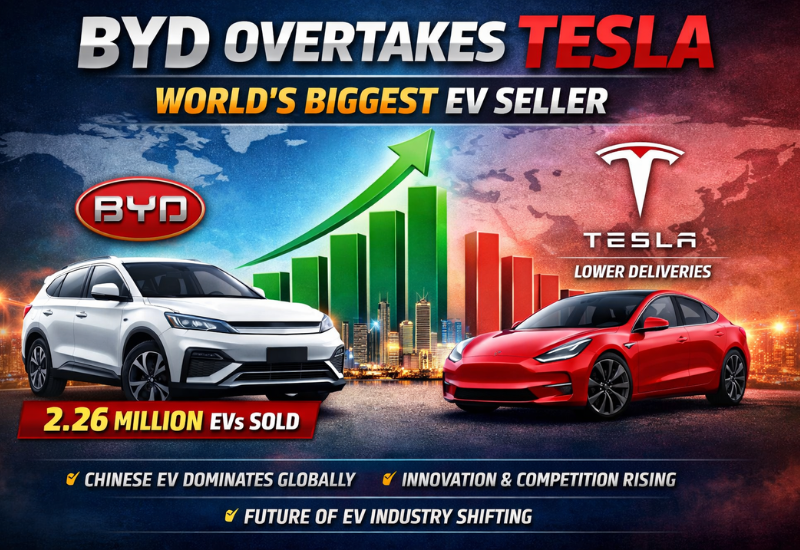
The global electric vehicle (EV) market has entered a significant new phase as Chinese automaker BYD has officially surpassed Tesla to become the world’s biggest EV seller. This milestone reflects a shifting competitive landscape driven by rapid innovation, aggressive pricing strategies, expanding product portfolios, and growing global demand for affordable electric mobility.
As EV adoption accelerates worldwide, BYD’s rise signals not just a company milestone but a broader transformation in how the global automotive industry approaches electrification.
Recent industry reports indicate that BYD delivered approximately 2.26 million electric vehicles, overtaking Tesla’s total deliveries during the same period. The achievement positions BYD at the top of the global EV market, highlighting the growing influence of Chinese automakers in the electric mobility sector.
While Tesla has long dominated the premium EV segment with models such as the Model 3 and Model Y, BYD’s success stems largely from its diverse lineup covering multiple price points — from affordable city cars to premium electric SUVs and plug-in hybrid vehicles.
Key factors behind BYD’s success include:
Wide range of electric and plug-in hybrid vehicles
Competitive pricing strategies
Strong domestic demand in China
Rapid expansion into international markets
Vertical integration, including in-house battery production
How BYD Managed to Beat Tesla
The competition between BYD and Tesla reflects two different approaches to the EV market.
1. Product Portfolio Diversity
BYD offers vehicles across various segments and price brackets, making EV adoption accessible to a broader consumer base. Tesla, on the other hand, has focused primarily on premium and mid-premium segments.
2. Battery Technology Advantage
BYD’s Blade Battery technology has been widely praised for safety and efficiency. Controlling battery production internally helps reduce costs and improve supply chain stability.
3. Emerging Market Expansion
BYD has aggressively expanded into Asia, Europe, and emerging markets where demand for affordable EVs is rising quickly.
4. Government Support and Manufacturing Scale
China’s EV policies and large-scale manufacturing capabilities have enabled BYD to scale production rapidly.
India is expected to benefit from the intensifying global EV competition. As companies expand internationally, Indian buyers may see:
New EV brands entering the market
More competitive pricing
Improved battery technology
Increased focus on charging infrastructure
With domestic manufacturers like Tata Motors already leading local adoption, global competition could accelerate India’s transition toward electric mobility.
EV Cost Calculator & Compare Tool
EV Running Cost Calculator
Estimate your EV's running costs.
Calculation Type
Estimated Cost
₹--
Estimated Cost Per Kilometer
₹--
Calculations are estimates based on provided values.