
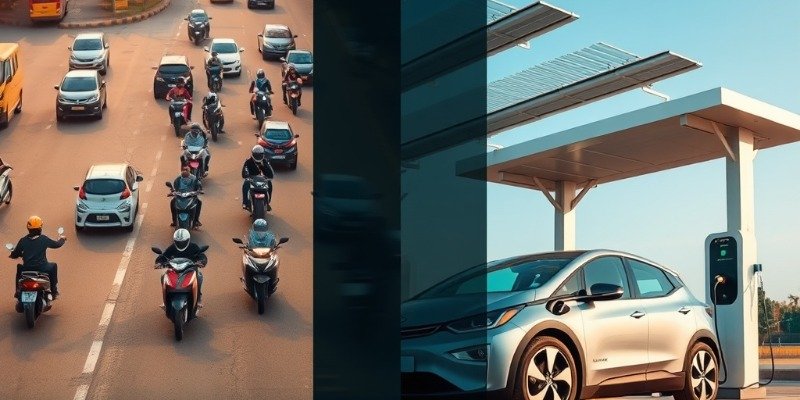
India's push for electric mobility has been marked by bold announcements and shifting timelines. Transport Minister Nitin Gadkari first declared in 2017 that he wanted only electric vehicles on Indian roads by 2030. That target was later revised. The current official plan aims for 30 percent of private cars, 70 percent of commercial vehicles, 40 percent of buses, and 80 percent of two- and three-wheelers to go electric by 2030. These numbers come from NITI Aayog, the government's policy think tank.
The ambition is clear. India wants to cut its crude oil import bill, which runs into lakhs of crores every year, and reduce emissions in cities that are already choking on pollution. The transport sector accounts for 18 percent of the country's total energy consumption. If current trends continue, energy demand could more than double by 2030. Electric vehicles are seen as a critical part of the solution.
The two-wheeler success story
The strongest progress so far has been in the two- and three-wheeler segments. Electric models already account for nearly half of all sales in these categories, according to data from the Council on Energy, Environment and Water. Hero Electric, the country's largest electric scooter maker, has even called for a complete stop to petrol two-wheeler sales by 2027. Ola Electric demonstrated the scale of latent demand when it sold about 100,000 scooters in a two-day online window, more than the entire annual electric two-wheeler sales of previous years. India sells roughly 17 million two-wheelers a year compared to just 2.7 million cars, so this segment drives the overall EV numbers.
The car market reality
The picture for electric cars is very different. Electric cars account for less than 4 percent of total car sales in the current financial year. The average price of a car in India is around seven lakh rupees, while the cheapest electric car starts at 12 lakh rupees. This price gap puts EVs out of reach for most buyers. Maruti Suzuki, the country's largest carmaker, has not yet launched an electric model, stating that prices are still too high for the mass market.
Supply is a bigger constraint than demand, according to the Federation of Automobile Dealers Associations. There are simply not enough models available, especially outside the big metros of Delhi, Mumbai, and Bangalore, which together make up only a fifth of the market. Charging infrastructure remains sparse. India has fewer than 2,000 public charging stations compared to approximately 900,000 in China. The FAME scheme aims to install 2,877 stations across 68 cities by 2024, but progress has been slow.
Policy push and state-level action
The central government has backed its targets with the Faster Adoption and Manufacturing of Hybrid and Electric Vehicles (FAME) program and a 3.5 billion dollar scheme to boost domestic manufacturing. Eighteen out of 28 states have drafted or announced their own EV policies. Delhi, which targets 25 percent electrification by 2024, has already reached 12.5 percent. Experts say uniform national regulations and a zero-emission mandate would accelerate adoption further.
Industry response and investment
Tata Motors, the current leader in electric cars, has announced a two billion dollar investment in its EV business after raising one billion dollars from international investors. The company plans to launch ten new electric models by 2025 and is building charging platforms and battery technology. Shailesh Chandra, head of Tata's passenger vehicle division, says daily bookings have jumped from 300 to 3,000, indicating a shift in consumer mindset.
Foreign brands have struggled. Ford exited India even as it invested heavily in EVs in the US. Tesla has expressed interest but wants lower import tariffs. Gadkari has said the government will support Tesla if it manufactures locally and does not sell Chinese-made cars in India. Analysts at IHS Markit do not expect a significant foreign entry before 2030 unless a drastic policy intervention occurs.
Global context and the 2027 benchmark
BloombergNEF projects that the United States could see electric vehicles reach almost one-third of new car sales by 2027, rising to 48 percent by 2030. China and Europe are expected to hit 60 percent and 41 percent respectively by 2027. India's trajectory is slower. The US forecast assumes current policies stay in place and affordable models from Ford, Rivian, Tesla, Hyundai, BMW, and Toyota reach the market. India's challenge is different. The market is extremely price-sensitive, and the ecosystem — batteries, charging, recycling — is still being built. Most batteries are imported, largely from China, creating a strategic vulnerability.
The road ahead
The transition is already visible on the ground. Every tenth delivery rider in major cities now uses an electric scooter. Connected vehicle data promises to improve transparency in insurance, loans, and resale values, which could address a key consumer worry. Battery recycling is emerging as a business opportunity, though environmental costs of mining and disposal remain concerns. Collaboration between automakers, battery makers, and energy suppliers will be essential to drive down costs and make EVs profitable in a tough market.
The gap between the 2030 target of 30 percent electric cars and today's sub-4 percent reality is wide. Closing it will require more affordable models, a dense charging network, stable policies across states, and a domestic battery supply chain. The two-wheeler revolution shows it can be done. The car segment is waiting for its tipping point.