
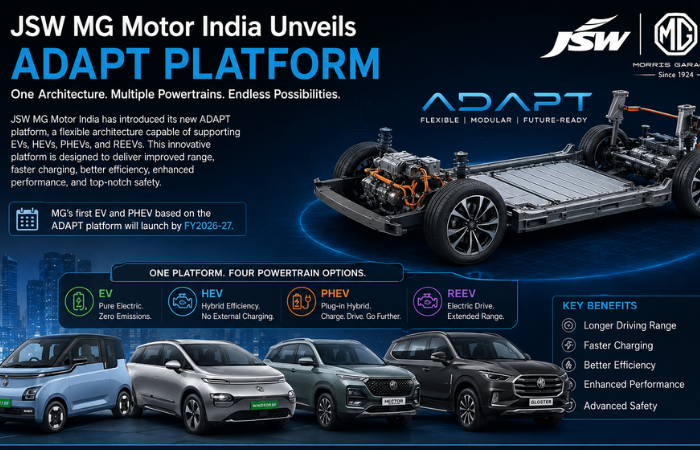
JSW MG Motor India has officially introduced its new ADAPT platform, marking a significant milestone in the company’s electrification strategy. Instead of building separate vehicle platforms for different powertrains, MG has developed a single modular architecture capable of supporting multiple types of electrified vehicles.
This move is expected to help MG launch new products faster while reducing development costs and improving vehicle performance.
What is the MG ADAPT Platform?
The ADAPT platform is MG’s next-generation modular vehicle architecture designed specifically for electrified mobility.
Unlike conventional vehicle platforms that are built around a single powertrain, ADAPT has been engineered to support multiple propulsion technologies on the same base.
These include:
- Battery Electric Vehicles (EVs)
- Hybrid Electric Vehicles (HEVs)
- Plug-in Hybrid Electric Vehicles (PHEVs)
- Range-Extended Electric Vehicles (REEVs)
This flexible approach allows MG to quickly respond to changing customer demand while keeping manufacturing more efficient.
What Makes the ADAPT Platform Special?
The biggest advantage of the ADAPT architecture is its versatility.
Instead of investing in different platforms for each vehicle type, MG can use one common foundation while changing only the powertrain components.
This approach provides several benefits:
- Faster product development
- Lower manufacturing costs
- Better production flexibility
- Easier technology upgrades
- Improved component sharing
For customers, this could translate into better pricing and quicker introduction of new technologies.
Four Powertrain Types
Battery Electric Vehicle (EV)
An EV runs entirely on electricity stored in a battery pack.
Features include:
- Zero tailpipe emissions
- Instant torque
- Quiet driving
- Fast charging capability
Examples include the MG Windsor EV and MG Comet EV.
Hybrid Electric Vehicle (HEV)
HEVs combine a petrol engine with an electric motor.
The battery charges automatically while driving, so external charging is not required.
Benefits include:
- Better fuel economy
- Reduced emissions
- Improved city driving efficiency
Plug-in Hybrid Electric Vehicle (PHEV)
PHEVs feature a larger battery that can be charged externally.
Drivers can travel significant distances on electric power before the petrol engine takes over.
Advantages include:
- Daily commuting on electricity
- Long-distance capability
- Lower fuel consumption
Range-Extended Electric Vehicle (REEV)
REEVs primarily drive using electric motors.
A small petrol engine acts only as a generator to recharge the battery rather than directly powering the wheels.
Benefits include:
- Longer driving range
- Less charging anxiety
- Smooth EV driving experience
MG’s modular strategy comes at a time when several manufacturers are expanding their electrified portfolios.
Major competitors include:
- Tata Motors
- Mahindra Electric Origin SUVs
- Hyundai
- Kia
- BYD
- Toyota Hybrid lineup
- Maruti Suzuki’s upcoming electrified models
A flexible architecture like ADAPT could help MG compete across multiple vehicle categories with faster product launches.
The JSW MG Motor India ADAPT platform is more than just another vehicle architecture—it’s a strategic move toward a flexible electrified future. By supporting EVs, HEVs, PHEVs, and REEVs on a single modular platform, MG aims to deliver improved efficiency, faster innovation, and a wider range of choices for Indian buyers.
With the first ADAPT-based models expected in FY2026-27, the coming years could see MG expand its presence across multiple electrified vehicle segments while making advanced mobility more accessible.
EV Cost Calculator & Compare Tool
EV Running Cost Calculator
Estimate your EV's running costs.
Calculation Type
Estimated Cost
₹--
Estimated Cost Per Kilometer
₹--
Calculations are estimates based on provided values.