
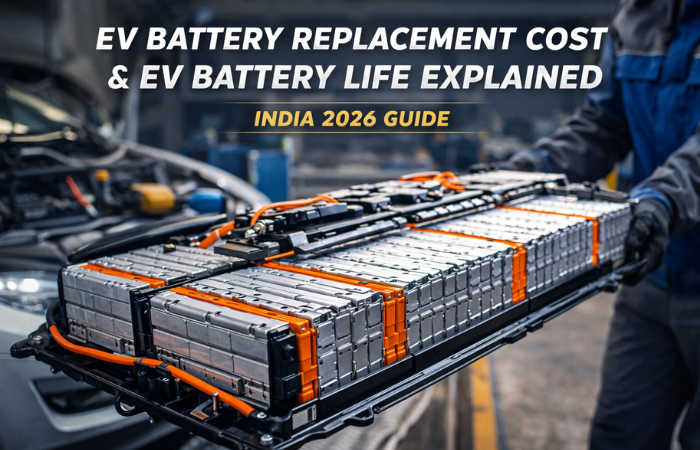
Electric vehicles (EVs) are rapidly gaining popularity in India as buyers look for cleaner and more economical transportation. However, one of the most common questions among potential EV buyers is about battery life and replacement cost. Since the battery is the most expensive component of an electric vehicle, understanding how long it lasts and how much it costs to replace is extremely important.
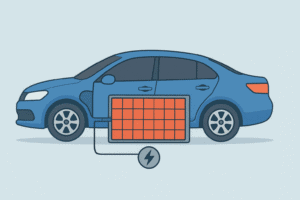
An EV battery is a large rechargeable battery pack that powers the electric motor of the vehicle. Most electric cars use Lithium-ion battery technology, similar to smartphone batteries but much larger and more powerful.
EV batteries consist of several components:
• Battery modules
• Battery management system (BMS)
• Cooling system
• High-voltage wiring
• Protective casing
These batteries store energy and deliver it to the motor when the vehicle is driven.
EV Battery Life in India
One of the biggest concerns for buyers is how long an EV battery lasts.
Most electric car manufacturers design their batteries to last 8 to 15 years, depending on usage and charging habits.
Typical EV Battery Lifespan
• Electric Cars: 8 – 15 years
• Electric Scooters: 4 – 7 years
• Battery Warranty (Most EVs): 8 years or 160,000 km
Many EV manufacturers also offer battery warranties that guarantee battery performance during this period.
Even after several years of use, EV batteries usually do not fail completely. Instead, they gradually lose capacity, meaning the driving range slowly decreases over time.
EV Battery Replacement Cost in India
Battery replacement is one of the biggest costs associated with electric vehicles.
The price depends on several factors including battery capacity, vehicle model, and battery technology.
Average EV Battery Replacement Cost
| Vehicle Type | Battery Size | Replacement Cost |
|---|---|---|
| Electric Scooter | 2 – 4 kWh | ₹40,000 – ₹90,000 |
| Small Electric Car | 20 – 30 kWh | ₹3 lakh – ₹5 lakh |
| Mid-size Electric Car | 30 – 50 kWh | ₹5 lakh – ₹8 lakh |
| Premium EV | 60 – 100 kWh | ₹10 lakh – ₹20 lakh |
For example:
• Tata Nexon EV battery replacement may cost around ₹6–7 lakh
• MG ZS EV battery replacement could cost around ₹8–10 lakh
However, battery prices are falling every year as EV production increases.
Why EV Batteries Are Expensive
EV batteries are expensive mainly because of the materials used in lithium-ion technology.
Key materials include:
• Lithium
• Nickel
• Cobalt
• Graphite
These materials are costly and require complex manufacturing processes.
However, global research and mass production are expected to reduce battery costs by up to 50% over the next decade.
Tips to extend battery life
- To maintain battery health and maximize lifespan, EV owners should follow these best practices.
- Maintain Optimal Charge Levels
- Keep the battery between 20% and 80% for daily use.
- Avoid Excessive Fast Charging
- Use DC fast charging mainly for long trips.
- Park in Shade
- High temperatures can degrade battery chemistry.
- Use Scheduled Charging
- Smart charging systems help maintain battery health.
- Follow Manufacturer Guidelines
- Always follow recommended charging and maintenance instructions.
What Happens to Old EV Batteries?
Even after they are no longer suitable for vehicles, EV batteries still have significant capacity.
Old batteries can be used for:
• Home energy storage
• Solar power storage systems
• Industrial energy backup
This process is known as second-life battery use.
Eventually, batteries can also be recycled to recover valuable materials like lithium and cobalt.
Future of EV Battery Technology
Battery technology is improving rapidly.
Future EVs may feature:
• Solid-state batteries with longer lifespan
• Ultra-fast charging capabilities
• Higher energy density for longer range
• Lower battery replacement costs
Many experts believe EV batteries in the future could last 15–20 years or more.
Conclusion
EV battery technology has improved significantly over the past decade, making electric vehicles more reliable and practical for everyday use. While battery replacement costs can be high, most EV batteries are designed to last 8–15 years, and manufacturers provide long warranties for peace of mind.