
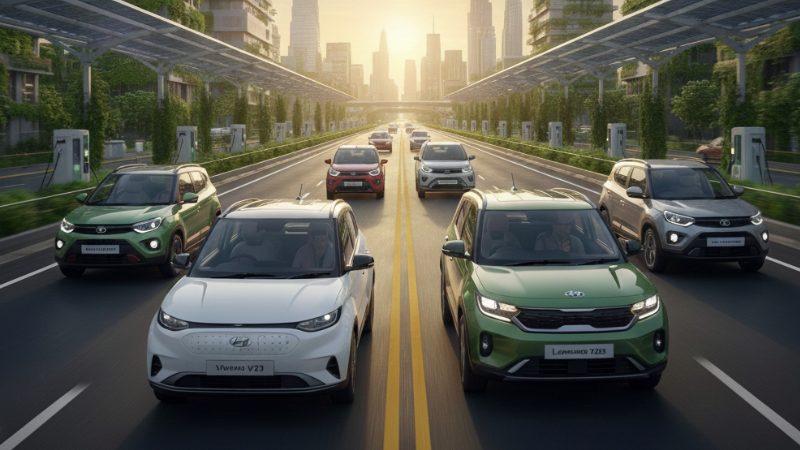
For a long time, the biggest hurdle for EV adoption in India has been the “price gap.” Electric cars were either ultra-compact city runabouts or premium luxury SUVs. However, 2026 is officially the year that the “Budget EV” matures. We are moving away from basic conversions toward purpose-built electric cars that offer better range, smarter tech, and prices that actually compete with petrol hatchbacks.
The most exciting development in this segment is the arrival of global “micro-SUVs” adapted for Indian roads. Leading the pack is the Hyundai Inster EV, a sub-compact powerhouse expected to start around ₹12 Lakh. Unlike budget EVs of the past, the Inster isn’t stripping away features; it’s bringing high-end tech like dual 10.25-inch screens and 360-degree cameras to the masses. With a claimed range of over 350 km, it is designed to be a primary car for urban families.
Not to be outdone, Kia is preparing the Syros EV, a “tall-boy” SUV that focuses on cabin space and premium comfort. Expected to launch in early 2026, the Syros will likely offer segment-firsts like cooled rear seats and a massive panoramic sunroof, making it a strong rival to the Tata Nexon EV. By utilizing a shared platform with Hyundai, Kia is able to keep costs low while delivering a vehicle that feels significantly more “premium” than its price tag suggests.
For those looking for the absolute entry point into electric mobility, 2026 will also see the rise of compact challengers like the VinFast VF3 and the Leapmotor T03. These cars are reimagining the “People’s Car” for the electric age, targeting a price point near ₹10 Lakh. With boxy, rugged designs and enough range for a week of city commuting, they prove that you don’t need a massive budget to join the green revolution.
Affordable EV Roadmap (2026)
| Model | Expected Price | Launch Window | Claimed Range |
| Leapmotor T03 | ₹8.00 – 10.00 Lakh | Jan 2026 | 280 km |
| VinFast VF3 | ₹10.00 – 12.00 Lakh | Feb 2026 | 200 km |
| Hyundai Inster | ₹12.00 – 15.00 Lakh | June 2026 | 355 km |
| Kia Syros EV | ₹14.00 – 18.00 Lakh | Aug 2026 | 400+ km |
| Tata Punch Facelift | ₹10.50 – 15.50 Lakh | Mid 2026 | 421 km |