
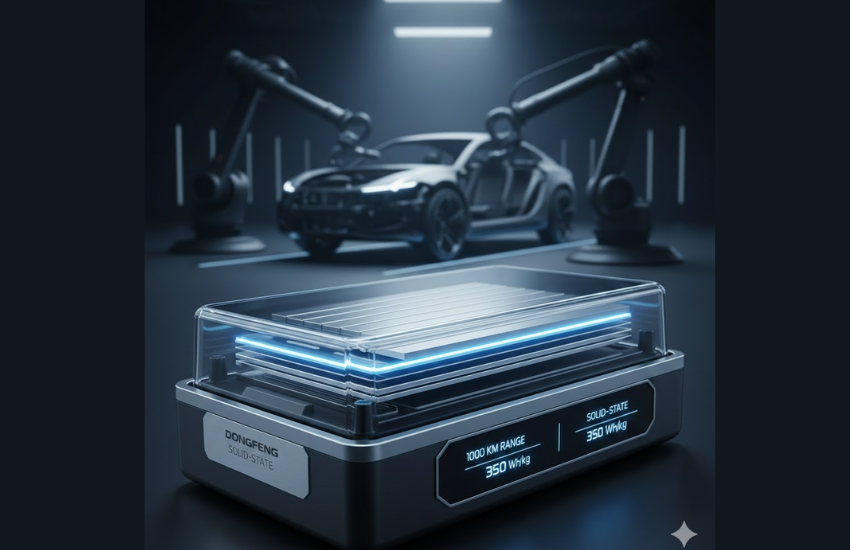
The development efforts by Chinese automaker Dongfeng Motor Corporation (DFMC) suggest that solid-state battery technology is reaching a critical inflection point, moving from laboratory testing to realistic production timelines. By setting an ambitious goal for mass production and vehicle integration in September 2026, Dongfeng is significantly accelerating the expected commercialization curve for this next-generation power source.
The company’s focus on achieving an energy density of 350 Wh/kg aims to deliver electric vehicles with ranges exceeding 1,000 kilometers, representing a step-change in performance compared to current lithium-ion chemistries. Crucially, the technology has demonstrated enhanced thermal stability, passing demanding safety tests at $170^\circ\text{C}$, alongside a superior capacity retention of over $72\%$ at $-30^\circ\text{C}$. These performance metrics underscore the potential of solid-state architecture to substantially improve the safety, longevity, and cold-weather effectiveness of electric mobility solutions, thereby addressing key consumer adoption barriers.
Promise of Solid-State Technology
The global push for solid-state batteries (SSBs) stems from their inherent advantages over current lithium-ion batteries, which use flammable liquid electrolytes:
Greater Safety: SSBs replace the flammable liquid electrolyte with a non-flammable solid material, drastically reducing the risk of fire or thermal runaway.
Longer Driving Range: The technology allows for higher energy density (more power stored in the same space), which translates directly to a larger driving range on a single charge.
Potential for Faster Charging: Solid electrolytes enable faster ion transfer, holding the promise of significantly reduced charging times.
Longer Lifespan: Solid electrolytes are generally more resistant to degradation over time, which can extend the overall operational life of the battery pack.