
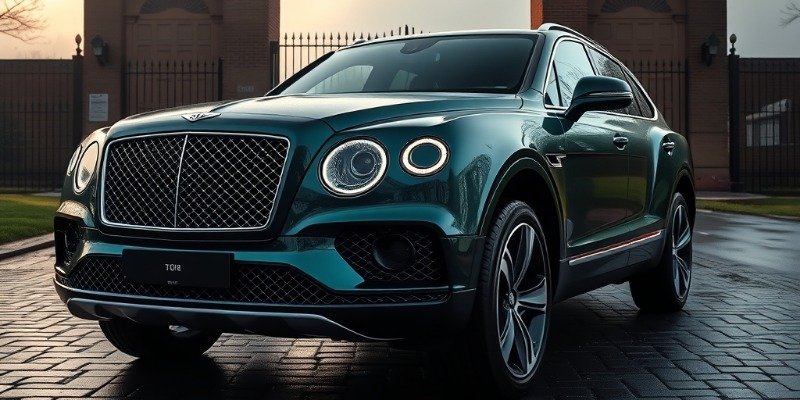
British luxury carmaker Bentley has confirmed that its first fully electric vehicle, the Torcal, will arrive in India during the second half of 2027. The announcement comes directly from chairman and CEO Frank-Steffen Walliser, who spoke to PTI about the company's plans for the Indian market. While the launch timeline is clear, what stands out is Bentley's firm decision to import every vehicle from its headquarters in Crewe, United Kingdom, with no plans for local assembly or manufacturing regardless of import duty structures.
The Crewe-Only Strategy Explained
Walliser was direct when asked about local production. He stated that Bentley vehicles will always come from Crewe, and the company will never react to tariff changes by setting up assembly or manufacturing operations in India. The reasoning goes beyond simple economics. Bentley vehicles involve complex engineering, specialised craftsmanship, and skills that the company believes make local manufacturing commercially unviable at its scale and quality standards.
More importantly, Walliser highlighted that Bentley customers actively prefer cars built in Britain. He drew a parallel with Swiss watchmaking, explaining that just as a Swiss watch must come from Switzerland, a British luxury car must come from the UK. The manufacturing location forms a core part of the brand's identity and the ownership experience. For Bentley, protecting this provenance matters more than reducing landed costs through local assembly.
India-UK FTA Benefits Apply to ICE Models First
The India-UK free trade agreement is expected to bring phased import duty reductions on qualifying British-made cars over five years. Walliser described the agreement as very beneficial for Bentley's business planning, providing stability and predictability in trade conditions. However, there is a critical distinction in how the tariff reductions apply. Currently, the duty benefits apply only to internal combustion engine models like the Bentayga SUV. Battery electric vehicles and plug-in hybrids face a different tariff timeline and do not receive the same concessions in the early years of the agreement.
This means the Torcal, as a fully electric model, will not immediately benefit from the reduced duty structure that petrol-powered Bentleys will enjoy. Walliser noted that the FTA announcement last year actually slowed sales temporarily as customers deferred purchases anticipating lower prices. The company is now seeing carryover effects but remains confident in the long-term value of the trade framework.
Torcal Specifications and Global Rollout
The Torcal will sit below the Bentayga in Bentley's lineup as an electric SUV designed to deliver the brand's signature luxury and comfort without a petrol engine. Based on global specifications released ahead of the India launch, the Torcal features a 113 kilowatt-hour battery with a claimed range of around 600 kilometres on the WLTP test cycle. It uses an 800-volt electrical architecture supporting peak DC charging up to 400 kilowatts.
Production is scheduled to begin in mid-2027 at Crewe, with initial deliveries starting in summer 2027 across the UK, Europe, and the United States. India will follow as part of the subsequent market expansion phase. Bentley has not yet announced an official India price, and the company has not published an Indian MIDC-certified range figure. The WLTP range figure from European testing is not directly comparable to Indian test cycles or real-world driving conditions.
Electrification Timeline Pushed Beyond 2035
Bentley had previously targeted a fully electric lineup by 2035. Walliser confirmed this timeline has been postponed, with the transition now expected after 2035 without a fixed end date. The company is adopting a more balanced approach to powertrains, responding to varying market readiness, regulations, and customer preferences rather than adhering to a rigid deadline. Walliser emphasised that the pace of electrification differs across markets, making it necessary to offer multiple powertrain options simultaneously.
For India, the Torcal represents an important step in Bentley's electric journey, but the company will continue selling its petrol and hybrid models alongside it. The focus remains on delivering Bentley's established luxury characteristics rather than making electrification the primary selling point.
Mulliner Personalisation and India's Growth Potential
Beyond the Torcal, Bentley sees significant growth potential in India through its Mulliner bespoke personalisation division. Wealthy Indian customers are increasingly seeking customised features, and Mulliner's contribution to Bentley's global business is growing. While no specific requests for India-themed design editions have been received yet, Walliser expects demand to emerge as Bentley's presence expands. He stressed that any India-inspired personalisation must reflect authentic local tastes, stating that the content must come from India, not from Crewe.
Walliser described India as a relatively stable and predictable market compared to several other regions facing geopolitical uncertainties. With the five-year FTA framework providing visibility, he expects India to become one of Bentley's fastest-growing markets as the number of wealthy buyers increases.
What This Means for Indian Buyers
For prospective buyers in India, the Torcal will arrive as a fully imported luxury electric SUV with British provenance as its core appeal. The lack of local assembly means the final price will reflect applicable customs duties, which for electric vehicles may not see immediate relief under the India-UK FTA. Real-world charging infrastructure for the 800-volt architecture and right-hand-drive allocation timing will also influence the ownership experience. Bentley has not confirmed India-specific variants or trim structures yet.
Bentley's decision to keep production in Crewe reflects a calculated brand strategy where heritage, craftsmanship, and customer perception of authenticity outweigh the cost advantages of local assembly. For a marque positioning itself at the absolute pinnacle of luxury, the "Made in Britain" label remains non-negotiable.